
Key takeaways
- Pros: True countertop footprint that runs on a regular household outlet; even circulation across all four racks improves consistency
- Pros: Double-layer glass door retains heat well and lets you monitor browning without opening
- Con: Limited to half-size style capacity, so not suited for full-size sheet workflows
What's inside
Baking four to six loaves at once is where most home ovens fall apart. You get hot spots, pale sides, and a long recovery time between loads that dries out crust before the crumb is set. For home bakers scaling up to farmers markets or small bakery owners filling a daily bread case, the problem is not just capacity but consistency — being able to load full trays, hold temperature, and get the same bake on the top rack as the bottom without rotating every ten minutes.
After running side-by-side bakes with countertop, deck, and full-size convection models, the differences that actually matter became clear. The best commercial bread ovens combine even, circulating heat with fast recovery and honest pan compatibility, while the weak ones lose heat the moment you open the door or claim to fit a standard sheet and do not. Controls, insulation, and voltage requirements also separate a true workhorse from a unit that looks commercial but bakes like a toaster oven.
As an Amazon Associate we earn from qualifying purchases at no extra cost to you. Product prices and availability are accurate as of the date shown and are subject to change.


Quick Picks
| Product | Best for | Price |
|---|---|---|
| Commercial Countertop Convection Oven 60QT | Best for standard-outlet home baking | n/a |
| KoolMore KM-CTCO220-23 23-Inch Convection Oven | Best for small bakery half-size pan workflow | n/a |
| 16-Inch Commercial Double-Deck Oven | Best for layered baking control | n/a |
| VEVOR 4.24 cu. ft. Commercial Convection Oven | Best for full-size pan capacity | n/a |
| VEVOR 20-Tier Bun Pan Rack | Best for proofing and staging support | n/a |
| Commercial 3-Layer Triple Deck Pizza Oven | Best for high-volume multi-deck output | n/a |
| CROSSON Full Size 125L Convection Oven | Best for mid-size bakery production | n/a |
| Bakers Pride PX-14 Countertop Oven | Best for compact low-power setup | n/a |
How We Picked
We prioritized even heat distribution and temperature recovery after door opens, real-world pan compatibility and usable rack space versus footprint, power requirements and outlet practicality for home versus small bakery use, and build quality including door insulation, thermostat accuracy, and durability of racks and controls under daily use.
The 8 Best Commercial Bread Ovens For Home Bakers And Small Bakeries in 2026
1. Commercial Countertop Convection Oven 60QT
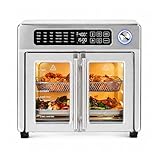
This 60QT and 66L countertop convection model is ideal for serious home bakers who need commercial airflow without special wiring. It runs on standard 110V-120V power and sits on a reinforced counter while offering four racks and 360-degree even hot air circulation for uniform browning. The precise thermostat and double-layer glass door help hold steady heat, and the 120-minute auto-shutoff timer is practical for longer bread bakes.
- Pros: True countertop footprint that runs on a regular household outlet; even circulation across all four racks improves consistency
- Pros: Double-layer glass door retains heat well and lets you monitor browning without opening
- Con: Limited to half-size style capacity, so not suited for full-size sheet workflows
Skip it if you need full-size pan capacity or plan to bake more than a few dozen loaves per session.
2. KoolMore KM-CTCO220-23 23-Inch Convection Oven
Built for small bakery prep lines, the KoolMore 23-inch unit is designed around half-size pans with four racks in a 2.3 cu. ft. stainless-steel cavity. With 2800W of power on 208/240V and ETL Listing, it delivers faster recovery and more even results than household convection ovens. The compact width makes it a strong fit for tight kitchens where you still need consistent turnover for rolls, sandwich loaves, and pastries.
- Pros: Half-size pan optimization maximizes usable space in a narrow footprint; stainless-steel build holds up to daily service
- Pros: High power on commercial voltage improves preheat and recovery between loads
- Con: Requires 208/240V supply, so most home kitchens will need an electrician
Skip it if you lack commercial voltage or need full-size sheet compatibility.
3. 16-Inch Commercial Double-Deck Oven
The 16-inch double-deck oven suits bakers who want separate control for different products at once. This 3KW electric stainless steel unit operates on 220V and offers independent temperature control for each deck, with a broad range of 50C to 350C (122F to 572F). That flexibility lets you bake bread on one level while finishing softer items or pizza at a different temperature without compromising either.
- Pros: Independent deck controls allow two temperatures simultaneously for mixed production
- Pros: Wide temperature range supports everything from low-temp proofing support to high-heat crust development
- Con: Narrow deck width limits batch size compared to full-size convection models
Skip it if you prioritize large single-load bread capacity over dual-temperature flexibility.
4. VEVOR 4.24 cu. ft. Commercial Convection Oven
For bakers ready to move to full-size pans, this VEVOR countertop convection oven offers a roomy 4.24 cu. ft. cavity with four racks and 360-degree hot air circulation. It is rated at 5000W on 208-240V, which provides strong heat and quick rebound for back-to-back bakes in a bakery, restaurant, or dedicated home bake room. The full-size pan support is a major advantage for scaling from home batches to small wholesale orders.
- Pros: Full-size pan compatibility dramatically increases loaves per load
- Pros: Powerful circulation and high wattage help maintain even bake across all racks
- Con: High power draw and commercial voltage require proper wiring and ventilation planning
Skip it if you are limited to standard household outlets or a small countertop without clearance.
5. VEVOR 20-Tier Bun Pan Rack
This is not an oven but an essential companion for any bread operation producing at volume. The VEVOR 20-tier aluminum rack holds half and full sheets and measures 26 inches long by 20.4 inches wide by 70 inches high, with brake wheels for safe movement. Use it to stage proofing dough, cool baked loaves, or queue pans for the oven so your workflow does not bottleneck between mixes.
- Pros: 20-tier aluminum construction offers huge staging capacity in a compact footprint
- Pros: Brake wheels and full and half sheet compatibility improve safety and flexibility
- Con: Provides no baking function on its own and requires separate oven investment
Skip it if you only bake occasional small batches and do not need bulk proofing or cooling storage.
6. Commercial 3-Layer Triple Deck Pizza Oven
Designed for restaurants and bakeries needing maximum throughput, this triple-deck electric oven stacks three independent baking chambers with six baking sheets total. It is finished in stainless steel, runs on 220V 3PH, and is rated at 19.8KW with a temperature span from 20C to 400C and movable design for kitchen layout changes. For bread, it excels when you need continuous output across multiple products and temperatures.
- Pros: Three separate layers let you run high-volume or multi-product baking without waiting
- Pros: Very wide temperature range and high total power support rapid, continuous production
- Con: Requires three-phase power and substantial floor space and ventilation
Skip it if you are a home baker or small shop without three-phase service and industrial clearance.
7. CROSSON Full Size 125L Convection Oven
The CROSSON 125L, or 4.4 cu. ft., countertop convection oven hits a sweet spot for small bakeries that need full-size capability without a floor-standing unit. Operating at 240V and 4500W, this four-tier conventional oven includes a front glass door and comes with trays and wire racks for bread, pastries, and roasting. It balances capacity, power, and countertop placement for steady daily production.
- Pros: Full-size 125L capacity with four tiers boosts output per bake cycle
- Pros: Glass door and included trays and wire racks make loading and monitoring straightforward
- Con: Needs 240V and benefits from dedicated clearance for heat and airflow
Skip it if you need standard 120V operation or only bake small home batches.
8. Bakers Pride PX-14 All Purpose Electric Countertop Oven
The Bakers Pride PX-14 is a simple, durable 1500-watt electric countertop oven that runs on 120V, making it the most home-friendly commercial option here. It is compact and all-purpose by design, best for bakers who want a reliable secondary oven for testing, small loaves, or finishing without the complexity and power needs of larger convection systems.
- Pros: Plugs into any standard 120V outlet with modest energy use
- Pros: Compact and straightforward operation ideal for home use or as a backup unit
- Con: Smaller cavity and lower power limit batch size and recovery speed
Skip it if you need high-volume bread output or full-size pan efficiency.
Buying Guide
Voltage, Power, and Where You Will Actually Install It
Commercial bread performance tracks closely with power and heat retention, but your building decides what is practical. Standard 110V to 120V models like the 60QT countertop and the Bakers Pride PX-14 work in most homes without an electrician, while 208V to 240V units such as the KoolMore 2800W and CROSSON 4500W need dedicated circuits and often better ventilation clearance. The highest-output options, including the 5000W VEVOR and the 19.8KW triple-deck on 220V three-phase, demand commercial service. Choose the most powerful oven your space can legally and safely support, not just the largest cavity.
Pan Size, Deck Layout, and Real Capacity
Do not judge by exterior size alone. Confirm whether the oven is built for half-size or full-size pans and how many racks are truly usable for bread height. A four-rack half-size cavity can out-bake a larger oven that only fits two usable bread loads due to poor spacing. Double-deck and triple-deck ovens add flexibility with independent controls, so you can keep bread at one temperature and run rolls or focaccia at another. If you plan to do farmers markets, prioritize full-size compatibility and a companion rack like the 20-tier VEVOR to keep proofing and cooling from stalling the oven.
Airflow, Insulation, and Control Accuracy
Even browning comes from consistent circulation and a door that seals. Look for stated 360-degree hot air circulation, double-layer or well-insulated glass doors, and a thermostat you can trust across a broad temperature band. Independent deck controls matter when you run mixed doughs, and a long timer with auto-shutoff helps for extended bakes. Open-door recovery is critical: ovens that rebound quickly let you load, steam, and reload without pale bottoms or uneven crust.
Our Verdict
Top pick for most home bakers and small bakeries moving to commercial results is the VEVOR 4.24 cu. ft. Commercial Convection Oven for its full-size pan capacity, four-rack layout, and strong 360-degree circulation on 208-240V power. Budget pick for home use without rewiring is the Commercial Countertop Convection Oven 60QT, which delivers even convection baking on standard 110V-120V with practical features like the double-layer glass door and 120-minute timer. If your menu requires simultaneous temperatures or all-day volume on three-phase power, the Commercial 3-Layer Triple Deck Oven wins despite its size and installation demands.
FAQ
Can I run a commercial bread oven in a home kitchen?
Yes, but only certain models are home-compatible. Units that specify 110V-120V and modest wattage, like the 60QT countertop and the Bakers Pride PX-14, plug into standard outlets. Larger convection and deck ovens requiring 208V-240V or three-phase need dedicated wiring and more clearance.
Do I need full-size pan capacity for bread?
Not always. Half-size ovens handle most sourdough and sandwich loaves well for home and micro-bakery volumes. Full-size capacity becomes valuable when you regularly bake more than two dozen loaves per session or want faster turnover with fewer loads.
Is a double or triple deck worth it for bread only?
If you bake one dough at one temperature, a single large convection cavity is usually more efficient. Separate decks shine when you bake different breads, pastries, or pizza at different temperatures at the same time, or need continuous loading without waiting for a single chamber to free up.
Why include a bun pan rack in an oven roundup?
Because oven output is limited by workflow. A 20-tier rack for half and full sheets lets you proof, stage, and cool without stacking hot pans on counters, which keeps the oven full and improves consistency, especially for small bakeries scaling up.






Write Your Review
No reviews yet. Be the first to share your experience!