
Key takeaways
- Best Motorized Grape Crusher Destemmers for Home Wineries in 2026: Compared and Ranked
- How to Choose Mini Refrigerators: What Actually Matters
- How to Choose Small Refrigerator Reviews: What Actually Matters
- How to Choose Centrifugal Juicers: What Actually Matters
- How to Choose Countertop Dishwashers: What Actually Matters
What's inside
- Crush First vs. Destem First: Understanding Mechanical Sequence
- Roller Materials, Shapes, and Adjustability
- Stainless Steel vs. Painted Enamel Construction
- Motor Sizing, Drive Systems, and Electrical Safety
- Hopper Capacity, Infeed Augers, and Output Handling
- Ease of Teardown and Sanitation
- Related Guides
- FAQ
- Related Guides
Transitioning from a manual hand-crank crusher to a motorized grape crusher destemmer is one of the most rewarding upgrades a home winemaker can make. When harvest day arrives, processing hundreds or thousands of pounds of fruit quickly preserves freshness, limits unwanted oxidation, and eliminates hours of backbreaking labor. However, motorized units represent a significant financial investment, and the market is filled with confusing terminology, varied build materials, and drastically different mechanical designs.
- Crush First vs. Destem First: Understanding Mechanical Sequence
- Roller Materials, Shapes, and Adjustability
- Stainless Steel vs. Painted Enamel Construction
- Motor Sizing, Drive Systems, and Electrical Safety
- Hopper Capacity, Infeed Augers, and Output Handling
- Ease of Teardown and Sanitation
- Related Guides
- FAQ
- Related Guides
Choosing the right machine is not simply about buying the highest horsepower motor or the largest hopper you can afford. The best choice balances throughput with gentle handling, ensuring skins are split without pulverizing bitter stems or cracking seeds. In this guide, we break down the critical technical features, sizing considerations, and workflow requirements so you can invest wisely for your 2026 harvest and beyond.
As an Amazon Associate we earn from qualifying purchases at no extra cost to you. Product prices and availability are accurate as of the date shown and are subject to change.
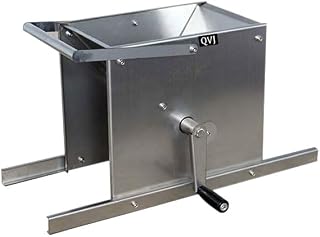
Crush First vs. Destem First: Understanding Mechanical Sequence
One of the most important architectural decisions in grape processing equipment is the order of operations. Traditional entry-level machines often crush the whole cluster through rubber or aluminum rollers before passing the mass into the destemming basket. While effective, crushing stems alongside fruit increases the risk of extracting harsh, green tannins into the must, particularly if the stems are not fully lignified (brown and woody).
Destem-first machines, by contrast, strip the berries from the rachis using a high-speed rotating beater bar inside a perforated cage before the loose berries fall through to the crushing rollers. This results in significantly cleaner juice, fewer torn stems, and better control over whole-berry fermentation percentages. If you produce delicate reds or aromatic whites where tannin management is paramount, prioritizing a destem-first design is worth the modest price increase.
Roller Materials, Shapes, and Adjustability
The crushing rollers perform the critical task of breaking the grape skin to release the pulp and juice without pulverizing the seeds. The two most common roller materials are food-grade aluminum and synthetic rubber or polyurethane. Rubber rollers are generally superior for home winemaking because they offer a softer grip, flexing slightly around irregular seed shapes rather than crushing them into the must.
Equally critical is roller adjustability. Fixed-gap rollers force you into a single crushing profile, which can over-crush thin-skinned varieties like Pinot Noir or fail to burst thick-skinned varieties like Cabernet Sauvignon. Look for units with external adjustment knobs or calibrated shims that allow you to widen the gap for a gentle “pop” or close it down for complete extraction. Helical or ridged roller profiles also pull clusters through more evenly than smooth cylinders.
Stainless Steel vs. Painted Enamel Construction
Grape crusher destemmers face extreme acidity, moisture, and mechanical strain during every run. Budget-friendly models typically feature painted or enameled steel bodies with stainless steel contact points, such as the destemming basket and feed auger. While these machines can last for years if washed, dried, and stored meticulously, any chip or scratch in the paint allows acidic grape must to rust the underlying steel rapidly.
All-stainless steel machines (typically AISI 304 food-grade) eliminate rust concerns entirely and withstand pressure washing, sanitizing agents, and long storage cycles without degrading. If your annual volume exceeds half a ton, or if you store your equipment in an unheated barn or damp cellar, paying extra for an all-stainless chassis protects your investment over decades of harvests.
Motor Sizing, Drive Systems, and Electrical Safety
Most home winery crusher destemmers feature motors ranging from 0.5 to 1.5 horsepower. For standard domestic batch sizes, a 1-horsepower motor running on standard household 110V or 120V power provides ample torque to process dense clusters without stalling. Beware of underpowered units that slow down when hoppers are loaded to capacity, as motor bogging leads to uneven destemming and belt slippage.
Examine the drive system connecting the motor to the beater bar and rollers. Direct-drive gearbox units offer excellent reliability and low maintenance, while belt-and-chain drive systems provide built-in mechanical safety by slipping if a foreign object jams the basket. Regardless of drive type, ensure the unit includes a clearly accessible emergency stop button and an enclosed safety guard over all moving belts and gears.
Hopper Capacity, Infeed Augers, and Output Handling
A machine’s processing rating (often listed in tons per hour) is rarely matched in a home setting because loading and must removal create natural bottlenecks. Look for a machine with a built-in screw auger at the base of the hopper. Augers actively feed clusters into the destemming basket at a consistent rate, preventing “bridging,” where tangled grape bunches hover above the rollers without dropping.
Consider how the processed must and discarded stems exit the machine. Standard units drop crushed fruit directly out of the bottom, requiring a dedicated receiving tub, macro bin, or separate must pump underneath. Make sure the footprint and ground clearance of the machine match your cellar setup. Some advanced motorized units include integrated progressive cavity or impeller pumps that transfer must directly into your fermentation vessel through flexible hose lines.
Ease of Teardown and Sanitation
Harvest day is long and exhausting, but you cannot leave a grape crusher dirty overnight without inviting fruit flies, mold, and wild bacterial blooms. A poorly designed machine with hard-to-reach crevices can turn post-crush cleaning into a two-hour ordeal. When evaluating models, examine how easily the destemming cage, beater shaft, and safety covers can be removed.
The best home units feature quick-release pins or minimal thumb-screws that allow you to slide out the perforated basket and beater bar without requiring a full mechanic’s toolkit. Smooth, seamless welds and fully removable collection chutes allow you to hose down and sanitize every surface in minutes, ensuring sterile processing conditions year after year.
Related Guides
To see our top-performing recommendations based on hands-on capacity tests, build quality, and value, explore our comprehensive review of the Best Motorized Grape Crusher Destemmers for Home Wineries in 2026: Tested and Ranked.
FAQ
How much fruit volume justifies buying a motorized crusher destemmer?
If you process more than 500 pounds (roughly a quarter-ton) of fruit annually, a motorized unit is well worth the investment. Manual processing at that volume takes hours of strenuous labor and often leads to inconsistent crushing as operator fatigue sets in.
Can a motorized grape crusher destemmer handle fruit other than grapes?
No, standard grape destemmers are specifically calibrated for the stem structure and berry size of wine and table grapes. Running stone fruits like cherries or plums through these machines will damage the destemming cage, crush bitter pits, and potentially burn out the motor.
How do I clean and store a motorized destemmer after harvest?
Immediately after use, disconnect power, disassemble the removable cage and beater bars, and hose down all parts with hot water to remove sticky sugars and skins. Dry the machine thoroughly, apply food-grade mineral oil to exposed chains, gears, and unpainted components, and store it under a breathable cover in a dry space.
Do I need an integrated must pump with my crusher destemmer?
Integrated pumps are convenient for single-operator setups processing several tons because they push must directly into tall fermentation tanks. However, for smaller home batches, letting the crushed fruit fall into a food-grade bin and manually scooping or bucketing it into fermenters is simpler, cheaper, and easier to clean.







Write Your Review
No reviews yet. Be the first to share your experience!