
Key takeaways
- 8 Best high end home espresso machine lists for supreme taste
- 8 Best home espresso machines under 200: top great options
- 8 Best espresso machines for under 1000: Ultimate Top Picks
- 8 Best rated espresso machine guides: ultimate perfect choices
- 8 Best espresso machines for home with grinder: Ultimate Guide
What's inside
A Sage espresso machine — sold as Breville in the US market — sits in a crowded field where the price gap between a reliable grinder-integrated brewer and a stripped-down manual lever is enormous. The core problem a buyer faces is not whether espresso exists at home, but whether the machine will produce a consistent shot week after week without requiring a secondary grinder, a separate tamper, or a steaming technique learned through trial and error. Good machines in this space deliver repeatable extraction pressure, integrated or bundled grinding that matches the basket size, and a steam wand with enough power to texturize milk for a single drink in under thirty seconds. Bad ones cut corners on boiler recovery time, use plastic internal components that vibrate and shift over months of use, or advertise a bar rating that tells you nothing about actual pressure stability during the pull.
What separates the worthwhile options from the disappointments is how well each component serves the others. A built-in grinder is only useful if the burr set produces a distribution tight enough for espresso and if the dosing matches the basket without manual adjustment. A 15-bar pump means little if the pre-infusion phase collapses or the PID is absent and the water temp swings beyond the extraction sweet spot. The roundup below compares published specs, street prices, and aggregated owner feedback to help you match a machine to your actual routine and budget.
As an Amazon Associate we earn from qualifying purchases at no extra cost to you. Product prices and availability are accurate as of the date shown and are subject to change.




Quick Picks
| Product | Best for | Price |
|---|---|---|
| Barista Express | Most buyers wanting a complete package | $685 |
| Barista Express Impress | Hands-free tamping and dosing | $649.95 |
| Bambino | Compact kitchens or a second machine | $299.95 |
| Barista Express (Black Truffle) | Color-matched kitchen setups | $699.95 |
| CASABREWS CM5418 | Entry-level steaming and espresso basics | $139.99 |
| 20 Bar Machine with Grinder and Frother | Versatility including cold brew on a budget | $179.99 |
| 2026 Upgrade 15 Bar with Anti-Clog Grinder | Budget buyers who still want an integrated grinder | $299.97 |
| Gevi 20 Bar Compact | Smallest footprint with latte and cappuccino drinks | $126.99 |
How We Picked
We compared machines on four criteria relevant to this category: extraction consistency (pump rating, temperature control, and pre-infusion presence), workflow integration (whether grinding, tamping, and steaming happen on one unit or require separate gear), foot print and kitchen fit, and long-term owner satisfaction regarding build quality and reliability past the first year. Price was used as a sorting filter, not a quality proxy.
The 8 Best Sage Espresso Machine Options in 2026
Breville BES870XL Barista Express
This is the default recommendation for most people upgrading from a pod machine. The conical burr grinder dosing directly into a portafilter eliminates a separate grinder purchase and keeps the workflow to a single station. Owners consistently praise the 54 mm basket and 15-bar Italian pump for producing shots that taste close to their local cafe. The steam wand has enough power for latte art once you build a technique. The main limitation is manual tamping and grind adjustment, which adds a small learning curve in the first two weeks. Skip it if you want a fully hands-free process or if your counter space is genuinely under twelve inches wide.
Breville BES876BSS Barista Express Impress
Positioned as a refinement of the original Express, the Impress adds a assisted tamp and dose-to-weight display that reduces the variability of the manual process. It sits at a slightly lower price point despite offering more automation, which makes it a compelling value for anyone worried about inconsistent tamping pressure. Owners report that the auto-tamp eliminates the channeling problems that plagued their earlier manual pulls. The trade-off is a slightly longer grind-to-extract cycle per shot and fewer granular grind-size adjustments than the original. Skip it if you enjoy the tactile ritual of manual tamping or prefer quicker turnaround between drinks.
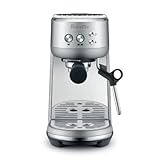
Breville BES450BSS Bambino
Without a grinder or auto-tamp, the Bambino is smaller and cheaper, aimed at buyers who already own a good espresso grinder. The 58 mm commercial portafilter is unusual at this price and gives it a professional extraction feel. ThermoJet heating means near-instant readiness, which matters for early-morning use. Owners love the compact form factor and the shot quality from the 9-bar pressure profile. The con is that it needs a companion grinder and a separate tamper, pushing total cost back toward the Express territory. Skip it if you want everything in one box.
Breville BES870BTR Barista Express Black Truffle
Functionally identical to the standard BES870XL but finished in a deep matte black. The price premium of about fifteen dollars over the brushed stainless is negligible for most buyers and worth it if your kitchen features dark hardware or if you want a machine that hides fingerprints. Performance, dimensions, and internals match the original exactly. Owners report the same extraction consistency and steam power. The only note is that the matte surface can show white coffee-dust marks more visibly than brushed steel during cleaning. Skip it if a slightly lower price matters more than the finish.
CASABREWS CM5418 Compact Espresso Machine
A genuine budget entry that handles espresso and milk frothing in a small footprint. The 20-bar pump and stainless-steel housing punch above their price tag for basic pull quality. Owners praise the included portafilter with dual spout and the steam wand for simple cappuccinos. The main drawback is the absence of a built-in grinder and a noticeably loud pump that can rattle on hard-finished counters. Skip it if you expect the shot precision of a Sage espresso machine at full tilt or plan to pull more than two or three drinks daily.
Espresso Coffee Machine with Grinder, Frother, and Cold Brew
At $179.99 this machine bundles an integrated grinder, a steam wand, and a cold-brew mode — a combination that would cost substantially more as separate purchases. The 20-bar pump is on paper the same as machines three times the price, though owners note pressure stability drops if the grind is too fine. The cold-brew cycle is a genuine convenience for warm-month drinkers. Skip it if you are particular about grind uniformity or want a commercial-standard 58 mm basket.
2026 Upgrade 15 Bar with Built-in Anti-Clog Grinder
The anti-clog grinder mechanism is the headline feature, addressing the jamming complaints common on older budget grinders. At $299.97 it undercuts the Bambino while including a grinder, steam wand, and tamping tools in the box. Owners like the almond color finish and the included accessories. The 15-bar rating is adequate but the boiler is small, so back-to-back drinks require a short wait. Skip it if your priority is milk-texturing speed or if you need more than two lattes in a row.
Gevi 20 Bar Compact Espresso Machine
The least expensive option here at $126.99, the Gevi trades materials and long-term durability for a working espresso and milk system in a truly tiny package. Owners appreciate that it fits under narrow upper cabinets and heats up quickly. The steam wand is functional but slower than any Breville or Sage espresso machine in this list, and the portafilter is plastic-heavy. Skip it if you will use the machine more than once a day or want a shot you can dial in with precision.
Buying Guide
Pump Pressure Is a Starting Point, Not a Promise
A 15-bar or 20-bar rating describes the maximum pressure the pump can generate, not the pressure your coffee experiences during extraction. What matters for taste is whether the machine holds a stable 9-bar window for the full 25-30 second shot. Look for PID temperature control or at minimum a fixed-temperature thermoblock with a pre-infusion phase. The Barista Express and Bambino are designed around a 9-bar extraction profile; the budget machines above often spike higher and then fall off, producing a harsher or thinner taste even when the numbers look impressive on a spec sheet.
Integrated Grinders: Convenience vs. Grind Quality
A built-in conical burr grinder removes a $200-plus purchase and keeps the workflow on one counter spot. The trade-off is that conical burrs produce less uniform particle distribution than the flat burrs found on dedicated espresso grinders costing more. For the Barista Express, that gap is acceptable for most drinkers. On budget machines like the CASABREWS or Gevi, you are either buying a separate grinder anyway (which defeats the value) or drinking a less-even extraction. Decide before you buy whether the machine needs to do the grinding for you or whether you already have or plan to acquire a dedicated grinder.
Steam Wand Power and Boiler Recovery
Thermoblock heaters in compact machines reach brewing temperature in seconds but lose steam pressure quickly when steaming milk. If you make lattes or flat whites daily, look for a machine with a dedicated steam boiler or a thermoblock rated for continuous output. The Breville machines use ThermoJet or dual-boiler systems that recover within the 20-30 second pull window. Budget options typically require a pause of one to three minutes between steaming sessions, which matters when making drinks for two people back to back.
Our Verdict
Top pick: The Breville Barista Express Impress at $649.95 gives you the most complete workflow — grinder, assisted tamp, and extraction in one unit — at a lower price than the standard Express. Budget pick: The 2026 Upgrade 15 Bar model at $299.97 includes the most features per dollar, bundling a grinder, steam wand, and tamping tools without the price of a Sage espresso machine in the Breville tier. Conditional winner: If you already own a quality espresso grinder, the Bambino at $299.95 delivers a better 58 mm extraction than any other machine in this list for less money, making it the smarter buy for grinder owners.
FAQ
What is the difference between Sage and Breville?
Sage is the brand name Breville uses for its espresso machines in the United Kingdom and some European markets. The machines are identical internally; only the logo and packaging differ. If you are comparing a Sage espresso machine review to a Breville one, you are looking at the same hardware.
Do I need a separate grinder with any of these machines?
Not for the Barista Express or Barista Express Impress, which include a conical burr grinder built into the body. The Bambino does require a separate grinder, as do all the budget options except the 2026 Upgrade and the cold-brew combo machine, which bundle their own.
Is 20 bar better than 15 bar for espresso?
No. Commercial espresso machines extract at 9 bar. Higher pump ratings mean the motor can push more pressure, but that does not translate to better taste — in fact, machines that spike above 9 bar during the pull often produce bitterness. Look for stable pressure profiles rather than maximum bar numbers.
How long do Breville and Sage machines typically last?
Owner feedback across the Barista Express line suggests five to seven years of daily use before a descaling cycle becomes difficult or a seal needs replacing. Budget machines often show pump or heating-element failures within two to three years, which is the primary reason to pay more upfront if you drink espresso every morning.



Write Your Review
No reviews yet. Be the first to share your experience!