
Key takeaways
- In a small kitchen, the toaster decision is rarely just about how many slices you make at once. It is about counter depth, cabinet storage, morning traffic, outlet access, and whether the appliance earns a permanent place beside the coffee…
In a small kitchen, the toaster decision is rarely just about how many slices you make at once. It is about counter depth, cabinet storage, morning traffic, outlet access, and whether the appliance earns a permanent place beside the coffee maker. A 2-slice toaster usually takes less room and costs less, while a 4-slice model can make breakfast faster for couples, families, and anyone who prepares several pieces of toast, bagels, or frozen waffles together.
The important distinction is that “4 slice” does not always mean twice the footprint. Some compact models use two long slots that fit four standard slices, while others have four separate slots. Slot design, wattage, controls, and actual counter dimensions matter as much as the slice count. This guide compares the trade-offs so you can choose confidently for your home in 2026.
Our top picks


As an Amazon Associate we earn from qualifying purchases at no extra cost to you. Ratings are shown as listed on Amazon.
Quick Verdict
Choose a 2-slice toaster if your kitchen has limited counter space, you usually toast for one or two people, or you prefer to store the appliance after every use. Most compact 2-slice models measure roughly 10 to 12 inches wide, 6 to 7 inches deep, and 7 to 8 inches tall. They commonly weigh about 2.5 to 4 pounds and use approximately 750 to 900 watts.
Choose a 4-slice toaster if several people need breakfast at the same time, you often toast different foods or browning levels, or you want to reduce repeated batches. Expect many conventional 4-slice models to measure about 11 to 14 inches wide, 7 to 8 inches deep, and 7 to 8.5 inches tall. Weight often falls between 4 and 6 pounds, with power requirements around 1,400 to 1,800 watts.
For the smallest kitchen, a 4-slice long-slot toaster can be the middle ground. It may fit four regular slices in two elongated slots while using less width than a traditional four-slot design. However, check the listed dimensions carefully: “slim” describes one measurement, not necessarily the toaster’s total footprint.
Side by Side
| Consideration | 2-slice toaster | 4-slice toaster |
|---|---|---|
| Comfort | Simple controls and easier lifting; ideal for one or two people | Fewer batches and more control zones; more convenient for busy mornings |
| Durability | Fewer mechanisms may mean fewer parts to wear, depending on construction | More heating elements, levers, and controls can increase complexity |
| Price range | About $15 to $45 for basic to midrange models | About $30 to $80 for basic to midrange models |
| Maintenance | Usually easier to carry, empty, and wipe around | Larger crumb tray or multiple trays may require more cleaning |
| Space needed | Typically 10–12 inches wide and 6–7 inches deep | Typically 11–14 inches wide and 7–8 inches deep |
| Look | More discreet; easier to match with a compact appliance setup | More substantial, with a stronger visual presence on the counter |
| Resale | Broad appeal for apartments, offices, and smaller households | Appeals to families but is less convenient to ship and store |
| Best for | One or two people, occasional toast, narrow counters, and small rentals | Families, frequent entertainers, and households that toast in batches |
Where 2 Slice Wins
The biggest advantage of a 2-slice toaster is footprint. On a narrow counter, saving 2 to 4 inches of width can preserve space for a cutting board, dish rack, or food-preparation area. A smaller body is also easier to slide into a cabinet or pantry when the counter needs to be cleared.
Two-slice models generally have a lower purchase price and use less electricity per cycle. If you toast only two slices, a larger toaster may not save energy simply because it has unused capacity. The difference in household electricity cost is usually modest, but the lower upfront price is easy to see. Basic 2-slice models commonly start around $15 to $20, while better-finished or long-slot versions often land between $20 and $45.
They are also convenient for mixed schedules. One person can make breakfast without heating a large appliance. A compact toaster is easier to carry for cleaning, and one crumb tray is usually simpler to empty than two. For occasional use, that straightforward design can be a genuine benefit rather than a compromise.
Slot shape is important. A standard 2-slice toaster may have slots about 1.25 inches wide, enough for many sandwich breads, Texas toast, and some bagels. Long-slot designs can accommodate larger artisan slices without requiring a wider body. For example, the Elite Gourmet 2-Slice Cool-Touch Toaster is listed with 1.25-inch extra-wide slots and a $15.99 price, while the bella Fits-Anywhere 2-Slice Slim Toaster, with a long slot and extra-wide opening, is listed at $22.49. These products illustrate why slot dimensions can matter more than the basic slice count.
Where 4 Slice Toaster for Small Kitchens Wins
A 4-slice toaster earns its counter space when multiple people eat at once. Four slices can finish in one cycle instead of two, which reduces waiting and keeps a busy breakfast moving. It is especially useful when two people want different browning levels or when one person is making toast while another prepares a bagel or frozen waffle.
Look for independent controls if flexibility matters. Separate browning dials and levers allow two settings at once; a single control system may make the appliance less useful for mixed preferences. Some 4-slice long-slot models use two slots rather than four, so confirm whether the controls divide the toaster into two zones and whether each slot handles one large slice or two standard slices.
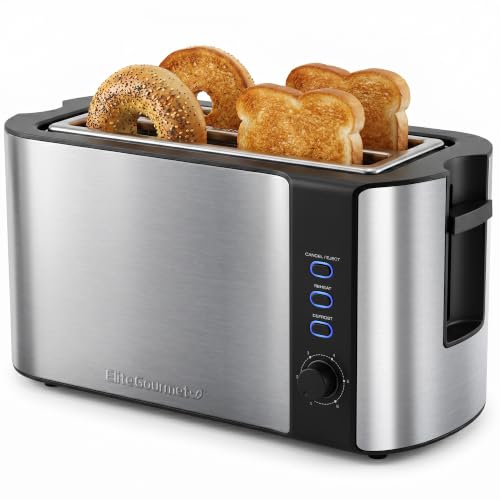
Long-slot designs can be particularly practical in compact kitchens. The bella Fits-Anywhere Slim Toaster, 4 Slice Extra Long & Wide Slot, Oatmilk is listed at $33.99, and the Elite Gourmet 4-Slice Long Slot Toaster with extra-wide slots is listed at $34.99. At those prices, a compact 4-slice option may cost only about $10 to $20 more than a comparable 2-slice model.
The drawbacks are primarily physical. A 4-slice toaster can occupy 80 to 120 square inches of counter area, compared with roughly 60 to 85 square inches for a small 2-slice model. It may also need a higher-wattage outlet circuit shared carefully with other appliances. Avoid running a toaster at the same time as a high-draw appliance if your kitchen frequently trips a breaker, and never use a toaster under a cabinet while it is operating unless the manufacturer specifically permits it.
Cost Over 5 Years
A realistic five-year comparison should include purchase price, electricity, and the value of saved time. For illustration, assume 300 uses per year, an average 3-minute toasting cycle, and an electricity rate of 18 cents per kilowatt-hour. A 2-slice toaster using 850 watts would consume about 12.75 kWh per year, or roughly $11.48 annually. Over five years, that is about $57 in electricity.
A 4-slice toaster using 1,600 watts would consume about 24 kWh per year under the same timing assumption, costing approximately $21.60 annually, or $108 over five years. The difference is about $51 across five years—not usually enough to determine the purchase by itself.
Purchase prices change the total more noticeably. A $20 2-slice toaster plus five years of estimated electricity would total about $77, before replacement or repair. A $35 4-slice toaster would total about $143 under the same assumptions. However, if the 4-slice model replaces two back-to-back cycles on most mornings, its convenience may justify the additional cost. These are estimates, not a guarantee of actual energy use; cycle length, settings, local utility rates, and standby consumption vary.
Which One for Your Home
Small apartment
Choose a 2-slice model unless you regularly feed three or more people. Prioritize a footprint under 12 inches wide, a removable crumb tray, cord storage, and a cool-touch exterior. A long-slot 2-slice toaster is a strong choice if you buy bakery bread or prefer larger slices without giving up counter space.
Family with kids or pets
A 4-slice toaster is usually more practical because it reduces breakfast batches. Select a stable model with a cool-touch exterior, clearly marked controls, and enough cord length to sit safely away from the counter edge. Keep the toaster where children and pets cannot pull it down, and allow clearance around the slots during operation.
Rental
Renters often benefit from a reasonably priced 2-slice toaster that is easy to move and replace. A basic model in the $15 to $30 range can make more sense than paying for a large appliance that may not fit the next kitchen. If you share the rental with roommates, a compact 4-slice model is worthwhile when several people use it every morning.
Long-term home
Buy for your most common routine rather than your current counter alone. If your household may grow or you frequently host guests, a 4-slice long-slot model can prevent an early upgrade. If you expect to remodel or value an uncluttered counter, choose a durable-feeling 2-slice model with replaceable or accessible crumb-tray components where available.
FAQ
Is a 4-slice toaster too big for a small kitchen?
Not necessarily. A long-slot design may fit four standard slices while staying near 12 inches wide. Measure the counter depth, surrounding clearance, and cabinet height—not just the advertised width.
Does a 4-slice toaster toast faster?
It can prepare twice as many slices in one cycle, but the individual slices do not necessarily toast faster. Heating performance depends on wattage, thermostat design, bread thickness, and the selected shade.
Are long-slot toasters better for small kitchens?
They can be. Long slots accommodate large bread slices and may provide four-slice capacity without the width of four separate slots. Check whether both halves have independent controls and measure the full appliance footprint.
How much counter clearance does a toaster need?
Leave enough room to operate the lever comfortably and keep the appliance away from water. Provide open space above the slots while it is running, and follow the manufacturer’s clearance instructions. Never store items on top of an operating toaster.




Write Your Review
No reviews yet. Be the first to share your experience!