
Key takeaways
- Chair joints wear first: repeated leaning, rocking, and uneven floors can loosen bolts or stress corner joints before the tabletop shows damage.
- Edges are vulnerable: tabletop edges and chair corners receive impacts from belts, toys, vacuum cleaners, and moving chairs. A rounded edge is more forgiving than a sharp profile.
- Upholstery needs practical care: light fabric looks airy but shows food stains quickly. Removable, washable covers are more useful than fabric color alone.
- Moisture causes slow damage: wipe spills around joints, veneer seams, and unfinished underside surfaces rather than allowing liquid to sit.
- Hardware needs retightening: check screws and bolts after two to four weeks, then at least twice a year if the chairs are used daily.
The best dining table sets are the ones that leave enough clearance to move, provide the right number of seats, and use materials suited to how often your household eats at the table—not simply the set with the lowest price.
Quick picks by space and budget
| Best for | Recommended table size | Typical seating | Best materials | General market range | Assembly expectation |
|---|---|---|---|---|---|
| Compact kitchen or apartment | 30–36 in round or 36–48 in square | 2–4 | Laminate, engineered wood, metal | $150–$450 | 30–90 minutes |
| Everyday family dining | 60–72 in long by 36–40 in wide | 6 | Solid wood, veneer, durable laminate | $400–$1,200 | 1–2 hours |
| Occasional entertaining | 72–96 in long by 36–44 in wide | 6–8 | Solid wood, wood veneer, reinforced engineered wood | $800–$2,500+ | 1–3 hours; extension fitting may be needed |
| Small breakfast nook | 24–30 in round or 30–36 in square | 2 | Laminate, painted wood, powder-coated metal | $100–$350 | 20–60 minutes |
How much space does a dining set need?
Measure the room before comparing styles. Allow at least 36 inches between the table edge and the nearest wall, cabinet, or appliance. If people need to walk behind seated diners, 42–48 inches is more comfortable. In a busy kitchen, the larger clearance reduces collisions with open oven doors, refrigerators, and drawers.

Signature Design by Ashley Caitbrook 7-Piece Dining Set, Gray Wash
Included for 'Best Dining Table Sets for Different Spaces and Budgets' because the listing specifies Gray Wash, details this guide uses to compare options.
View on Amazon
LUXOAK 3-Piece Corner Dining Set with Hidden Storage, Black Oak
Included for 'Best Dining Table Sets for Different Spaces and Budgets' because the listing specifies Black Oak, details this guide uses to compare options.
View on Amazon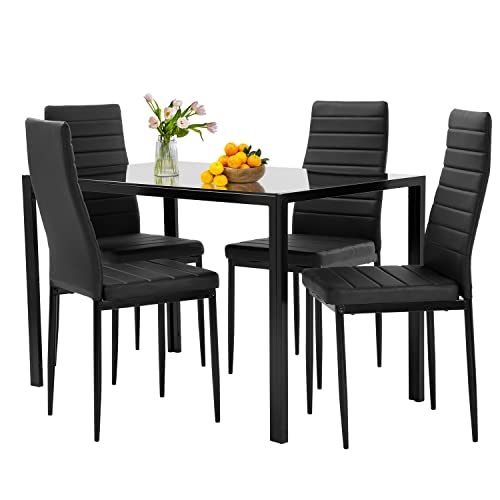
FDW | 5-Piece Dining Table Set | Black | Glass Kitchen Table
Included for 'Best Dining Table Sets for Different Spaces and Budgets' because the listing specifies 5-Piece Dining Table Set and Black, details this guide uses to compare options.
View on Amazon
Feonase 5-Piece Dining Table Set for 4-8 People, 63" Extendable Kitchen Table with 2 Benches and 2 Square Stools, Mid-Century Modern Wooden Dining Room Table, Space-Saving, Walnut
Included for 'Best Dining Table Sets for Different Spaces and Budgets' because the listing specifies Mid-Century Modern Wooden Dining Room Table and Space-Saving, details this guide uses to compare options.
View on AmazonFor a useful fit calculation, add 72 inches to both the table length and width. A 60-by-36-inch rectangular table therefore needs approximately 132 by 108 inches of open floor area, or 11 by 9 feet, for basic chair clearance. If one side borders a wall and chairs will not be used there, you may be able to reduce the requirement, but do not assume every chair can slide out comfortably.
Compact kitchens and apartments
A round table measuring 30–36 inches across is often more forgiving than a rectangular table because it has no corners projecting into walkways. A square pedestal table can also work well when two people usually eat together but four seats are needed occasionally.
Look for stackable or armless chairs, drop-leaf tops, and a central pedestal rather than four corner legs. A drop-leaf design can shrink from roughly 42–48 inches wide to about 24–30 inches when folded. Check the folded dimensions carefully: the chairs may still need a separate storage location.
Family dining rooms
A 60-inch rectangular table generally seats six only when the chairs are relatively narrow and diners do not need much elbow room. For more comfortable daily use, 72 inches is a better target. Allow approximately 24 inches of table edge per person; 20 inches is workable for occasional use but feels crowded with large plates, serving dishes, or children’s place settings.
Benches can increase flexibility on one or both long sides, but they are not automatically more comfortable. A bench without a back may be useful in a narrow room, while a backed bench takes up more visual and physical space. Make sure the bench can slide fully under the table if circulation is tight.
Larger dining areas
For eight people, choose an 84–96-inch table or an extendable table rated for that capacity. Extension leaves are practical when the household size changes, but inspect how they store and how much effort is required to install them. A heavy solid-wood extension may require two adults, whereas a lighter engineered-wood leaf is easier to handle but may be less resistant to moisture and edge damage.
Material comparison: what changes in ownership?
| Material | Advantages | Common wear | Care requirements | Best match |
|---|---|---|---|---|
| Solid wood | Repairable, substantial, long service life | Scratches, dents, seasonal movement, water marks | Wipe spills promptly; use coasters and suitable wood care | Frequent family use and long-term ownership |
| Wood veneer | Wood appearance at lower weight and cost | Exposed edges can chip; deep scratches are difficult to repair | Use mild cleaners; avoid standing moisture and abrasive pads | Dining rooms and moderate daily use |
| Laminate | Easy cleaning, stain resistance, usually affordable | Edges may lift; surface cannot usually be refinished | Wipe with a damp cloth; keep hot cookware on trivets | Busy kitchens, renters, and value-focused buyers |
| Glass | Visually light and easy to inspect for spills | Fingerprints, chips, visible dust, potential cracking from impact | Use non-abrasive glass cleaner and soft cloths | Small rooms where visual openness matters |
| Metal | Strong frames, modern appearance, often easy to clean | Scratches, corrosion if the finish is damaged, cold touch | Dry after cleaning; check welds and finish periodically | Industrial or contemporary kitchens |
Choosing between the best dining table sets by budget
Under about $300
Prioritize correct dimensions and a stable frame over decorative features. A laminate or engineered-wood table with metal legs may offer better everyday value than an inexpensive imitation of distressed solid wood. Expect thinner tops, simpler finishes, and chairs that may need occasional screw tightening. For a two-person kitchen, a compact round set can provide more usable floor space than a larger rectangular bargain set.
About $300–$800
This is the broadest value category. You can often find a six-seat set with a stronger frame, better chair padding, and a more convincing veneer or solid-wood construction. Check whether the listed price includes all chairs, whether the table has adjustable feet, and whether replacement chairs or matching parts are available. A well-made four-seat set may be a better purchase than a poorly reinforced six-seat set.
Above about $800
Spend more for construction details rather than appearance alone: thicker solid-wood components, reinforced corner blocks, quality drawer slides if storage is included, smoother extension mechanisms, and replaceable glides or hardware. Premium pricing does not eliminate maintenance. Wood can still move with humidity, and upholstered chairs can still stain or compress.
Assembly: what to expect before buying
Most dining sets arrive with the table base, tabletop, and chairs partially disassembled. A realistic setup sequence is:
- Inventory every panel, fastener, washer, and tool before tightening anything.
- Attach legs or the pedestal loosely so the frame can self-align.
- Place the tabletop upside down on a blanket, then secure the base evenly.
- Turn the table upright with two adults if it is large, heavy, or has an extension mechanism.
- Assemble chairs on a level surface and tighten fasteners again after several days of use.
Do not use a power drill at maximum torque on particleboard or veneer components; it can strip the insert or crush the material. If the set includes many identical screws, label them rather than assuming they are interchangeable. Uneven leg tension is a common cause of wobble, so level the table only after it is on its final floor surface.
Durability details listings often leave out
- Chair joints wear first: repeated leaning, rocking, and uneven floors can loosen bolts or stress corner joints before the tabletop shows damage.
- Edges are vulnerable: tabletop edges and chair corners receive impacts from belts, toys, vacuum cleaners, and moving chairs. A rounded edge is more forgiving than a sharp profile.
- Upholstery needs practical care: light fabric looks airy but shows food stains quickly. Removable, washable covers are more useful than fabric color alone.
- Moisture causes slow damage: wipe spills around joints, veneer seams, and unfinished underside surfaces rather than allowing liquid to sit.
- Hardware needs retightening: check screws and bolts after two to four weeks, then at least twice a year if the chairs are used daily.
A simple decision matrix
| Your situation | Choose | Why |
|---|---|---|
| Two people eat daily; limited floor space | 30–36-inch round or drop-leaf set | Improves circulation and can add occasional seating |
| Four to six people eat every day | 60–72-inch rectangular set | Provides useful serving space and stable chair positions |
| Children use the table for meals and homework | Durable laminate or protected solid wood | Handles frequent wiping and reduces concern about minor marks |
| Guests arrive only a few times a year | Extendable table with stored or spare seating | Avoids dedicating everyday floor space to rare capacity needs |
| Moving or assembling furniture is difficult | Lightweight engineered wood or metal-frame set | Reduces handling weight and usually simplifies repositioning |
Final buying checklist
Before choosing among the best dining table sets, confirm the assembled table dimensions, chair width, seat height, tabletop clearance, and the full footprint with chairs pulled out. Verify the maximum seating capacity rather than counting only the number of included chairs. Then match the finish to your cleaning habits: laminate for low-maintenance practicality, solid wood for repairability, veneer for a balance of appearance and weight, and glass or metal when visual openness is more important than hiding fingerprints. The right set is the one that fits your room on an ordinary day, not just when every seat is occupied.

Write Your Review
No reviews yet. Be the first to share your experience!