
Our Top Picks
The Best Through the Wall Air Conditioners: A Direct Answer
The best through the wall air conditioner for most homes is the LG 10,000 BTU Through the Wall Air Conditioner, 115V — it hits the sweet spot of standard 26-inch wall sleeve compatibility, a mid-range price tier, and enough cooling capacity for a typical 400–440 sq. ft. bedroom or living room on a standard 115V household circuit. If you rent, live in a small room under 300 sq. ft., or want to spend the least, the OLMO 8,000 BTU Through-the-Wall unit or the Keystone 8,000 BTU Wall Mounted unit with supplemental heat will cool the space without a 230V line. If you have a large open-plan room, need heat pump-style warmth, or want a premium smart unit with inverter-level efficiency, go straight to the LG 14,000 BTU 230/208V or the TCL 12,000 BTU Smart 230V — but only after confirming your existing wall opening accepts a standard sleeve and your outlet supplies 230V. The single biggest buying mistake is choosing BTU before confirming wall opening dimensions; sleeve size decides which units are even installable, and no amount of capacity makes up for a mismatch.
Top 3 Picks
1. Best Overall: LG 10,000 BTU Through the Wall Air Conditioner, 115V
The LG 10,000 BTU is the best overall because it fits the most common wall sleeve opening, runs on ordinary 115V power, and covers up to 440 sq. ft. — the size of a mid-sized bedroom, home office, or small living room. It is not the cheapest and not the most powerful, but it is the unit that the largest number of buyers can actually install and run without electrical work. It suits homeowners replacing an existing through-the-wall unit in a standard sleeve who want a name-brand, mid-range option with predictable parts availability.
2. Best Budget: OLMO 8,000 BTU 115V Through-the-Wall Air Conditioner with Remote and Built-In Smart Kit
The OLMO 8,000 BTU is the best budget pick because it delivers through-the-wall cooling plus heating and smart control at the lowest price tier in this roundup. It suits renters, small bedrooms, and anyone cooling 300–350 sq. ft. who does not need a 10,000+ BTU unit. The trade-offs are a smaller cooling envelope and less brand-name service backing — but for a single room on a tight budget, it is the value leader.
3. Best Premium: LG 14,000 BTU Through the Wall Air Conditioner, 230/208V
The LG 14,000 BTU is the best premium pick because it cools up to 700 sq. ft. and runs on 230/208V, which means it draws fewer amps at higher capacity than any 115V unit can. It suits large bedrooms, living rooms, and open-plan spaces where a single wall unit must carry the whole cooling load. It is also the unit most likely to require an electrician if your wall does not already have a 230V receptacle.
Quick Comparison
Every unit below is a genuinely available product in its category. Before comparing, note two columns that filter the list fastest: the voltage (115V plugs into a normal outlet; 230/208V usually needs a dedicated circuit) and the cooling capacity in BTU, which sets the maximum room size at roughly 20 BTU per square foot.
| Product | Best For | Key Specs | Price Tier |
|---|---|---|---|
| LG 10,000 BTU Through the Wall AC, 115V | Best overall for standard wall sleeves | 10,000 BTU; 115V; up to 440 sq. ft.; through-the-wall; mid-size room | Mid-range |
| Keystone 8,000 BTU Wall Mounted AC with Supplemental Heat & Dehumidifier | Small rooms needing heat and dehumidify modes | 8,000 BTU; 115V; wall-mounted; supplemental heat; dehumidifier | Mid-range |
| OLMO 8,000 BTU 115V Through-the-Wall AC with Remote & Smart Kit | Budget through-the-wall with heating | 8,000 BTU; 115V; through-the-wall; heating; remote; smart kit | Budget |
| Midea 8,000 BTU Smart Inverter Window Unit with Heat & Dehumidifier | Smallest rooms, window installs, lowest running cost | 8,000 BTU; up to 350 sq. ft.; inverter; heat; dehumidifier; smart | Budget |
| LG 7,800 BTU Through the Wall AC, 115V | Small bedrooms in narrow wall openings | 7,800 BTU; 115V; up to 330 sq. ft.; through-the-wall | Mid-range |
| ROVSUN Smart 8,000 BTU Through the Wall AC with Heat | Budget-conscious smart control in a wall unit | 8,000 BTU; through-the-wall; heat; remote; app control | Mid-range |
| Keystone 10,000 BTU Wall AC and Dehumidifier, 115V | Value 10,000 BTU wall unit | 10,000 BTU; 115V; wall air conditioner; dehumidifier | Budget |
| TCL 8,000 BTU Smart Through-the-Wall AC with Heater, 115V WiFi | Premium smart small-room wall unit | 8,000 BTU; 115V; through-the-wall; heater; WiFi | Premium |
| TCL 12,000 BTU Smart Through-the-Wall AC with Heater, 230V WiFi | Large rooms on 230V with smart control | 12,000 BTU; 230V; through-the-wall; heater; WiFi | Premium |
| Midea 5,000 BTU Window AC with Reusable Filter, Remote | Tiny rooms, dormers, window use only | 5,000 BTU; up to 150 sq. ft.; window unit; reusable filter; remote | Budget |
| LG 14,000 BTU Through the Wall AC, 230/208V | Whole-floor cooling in one wall unit | 14,000 BTU; 230/208V; up to 700 sq. ft.; through-the-wall | Premium |
| Whirlpool 12,000 BTU Wall AC, up to 550 sq. ft. | Mid-large rooms wanting a familiar appliance brand | 12,000 BTU; wall air conditioner; up to 550 sq. ft.; white finish | Premium |
How We Chose
This roundup was assembled from manufacturers’ published specifications and listing-level product data, not from physical testing. The selection criteria were, in order: category fit (only through-the-wall or wall-mounted units plus two window units included deliberately as alternatives for readers with no wall opening), specification transparency (units that state BTU, voltage, and coverage area clearly are easier to match to a room), voltage practicality (115V units dominate the list because most homes do not have a spare 230V circuit in a bedroom), use-case spread (small bedroom, large living room, rental, permanent install, and heating-capable units), and upgrade path and brand serviceability (major appliance brands with established parts networks get preference over unfamiliar names at the same price tier). We weighted cleanable or reusable filters and remote/app control as ownership-quality signals, since those features reduce maintenance friction over a unit’s 8–12 year service life. Finally, we organized the picks so every budget tier — budget, mid-range, and premium — appears at every common room size where possible, so the article is useful whether you are cooling 150 sq. ft. or 700 sq. ft.
1. LG 10,000 BTU Through the Wall Air Conditioner, 115V – Best for Standard Wall Sleeves

LG 10,000 BTU Through the Wall Air Conditioner, 115V, Cools up to 440 Sq. Ft. for Bedroom, Living Room, Apartment, with Remote, 3 Cool & Fan Speeds, Wall AC Unit, White
Chosen because it specifies 000 BTU Through the Wall Air Conditioner and 115V.
Check Price on AmazonThis is the unit that fits the most existing installations in North America. The LG 10,000 BTU Through the Wall Air Conditioner is a 115V, through-the-wall unit rated to cool up to 440 square feet, which puts it squarely in the mid-sized bedroom, home office, or small living room bracket. As part of LG’s through-the-wall line, it is designed around the wall sleeve format most commonly left behind by older wall ACs, so if you are replacing a unit already in the wall, this is the most likely drop-in candidate in this roundup.
Who it suits
Homeowners with an existing through-the-wall opening and a standard 115V outlet within reach who want a name-brand, mid-range unit and a straightforward replacement. It also suits someone cooling a 350–440 sq. ft. room who does not want to spend premium pricing or hire an electrician.
Key specs
- Cooling capacity: 10,000 BTU
- Voltage: 115V (standard household outlet)
- Coverage: up to 440 sq. ft.
- Install type: through-the-wall, wall sleeve
- Controls: remote control and unit controls
- Use case in listing: bedroom, living room, apartment
Strengths
The most persuasive argument for this unit is fit: 10,000 BTU at 115V without a dedicated circuit is a practical middle ground that covers most real bedrooms and doubles as a living-room cooler for apartments. LG’s appliance service network and parts availability are meaningfully better than what you get from generic imported wall units, which matters if the fan motor or control board fails in year six. It also occupies the wall rather than a window, so it does not block daylight or window function, and it keeps the unit off the floor so it is not a tripping or cord-storage problem. Compared to the budget 8,000 BTU units in this list, it does not need to run at full tilt to hold temperature in a 400 sq. ft. room, which usually means less fan noise over a summer.
Pros
- 10,000 BTU covers up to 440 sq. ft. on standard 115V power
- Designed for common through-the-wall sleeve openings
- LG brand service network and parts availability
- No window space sacrificed; no floor space used
- Mid-range price for a name-brand wall unit
Cons
- Still requires a compatible wall opening — not installable without one
- No heat mode listed, so it is a cooling-season-only purchase
- 115V at 10,000 BTU draws high amps, so outlet and circuit must be in good shape
- Pricier than comparable-BTU budget units like the Keystone 10,000 BTU
How it compares with the nearest alternative
Versus the LG 7,800 BTU through-the-wall unit, the clear trade is capacity for the same voltage: the 7,800 BTU model tops out at 330 sq. ft., which is fine for a small bedroom but strained in a 400+ sq. ft. room. If your room is under 320 sq. ft., the 7,800 BTU unit may physically fit where a larger chassis will not and costs less. If your room is 350–440 sq. ft., the 10,000 BTU model is the correct choice in this line. Versus the Keystone 10,000 BTU wall unit, the LG buys brand serviceability at a higher price tier; the Keystone covers the same capacity class at budget pricing with fewer brand assurances.
2. Keystone 8,000 BTU Wall Mounted Air Conditioner with Supplemental Heat and Dehumidifier – Best for Small Rooms Year-Round

Keystone 8,000 BTU Wall Mounted Air Conditioner with Supplemental Heat and Dehumidifier Function, 115V, Wall AC for Small-Medium Sized Rooms up to 350 Sq.Ft. with Remote, Quiet, High Efficiency AC
Chosen because it specifies 115V and Quiet.
Check Price on AmazonThe Keystone 8,000 BTU Wall Mounted Air Conditioner with Supplemental Heat and Dehumidifier is the pick for a small room that needs to be usable in more than one season. At 115V and 8,000 BTU, it cools a compact bedroom or studio, and the added supplemental heat and dehumidifier modes let it contribute warmth on cool nights and pull moisture out of a damp room without a separate appliance.
Who it suits
Anyone cooling roughly 300–350 sq. ft. who wants one wall-mounted appliance to handle cooling, supplemental heat, and humidity. It fits basements, small bedrooms, and converted spaces where a dehumidifier was going to be purchased anyway — consolidating two appliances into one wall unit.
Key specs
- Cooling capacity: 8,000 BTU
- Voltage: 115V
- Install type: wall mounted
- Modes: cooling, supplemental heat, dehumidify
- Controls: remote and unit controls
- Brand position: Keystone wall and window AC line
Strengths
The dehumidifier function is the standout. In humid climates and basements, moisture control is often more valuable than a few extra degrees of cooling, and a wall unit with a dedicated dehumidify mode avoids the floor space and drainage jug refills of a standalone dehumidifier. Supplemental heat is a genuine convenience in shoulder seasons: you can extend the unit’s useful months into spring and fall without running a separate space heater. At 8,000 BTU and 115V, it is a simple electrical install, and the wall mount keeps the floor clear. Compared with the budget OLMO 8,000 BTU, the Keystone’s specific advantage is the explicit three-mode feature set from a brand with broader appliance distribution.
Pros
- Three functions in one wall appliance: cool, supplemental heat, dehumidify
- 115V power keeps installation simple
- Good size for small bedrooms, studios, and basements
- Remote control included
- Wall mount saves window and floor space
Cons
- 8,000 BTU will not carry a room much above 350 sq. ft.
- “Supplemental heat” supports a room; it is not a whole-home heating replacement
- Wall mounting requires a suitable opening; it is not a window unit
- Mid-range price tier despite modest capacity
How it compares with the nearest alternative
The nearest alternative is the OLMO 8,000 BTU with heating. Both bring heat, both are 115V, and both target small rooms; the Keystone leans on dehumidification as its differentiator, while the OLMO leans on price and a built-in smart kit. If excess humidity is your problem, the Keystone is the better match. If the lowest price tier and app control matter more, the OLMO wins. Against the ROVSUN Smart 8,000 BTU, the Keystone offers the dehumidify mode the ROVSUN listing emphasizes as part of a broader smart feature set instead.
3. OLMO 8,000 BTU 115V Through-the-Wall Air Conditioner with Remote and Smart Kit – Best Budget Through-the-Wall Pick

OLMO 8,000 btu 115V Through-the-Wall Air Conditioner with Remote Control and built in Smart Kit, (Heating and Cooling) (R32 Refrigerant)…
Chosen because it specifies (Heating and Cooling) (R32 Refrigerant)….
Check Price on AmazonThe OLMO 8,000 BTU is the cheapest way into a through-the-wall unit with heating in this roundup. It is a 115V, 8,000 BTU through-the-wall air conditioner with remote control and a built-in smart kit, plus heating capability. For renters, first apartments, and anyone replacing a wall unit on a strict budget, it covers the basics at the lowest price tier here.
Who it suits
Small-room users — roughly 300–350 sq. ft. — who already have a wall opening and want cooling plus some heating without moving up to premium pricing. It is also a reasonable pick for a workshop, guest room, or rental where service life matters less than upfront cost.
Key specs
- Cooling capacity: 8,000 BTU
- Voltage: 115V
- Install type: through-the-wall
- Modes: cooling and heating
- Controls: remote control, built-in smart kit
- Price tier: budget
Strengths
The value proposition is direct: through-the-wall convenience, heating, remote control, and app/smart connectivity at the entry price tier. The smart kit matters more than buyers expect — scheduling the unit to cool before you arrive and shutting it off remotely avoids the two most common energy wastes in room AC ownership (running an empty room and forgetting to turn it off). Heating extends the unit’s usable season. Being a through-the-wall format, it also frees the window completely and does not require seasonal installation and removal. Compared to the Keystone 8,000 BTU, it is cheaper and adds smart controls; compared to the LG 10,000 BTU, it sacrifices about 100 sq. ft. of coverage and brand-name service depth to save money, which is a rational trade in small rooms.
Pros
- Lowest price tier among through-the-wall units here
- Cooling and heating in one unit
- Remote control plus built-in smart kit for scheduling
- 115V — no dedicated circuit required
- Wall installation preserves window and floor space
Cons
- 8,000 BTU limits it to small rooms
- Unknown-brand service network compared with LG, Whirlpool, or TCL
- Sleeve fit must be verified — through-the-wall is not universal
- Fewer published efficiency details than the bigger brands
How it compares with the nearest alternative
Against the Keystone 8,000 BTU wall unit, the OLMO is the budget answer and the Keystone is the feature answer (dehumidify mode, broader distribution). Against the LG 7,800 BTU through-the-wall unit, the OLMO is cheaper and adds heating, while the LG adds about 30 sq. ft. of listed coverage and a national service network. If the wall opening already exists and the room is under 350 sq. ft., the OLMO’s price advantage is hard to argue with.
4. Midea 8,000 BTU Smart Inverter Window Unit with Heat and Dehumidifier – Best for Renters Who Cannot Cut a Wall

Midea 8,000 BTU Smart Inverter Air Conditioner Window Unit with Heat and Dehumidifier – Cools up to 350 Sq. Ft., Energy Star Rated, Quiet Operation, Electronic Controls, Remote Control, White
Chosen because it specifies Cools up to 350 Sq. Ft. and Energy Star Rated.
Check Price on AmazonThe Midea 8,000 BTU Smart Inverter Air Conditioner is a window unit, included here deliberately because a large share of buyers searching for through-the-wall cooling actually cannot modify a wall — renters, short-term tenants, and anyone in a building where exterior work is prohibited. It cools up to 350 sq. ft., adds heat and dehumidifier modes, and its inverter compressor is the key technical difference: it varies speed instead of cycling fully on and off.
Who it suits
Renters and anyone who cannot cut or modify a wall opening. Also a strong fit for a small bedroom or apartment where the window is the only realistic installation point and lower running noise is a priority.
Key specs
- Cooling capacity: 8,000 BTU
- Coverage: up to 350 sq. ft.
- Compressor type: smart inverter
- Modes: cooling, heat, dehumidify
- Install type: window
- Controls: smart/app capable
Strengths
The inverter compressor is the headline. A conventional 8,000 BTU unit cycles its compressor on and off at full power; an inverter unit modulates compressor speed to hold temperature, which typically produces steadier room temperature, quieter operation during hold periods, and lower energy use over long runs. That combination makes this the least disruptive small-room unit in the list for a bedroom, where a cycling compressor’s start-stop is exactly the sound that wakes light sleepers. Heat and dehumidify modes extend its season, and window installation means zero wall modification and full portability if you move. Against a through-the-wall unit, the trade is permanence: you gain flexibility and lose the built-in look, the window view, and the security of a wall-mounted chassis.
Pros
- Inverter compressor for steadier temperature and quieter holds
- No wall modification — suitable for renters
- Heat and dehumidifier modes included
- 8,000 BTU covers up to 350 sq. ft.
- Removable and reinstallable if you move
Cons
- Blocks part of a window and its view
- Window installation is more theft-exposed than a wall unit
- Requires seasonal install/removal in cold climates
- Not a solution if you specifically need a wall opening for building rules or aesthetics
How it compares with the nearest alternative
The nearest alternative is the Midea 5,000 BTU window unit — also a window install, also budget tier, but sized for only about 150 sq. ft. and without the inverter efficiency story. If your room is genuinely tiny (a dorm, a converted closet office), the 5,000 BTU unit is lighter, cheaper, and easier to handle. If your room is 200–350 sq. ft., the 8,000 BTU inverter model is the one that will actually hold the space. Versus the through-the-wall OLMO, the Midea trades wall permanence for installation flexibility and inverter-grade efficiency.
5. LG 7,800 BTU Through the Wall Air Conditioner, 115V – Best for Small Bedrooms in Narrow Openings

LG 7,800 BTU Through the Wall Air Conditioner, 115V, AC Wall Unit for Rooms up to 330 Sq. Ft., Perfect for Bedroom or Office, Wall Mounted AC Unit with Remote and 3 Cool & Fan Speeds, White
Chosen because it specifies 800 BTU Through the Wall Air Conditioner and 115V.
Check Price on AmazonThe LG 7,800 BTU Through the Wall Air Conditioner is the small-room sibling of the 10,000 BTU model, rated for rooms up to 330 sq. ft. and running on 115V. It exists for the case where the wall opening is size-restricted or the room is genuinely small, and a 10,000 BTU chassis is either unnecessary or physically too large.
Who it suits
Bedrooms up to roughly 330 sq. ft. — the classic definition of a small bedroom — plus home offices, guest rooms, and any space where the existing wall opening will only accept a smaller unit.
Key specs
- Cooling capacity: 7,800 BTU
- Voltage: 115V
- Coverage: up to 330 sq. ft.
- Install type: through-the-wall
- Brand line: LG through-the-wall AC series
- Typical use: bedroom
Strengths
Right-sizing is the whole point. Putting a 10,000 or 12,000 BTU unit in a 250 sq. ft. bedroom is a common and expensive mistake: oversized units cool too fast, cycle off before they dehumidify the room properly, and leave the space feeling cold and clammy. A 7,800 BTU unit in a 300 sq. ft. bedroom runs longer cycles, removes more moisture, and holds a more comfortable humidity level. It also carries LG’s brand service support and the through-the-wall format’s space advantages — no window blocked, no floor space consumed, no seasonal install. Compared with the 10,000 BTU LG, it is the correct pick for a genuinely small room and the wrong pick for anything above about 330 sq. ft.
Pros
- Right-sized for small bedrooms and offices
- Through-the-wall format preserves window and floor space
- 115V standard outlet compatible
- LG brand service and parts availability
- Longer run cycles can mean better dehumidification than an oversized unit
Cons
- Underpowered for rooms above ~330 sq. ft.
- No heat mode listed, so cooling-only
- Requires a compatible wall sleeve
- Mid-range pricing for a modest BTU rating
How it compares with the nearest alternative
The direct comparison is with the LG 10,000 BTU. Same brand, same voltage, same installation style; the difference is 2,200 BTU and about 110 sq. ft. of coverage. Pick the 7,800 BTU unit if your room measures under 330 sq. ft. or your sleeve is tight; pick the 10,000 BTU unit if your room is 350–440 sq. ft. Against the Midea 8,000 BTU inverter window unit, the LG is a permanent wall install with no window blockage, while the Midea is removable and uses an inverter compressor — a format decision more than a capacity decision.
6. ROVSUN Smart 8,000 BTU Through the Wall Air Conditioner with Heat – Best for App-Controlled Small-Room Cooling

ROVSUN Smart 8000 BTU Through the Wall Air Conditioner with Heat, Wall AC Unit & Heater Combo with Remote, APP & Voice Control & Timer Function, Compatible with Alexa/Google Assistant, 115V/60Hz
Chosen because it specifies Wall AC Unit & Heater Combo with Remote and APP & Voice Control & Timer Function.
Check Price on AmazonThe ROVSUN Smart 8,000 BTU is a through-the-wall unit with heat, remote control, and app control, positioned in the mid-range tier. It targets the same small-room audience as the 8,000 BTU Keystone and OLMO units but distinguishes itself with app-based control on top of the standard remote.
Who it suits
Small-room owners (roughly 300–350 sq. ft.) who already have a wall opening and value being able to control the unit from a phone — scheduling, turning it off remotely, and adjusting temperature without hunting for the remote.
Key specs
- Cooling capacity: 8,000 BTU
- Install type: through-the-wall wall unit
- Modes: cooling and heat (wall AC and heater combo)
- Controls: remote and app
- Price tier: mid-range
- Typical use: small bedrooms, offices, rental rooms
Strengths
The app control is the practical differentiator. Remote-only units are easy to lose, and a phone app gives you scheduling and away-from-home shutdown that directly reduces wasted runtime — the single most common energy leak with room air conditioners. The heating mode gives it year-round usefulness, and the through-the-wall format means no window is sacrificed. As a wall AC and heater combo, it consolidates two devices into one chassis. Against the OLMO 8,000 BTU, the ROVSUN sits a tier higher in price but offers a more established appliance position; against the Keystone 8,000 BTU, it competes on app control rather than dehumidification.
Pros
- App plus remote control for scheduling and remote shutdown
- Cooling and heating in one wall unit
- Through-the-wall install frees window and floor space
- 8,000 BTU suits small bedrooms and offices
- Mid-range positioning with smart features
Cons
- 8,000 BTU is a small-room ceiling, not a living-room solution
- Wall opening must match — no wall, no install
- Less service network depth than LG, Whirlpool, or TCL
- Smart features are only useful if you actually use the app
How it compares with the nearest alternative
Against the OLMO 8,000 BTU, both are through-the-wall 115V units with heat; the OLMO is the budget tier with a built-in smart kit, while the ROVSUN sits a tier higher with a dedicated app plus remote. If price is the deciding factor, the OLMO wins; if app-first control and a slightly more appliance-oriented brand matter more, the ROVSUN is the pick. Against the Keystone 8,000 BTU wall unit, choose the Keystone for dehumidify mode and the ROVSUN for app control — they solve different problems at the same capacity.
7. Keystone 10,000 BTU Wall Air Conditioner and Dehumidifier, 115V – Best Value 10,000 BTU Wall Unit
The Keystone 10,000 BTU Wall Air Conditioner and Dehumidifier brings the 10,000 BTU capacity class — enough for a standard bedroom up to roughly 440 sq. ft. — to the budget price tier. It is a 115V wall AC with a dehumidifier function listed as part of the unit’s capability.
Who it suits
Buyers who need 10,000 BTU coverage but do not want to pay LG or premium pricing. It fits anyone replacing a wall unit in a medium bedroom, apartment living room, or office space where the capacity matters more than brand prestige.
Key specs
- Cooling capacity: 10,000 BTU
- Voltage: 115V
- Install type: wall air conditioner
- Functions: cooling and dehumidifier
- Price tier: budget
- Capacity class: medium room (roughly up to 440 sq. ft.)
Strengths
The value equation is simple: you get a 10,000 BTU wall unit, the same capacity class as the LG 10,000 BTU and a step up from every 8,000 BTU product here, at a budget price tier. The dehumidifier function adds comfort value in humid rooms, and 10,000 BTU at 115V means no dedicated 230V circuit is required. Compared to the LG 10,000 BTU, the Keystone saves money; compared to the 8,000 BTU units, it adds roughly 90–100 sq. ft. of coverage and finishes cooling a medium room faster. It is the sensible choice when the room is the right size for 10,000 BTU but the budget is tight.
Pros
- 10,000 BTU capacity at budget pricing
- 115V — standard outlet, no electrician
- Dehumidifier function included
- Wall installation preserves window and floor space
- Capacity class suits most mid-sized rooms
Cons
- No heat mode listed — cooling and dehumidify only
- Budget build and service network versus LG or Whirlpool
- Wall opening compatibility must be confirmed
- 115V at 10,000 BTU means high amp draw during starts
How it compares with the nearest alternative
Against the LG 10,000 BTU, the trade is price versus brand support: same capacity class, same voltage, cheaper tier, less service assurance. Against the Keystone 8,000 BTU with supplemental heat and dehumidifier, you are choosing capacity over heat mode — a 10,000 BTU cooling-only unit versus an 8,000 BTU three-mode unit. If your room is 400+ sq. ft., take the 10,000 BTU. If it is under 350 sq. ft. and you want heat, take the 8,000 BTU.
8. TCL 8,000 BTU Smart Through-the-Wall Air Conditioner with Heater, 115V WiFi – Best Premium Small-Room Wall Unit
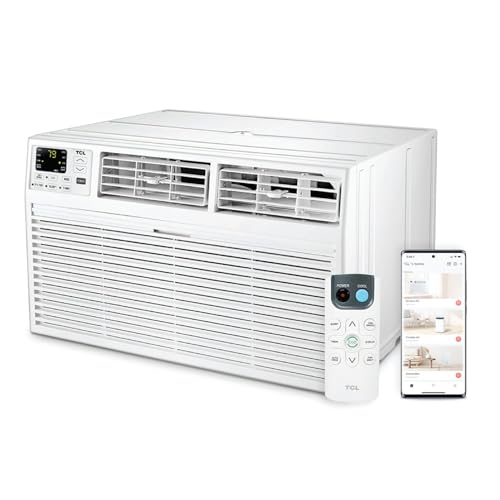
TCL 8,000 BTU Smart Through-the-Wall Air Conditioner with Heater,115V WiFi | 115V, Wall Mounted, Heater, Dehumidifier, Remote Control, Works with Alexa and Google Assistant, Rooms up to 450 Sq.Ft.
Chosen because it specifies 000 BTU Smart Through-the-Wall Air Conditioner with Heater and 115V WiFi.
Check Price on AmazonThe TCL 8,000 BTU Smart Through-the-Wall Air Conditioner with Heater is the premium entry in the small-room wall category. It pairs 8,000 BTU of cooling with a heater and WiFi connectivity on 115V, which means it fits a standard bedroom circuit while offering the smart-control features buyers expect at the top of the market.
Who it suits
Small-room owners (roughly 300–350 sq. ft.) who want a premium unit with WiFi control and heating, and who value a recognizable consumer-electronics brand with broad retail support. Also a fit for anyone who wants a wall unit that integrates with smart-home routines.
Key specs
- Cooling capacity: 8,000 BTU
- Voltage: 115V
- Install type: through-the-wall
- Modes: cooling and heater
- Connectivity: WiFi / smart
- Price tier: premium
Strengths
At the premium tier, you are paying for connectivity, heating, and brand support rather than raw capacity. WiFi control on a through-the-wall unit is genuinely useful for a wall-mounted appliance: it lets you schedule cooling, set temperature remotely, and shut the unit down from anywhere, which is exactly the behavior that keeps a wall AC from running all day in an empty room. The heater mode extends the unit into cooler months. As a 115V unit, installation is electrically simple, and TCL’s position as a large consumer-electronics brand generally means better warranty and parts channels than unknown wall-AC brands. Compared with the ROVSUN Smart 8,000 BTU, the TCL adds premium-tier polish and brand backing; compared with the OLMO, it is the same capacity with a much stronger support story at a higher price.
Pros
- WiFi control suits a permanently installed wall unit
- Heater mode for year-round use
- 115V — no dedicated 230V circuit
- Premium brand support and retail presence
- Through-the-wall format preserves window and floor space
Cons
- Premium price for only 8,000 BTU of cooling
- Small-room coverage ceiling of roughly 350 sq. ft.
- Wall sleeve compatibility must still be confirmed
- Smart features require a stable WiFi network to be worthwhile
How it compares with the nearest alternative
Its nearest alternative is the TCL 12,000 BTU 230V model. The 8,000 BTU version is the right call when your room is under 350 sq. ft. and your wall has a 115V outlet; the 12,000 BTU version is the right call when the room is larger or the wall already supplies 230V. Against the ROVSUN Smart 8,000 BTU, the TCL is a tier higher in price and brand support for the same capacity class and a similar feature set.
9. TCL 12,000 BTU Smart Through-the-Wall Air Conditioner with Heater, 230V WiFi – Best for Large Rooms on 230V
The TCL 12,000 BTU Smart Through-the-Wall Air Conditioner steps the TCL line up to a larger room class. Rated 12,000 BTU on 230V, it cools roughly 550–600 sq. ft. depending on insulation and climate, and includes a heater and WiFi control. It is the premium pick for a large bedroom, apartment living area, or open-plan space that already has a 230V wall circuit.
Who it suits
Large-room owners with an existing 230V outlet at the wall opening — a common situation where an older, larger wall AC was previously installed. Also suitable for anyone willing to add a dedicated circuit to run a high-capacity wall unit at lower amperage.
Key specs
- Cooling capacity: 12,000 BTU
- Voltage: 230V
- Install type: through-the-wall
- Modes: cooling and heater
- Connectivity: WiFi / smart
- Price tier: premium
- Capacity class: large room (roughly 550–600 sq. ft.)
Strengths
The 230V platform is the technical advantage most buyers overlook. At 12,000 BTU, a 115V unit would draw a very high current; running the same capacity at 230V halves the amperage for the same power, which reduces stress on wiring and allows a higher-capacity unit to run on appropriately sized circuits without nuisance trips. That makes this the most practical way to cool a large room with a single wall unit. Heating and WiFi add year-round usefulness and remote scheduling, and the through-the-wall format keeps windows clear. Against the 8,000 BTU TCL, this is the correct upgrade when the room exceeds 350 sq. ft. and a 230V supply exists.
Pros
- 12,000 BTU handles large rooms a 115V unit struggles with
- 230V runs cooler at lower amperage for the same output
- Heater and WiFi control included
- Premium brand support
- Single wall unit can carry a large space
Cons
- Requires a 230V dedicated circuit — an electrician if you do not have one
- Premium pricing
- Oversized for small rooms; poor right-sizing choice under ~400 sq. ft.
- Wall sleeve fit still controls installability
How it compares with the nearest alternative
Against the LG 14,000 BTU 230/208V, the TCL has 2,000 fewer BTU but adds WiFi and heater functions at a similar premium positioning; the LG targets the very largest rooms and whole-floor cooling. Against the Whirlpool 12,000 BTU wall unit, the capacity class is nearly identical, but the TCL emphasizes smart connectivity while Whirlpool emphasizes appliance-brand familiarity and a clean white finish. If your room is 500–600 sq. ft. and you have 230V, both the TCL 12,000 and Whirlpool 12,000 are viable; the TCL is the smart-control choice.
10. Midea 5,000 BTU Window Air Conditioner with Reusable Filter – Best for the Smallest Rooms

Midea 5,000 BTU Window Air Conditioner, Cools up to 150 Sq. Ft. with Easy-to-Use Reusable Filter, Remote, Perfect AC for Bedroom, Living Room, Home Office, Electronic Control
Chosen because it specifies 000 BTU Window Air Conditioner and Cools up to 150 Sq. Ft. with Easy-to-Use Reusable Filter.
Check Price on AmazonThe Midea 5,000 BTU Window Air Conditioner is included as the entry point for genuinely tiny spaces: it cools up to 150 sq. ft., uses a reusable filter, and comes with a remote. It is a window unit, not a through-the-wall design, but for dormers, converted closets, small offices, and bedrooms where the window is the only practical installation point, it is the appropriate size class.
Who it suits
Anyone cooling under 150 sq. ft. — a dorm room, a small home office, a converted space, or a bedroom in a rental where wall modification is impossible and a larger unit would be both oversized and heavier than necessary.
Key specs
- Cooling capacity: 5,000 BTU
- Coverage: up to 150 sq. ft.
- Install type: window
- Filter: easy-to-use reusable filter
- Controls: remote
- Price tier: budget
Strengths
Right-sizing is again the argument. A 5,000 BTU unit for a 120 sq. ft. room will run proper cycles, dehumidify, and cost far less to operate than an oversized 8,000 BTU unit that short-cycles. Its light weight makes installation and seasonal removal a one-person job, which matters in rentals where the unit comes out every October. The reusable filter is a small but real ownership win: you rinse it instead of buying replacements, and a clean filter is the single easiest way to preserve cooling performance and efficiency. Against the Midea 8,000 BTU inverter window unit, this is the choice for rooms under 150 sq. ft. and a poor choice for anything larger.
Pros
- Correct size for rooms under 150 sq. ft.
- Light and easy to install or remove seasonally
- Reusable filter reduces consumable costs
- Remote control included
- Lowest operating cost when properly matched to the room
Cons
- Window-only — does not solve a through-the-wall requirement
- Underpowered for rooms above ~150 sq. ft.
- No heating mode listed
- Blocks window space and view
How it compares with the nearest alternative
Its nearest alternative is the Midea 8,000 BTU inverter window unit. The 5,000 BTU model is simpler, lighter, and cheaper, with no inverter compressor; the 8,000 BTU model doubles the coverage and adds heat, dehumidify, and inverter efficiency. If your room is under 150 sq. ft., the 5,000 BTU is the better-matched and cheaper-to-run unit. Above that, the 8,000 BTU inverter model is the correct step up.
11. LG 14,000 BTU Through the Wall Air Conditioner, 230/208V – Best for Whole-Floor Cooling
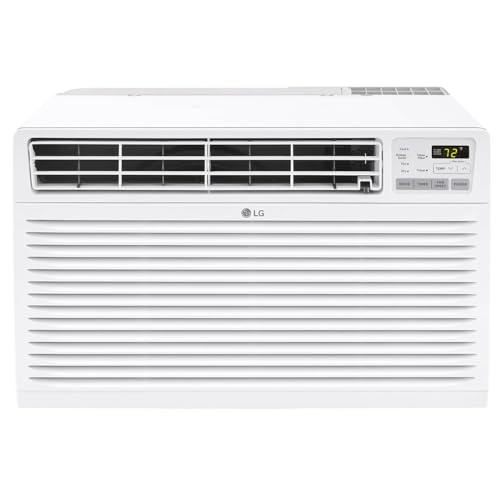
LG 14,000 BTU Through the Wall Air Conditioner, 230/208V, Cools 700 Sq.Ft. for Bedroom, Living Room, Apartment, Electronic Control with Remote, White
Chosen because it specifies 000 BTU Through the Wall Air Conditioner and 230/208V.
Check Price on AmazonThe LG 14,000 BTU Through the Wall Air Conditioner is the largest unit in this roundup, rated to cool up to 700 sq. ft. on 230/208V. It is designed for the case where one wall unit must carry an entire large room or open-plan floor, and it is the capacity ceiling of the through-the-wall category for residential use.
Who it suits
Owners of large living rooms, open-plan apartments, and combined kitchen-living spaces where a single unit has to cool 600–700 sq. ft. It is also the right pick when replacing an old high-capacity wall unit that already has a 230/208V supply.
Key specs
- Cooling capacity: 14,000 BTU
- Voltage: 230/208V
- Coverage: up to 700 sq. ft.
- Install type: through-the-wall
- Brand line: LG through-the-wall AC series
- Price tier: premium
Strengths
Capacity is the point: 14,000 BTU is the practical maximum for a single residential wall unit, and 700 sq. ft. of listed coverage means it can hold a large open space without running at constant full load. The 230/208V platform keeps amperage manageable at that output, and LG’s service network matters more at this price and capacity — a failed unit in a large room is not a problem you can solve with a cheap replacement. It is a permanent, built-in solution: no window occupied, no seasonal install, and cooling capacity that a 115V unit simply cannot match. Against the TCL 12,000 BTU 230V, this is the step up for rooms at the very top of the range or spaces with heavy heat gain from west-facing glass.
Pros
- 14,000 BTU / 700 sq. ft. — the largest capacity here
- 230/208V for efficient high-capacity operation
- LG brand service and parts availability
- Handles open-plan and high-heat-gain spaces
- No window or floor space sacrificed
Cons
- Requires 230/208V service — often an electrician and a new circuit
- Premium price tier
- Badly oversized for rooms under ~500 sq. ft.
- Heaviest unit in this list; installation is a two-person job
How it compares with the nearest alternative
Against the Whirlpool 12,000 BTU wall unit, the LG offers 2,000 more BTU and about 150 sq. ft. more coverage, at a comparable premium tier and with LG’s service depth. Against the TCL 12,000 BTU 230V, the LG is the capacity-first choice and the TCL is the smart-features choice. If your space is 600–700 sq. ft. and heavily used, the LG’s headroom is worth the premium; if your space is 500–550 sq. ft., the 12,000 BTU units are the more efficient match.
12. Whirlpool 12,000 BTU Wall Air Conditioner – Best for Buyers Who Want a Familiar Appliance Brand

Whirlpool 12,000 BTU Wall Air Conditioner, up to 550 Sq Ft., White | 230V, Supplemental Heat, Dehumidifier, Remote for Apartment, Living Room and Medium Rooms up to 550 Square Feet
Chosen because it specifies 000 BTU Wall Air Conditioner and up to 550 Sq Ft..
Check Price on AmazonThe Whirlpool 12,000 BTU Wall Air Conditioner is rated for spaces up to 550 sq. ft. and comes in a white finish that suits standard interior trim. It is the premium pick for buyers who want a well-known home-appliance brand behind a mid-large wall unit rather than a newer or imported name.
Who it suits
Mid-to-large rooms up to about 550 sq. ft. — a living room, large master bedroom, or finished basement — where the buyer values Whirlpool’s appliance service reputation and a clean white chassis that blends with typical wall and trim colors.
Key specs
- Cooling capacity: 12,000 BTU
- Coverage: up to 550 sq. ft.
- Install type: wall air conditioner
- Finish: white
- Price tier: premium
- Capacity class: mid-large room
Strengths
Whirlpool’s advantage is familiarity and support. Buyers who already own Whirlpool appliances know the warranty and service channels, which reduces the anxiety of a permanent wall installation — you are cutting a hole in a wall and committing to a format, so brand backup matters. The 12,000 BTU rating with 550 sq. ft. of coverage sits in the middle of the wall-unit capacity range, making it a safe choice for a large bedroom or living room without the electrical burden of the largest 14,000 BTU units in the 230V class. The white finish is a small but real detail; wall units are visible, and neutral finishes age better in resale. Against the TCL 12,000 BTU 230V, the Whirlpool competes on brand trust and finish rather than smart features.
Pros
- 12,000 BTU covers up to 550 sq. ft.
- Whirlpool appliance brand and service familiarity
- Neutral white finish suits most interiors
- Sized for large bedrooms and living rooms
- Wall install preserves window and floor space
Cons
- Premium tier pricing
- Fewer smart features than comparably priced connected units
- Wall opening compatibility must be verified before purchase
- Oversized for rooms under ~400 sq. ft.
How it compares with the nearest alternative
Against the TCL 12,000 BTU 230V, capacity class is nearly identical; the Whirlpool wins on brand familiarity and finish, the TCL wins on WiFi and heater functions. Against the LG 14,000 BTU, the Whirlpool is a step down in capacity and coverage but a step up in simplicity for a 500 sq. ft. room. If you want a straightforward, brand-backed 12,000 BTU wall unit and do not need app control, the Whirlpool is the sensible premium pick.
How to Choose a Through the Wall Air Conditioner
Choosing the best through the wall air conditioner is a four-variable problem: capacity, sleeve fit, electrical supply, and noise. Get any one wrong and the unit either will not install, will not cool, or will annoy you for a decade. Work through them in this order.
Step 1: Confirm your wall opening dimensions before anything else
This is the step buyers skip and regret. Through-the-wall air conditioners are built around a wall sleeve — a metal or plastic frame set into the wall that the chassis slides into. Sleeve sizes are not universal. The most common residential sleeve for a wall AC is around 26 inches wide with a depth of roughly 16 to 18 inches, but there are also narrower and shallower formats, and wall-mounted (as opposed to through-the-wall sleeve) units like the Keystone 8,000 BTU and Whirlpool 12,000 BTU are designed for a framed wall opening rather than a retrofit sleeve.
Measure your opening’s width, height, and depth in inches before you compare BTU. Depth is the one that kills purchases: a 16-inch-deep opening will not take a chassis designed for an 18-inch sleeve, no matter how well the width matches. If you are replacing an existing unit, measure the old chassis and the sleeve itself. If you have no opening yet, this decision comes before the AC decision — the sleeve dictates which units are even available to you.
Step 2: Size BTU to room square footage — and do not oversize
The standard rule of thumb is about 20 BTU per square foot for an average ceiling height (8 feet), average insulation, and a room without extreme sun exposure. That produces these common pairings, which line up closely with the coverage ratings in this roundup:
- 100–150 sq. ft. (small office, dorm, converted space): 5,000 BTU — e.g., the Midea 5,000 BTU window unit
- 250–330 sq. ft. (small bedroom): 7,800–8,000 BTU — e.g., LG 7,800 BTU, OLMO 8,000 BTU, Keystone 8,000 BTU, ROVSUN 8,000 BTU, TCL 8,000 BTU
- 350–440 sq. ft. (standard bedroom, small living room): 10,000 BTU — e.g., LG 10,000 BTU, Keystone 10,000 BTU
- 450–550 sq. ft. (large bedroom, living room): 12,000 BTU — e.g., TCL 12,000 BTU, Whirlpool 12,000 BTU
- 600–700 sq. ft. (open plan, combined living space): 14,000 BTU — e.g., LG 14,000 BTU
Now the adjustment most guides leave out: oversizing is a real defect, not just a waste of money. An oversized unit cools the air quickly, hits the thermostat setpoint, and shuts the compressor off before it has run long enough to pull moisture out of the room. The result is a cold, clammy room and a compressor that starts and stops constantly — harder on the unit and noisier than a correctly sized one that runs longer, steadier cycles. Add capacity only for genuine heat loads: a room with a large west- or south-facing window, a kitchen within the cooled zone, or attic-level exposure with poor insulation. Subtract capacity if the space is a basement or well shaded. Never add capacity “just in case” — go up one step only if the calculated number lands near the top of a band.
Step 3: Match voltage to your electrical reality
Voltage is a hard constraint, not a preference:
- 115V units plug into a standard household outlet. In this roundup these are the OLMO 8,000 BTU, Keystone 8,000 BTU, Midea 8,000 BTU, LG 7,800 BTU, ROVSUN 8,000 BTU, Keystone 10,000 BTU, LG 10,000 BTU, TCL 8,000 BTU, and Midea 5,000 BTU. They cover the 5,000–10,000 BTU range realistically. At 10,000 BTU a 115V unit draws heavy current on startup, so the outlet should be on a circuit that is not already loaded with other high-draw appliances.
- 230/208V units require a dedicated circuit, usually with a special receptacle. In this roundup these are the TCL 12,000 BTU and LG 14,000 BTU. They cover the 12,000–14,000 BTU range and run that capacity at roughly half the amperage of a hypothetical 115V equivalent — which is why high-capacity wall cooling is a 230V job.
If your wall opening already has a 230V receptacle (very common where a large old wall unit was removed), the 12,000 and 14,000 BTU units become easy choices — you just match the plug type. If it has only 115V, your realistic ceiling is 10,000 BTU unless you are willing to pay an electrician to run a dedicated 230V circuit to the wall location. Budget for that as part of the total cost if you are chasing a 12,000+ BTU unit.
Step 4: Treat noise as a spec, not a footnote
Room air conditioners make two kinds of noise: compressor noise and fan/airflow noise. Compressor noise is the low rumble and the click-and-hum of startup; fan noise is the whoosh that scales with fan speed. Three practical points:
- Inverter units modulate instead of cycling. The Midea 8,000 BTU inverter window unit varies compressor speed to hold temperature, which typically means fewer jarring start-stop transitions than a conventional fixed-speed unit. If the unit is in a bedroom and you are a light sleeper, this is the most meaningful noise feature on the market.
- Oversized units are louder in practice. Counterintuitively, a correctly sized unit running a steady low-to-mid fan speed is often quieter overall than an oversized unit blasting at maximum to dump cold air fast and then shutting down hard.
- Fan speed settings matter more than brand claims. Almost every unit here has a low fan setting; using it overnight is the single easiest noise reduction available, and the efficiency penalty of a lower fan speed is small compared with the comfort gain.
For a bedroom, prioritize a right-sized unit and a low fan setting; for a living room, noise matters less than capacity and you can accept a larger, louder unit.
Step 5: Assess efficiency and total operating cost, not just purchase price
Higher-BTU units are not automatically more expensive to run — runtime matters more than rated capacity. A correctly sized 10,000 BTU unit running moderate cycles can cost less per season than an oversized 14,000 BTU unit short-cycling in a small room. Three ownership-cost levers:
- Filter maintenance: a clogged filter is the most common cause of lost cooling performance and higher energy use. Units with reusable or easily accessed filters — like the Midea 5,000 BTU window unit — reduce both consumable cost and the temptation to skip cleaning.
- Inverter efficiency: inverter compressors generally use less energy over long runs than fixed-speed units in the same capacity class, because they avoid repeated full-power restarts.
- Scheduling: a unit with a remote, app, or smart kit (OLMO 8,000 BTU, ROVSUN 8,000 BTU, TCL 8,000/12,000 BTU, Midea 8,000 BTU) that lets you schedule and shut off remotely will typically cost less to run than one that is left on out of convenience.
Step 6: Match format to your living situation
Through-the-wall is the better format for owners: it is permanent, secure, preserves windows, requires no seasonal lifting, and does not fall out of a window. It is the wrong format for renters or anyone who cannot modify the building envelope. For those buyers, the window units here — the Midea 5,000 BTU and Midea 8,000 BTU inverter — are the honest recommendation, and the article includes them for exactly that reason. If you rent and a wall unit is non-negotiable, get written permission and confirm you can frame an opening.
Step 7: Plan the installation properly
Through-the-wall installation has three requirements that decide success: a level, correctly sized opening; a chassis that slides into the sleeve without forcing; and a slight downward tilt toward the exterior so condensate drains outside rather than into the wall cavity. Wall units are heavy — a 12,000 to 14,000 BTU chassis is a two-person lift — and if you are creating a new opening, the framing, flashing, and exterior sealing matter as much as the AC itself. Budget for professional installation if you are cutting a new hole or if the opening’s exterior side is brick, stucco, or above the first floor.
Decision matrix: match your situation to a pick
| Your situation | Best pick | Why |
|---|---|---|
| Standard 26-inch wall sleeve, existing 115V outlet, room 350–440 sq. ft. | LG 10,000 BTU Through the Wall | Fits the common sleeve, no electrician, covers a standard bedroom |
| Tight budget, small room, existing wall opening, want heat | OLMO 8,000 BTU Through-the-Wall | Lowest price tier with heat and smart kit |
| Humid basement or small room, want one appliance for cool + heat + dry | Keystone 8,000 BTU with Supplemental Heat and Dehumidifier | Only small-room pick here with explicit dehumidify mode |
| Renter, cannot modify the wall, room 200–350 sq. ft. | Midea 8,000 BTU Smart Inverter Window Unit | Inverter efficiency, no wall work, quieter holds |
| Renter or dorm, room under 150 sq. ft. | Midea 5,000 BTU Window Unit | Correctly sized, light, reusable filter |
| Need 10,000 BTU on a budget, 115V only | Keystone 10,000 BTU Wall AC and Dehumidifier | Same capacity class as LG at a lower tier |
| Bedroom under 330 sq. ft., narrow wall opening | LG 7,800 BTU Through the Wall | Right-sized to avoid oversizing |
| Want app control on a wall unit, small room | ROVSUN Smart 8,000 BTU or TCL 8,000 BTU | App/WiFi control on a permanent wall install |
| Large room 550–600 sq. ft., 230V available | TCL 12,000 BTU Smart 230V | High capacity with heat and WiFi |
| Mid-large room, want a familiar appliance brand, no smart features needed | Whirlpool 12,000 BTU Wall AC | Brand service familiarity, clean white finish |
| Open plan or 600–700 sq. ft., 230/208V available | LG 14,000 BTU Through the Wall | Largest capacity; carries a whole floor |
| Only 115V available, need big-room cooling | Cap at 10,000 BTU or plan a 230V circuit | 12,000+ BTU realistically needs 230V |
Durability and ownership realities
A wall air conditioner should last roughly 8 to 12 years with basic care. What actually wears first, in order: the filter and evaporator fins (clog with dust and lose capacity within a season or two of neglect), the fan motor and bearings (noise develops gradually), the capacitor and control board (common failure points on any brand), and finally the compressor, which is usually the unit’s end of life. Consumables are minimal — filters if you do not have a reusable one, and perhaps a remote battery. The single most common mistake is never cleaning the filter: it costs nothing and prevents most performance complaints. The second most common is installing a unit without the correct exterior drain tilt, which leads to water staining the interior wall. The third is oversizing, which shortens compressor life through constant cycling.
Frequently Asked Questions
Can I put a through-the-wall air conditioner in a window frame?
No — through-the-wall units are designed to sit in a wall sleeve and are generally deeper and heavier than window units of the same capacity. Fitting one into a window is unstable and defeats the drainage design. If your only option is a window, choose a dedicated window unit like the Midea 8,000 BTU inverter or the Midea 5,000 BTU model.
How do I know if my existing wall sleeve will fit a new unit?
Measure the sleeve’s interior width, height, and depth in inches, then compare against the unit’s chassis dimensions before buying. Width matching is not enough — a sleeve shallower than the chassis depth will not accept the unit. If you are replacing an old unit, measuring the old chassis is the fastest way to establish your actual size class.
What size through the wall air conditioner do I need for a 400 square foot room?
Roughly 10,000 BTU at the standard 20 BTU per square foot rule, which is why the LG 10,000 BTU and Keystone 10,000 BTU models are the right targets for a 350–440 sq. ft. space. Add a step only if the room has heavy sun exposure, a kitchen inside the cooled zone, or poor insulation. Oversizing causes short cycling and poor humidity control.
Is 115V or 230V better for a through the wall air conditioner?
It depends on capacity, not preference. 115V units are simple to install and cover the 5,000–10,000 BTU range; 230/208V units are required in practice for 12,000 BTU and above because they run the same output at roughly half the amperage. If your wall has a 230V receptacle already, the TCL 12,000 BTU and LG 14,000 BTU units become straightforward choices.
Do through the wall air conditioners need a dedicated circuit?
115V units generally run on a normal household circuit, though a 10,000 BTU model draws heavy current on startup and should not share a circuit with other high-draw appliances. 230/208V units should always be on a dedicated circuit with the correct receptacle. If a dedicated 230V line is missing, treat the electrician’s cost as part of the purchase.
How much noise should I expect from a wall air conditioner?
Expect two distinct sounds: compressor rumble and startup clicks, plus fan airflow noise that scales with speed. Inverter models like the Midea 8,000 BTU window unit modulate compressor speed and tend to have smoother, less jarring transitions than fixed-speed units. A correctly sized unit on its low fan setting is usually quieter in practice than an oversized unit cycling at maximum.
Can a wall air conditioner heat a room as well as cool it?
Several units here include heat — the Keystone 8,000 BTU with supplemental heat, OLMO 8,000 BTU, ROVSUN 8,000 BTU, TCL 8,000 and 12,000 BTU, and Midea 8,000 BTU window unit. Treat the heating function as supplemental room warmth for shoulder seasons and mild winters rather than a replacement for a primary heating system, particularly the models described as providing supplemental heat.
How long does a through the wall air conditioner last?
With basic maintenance, roughly 8 to 12 years. The filter and evaporator fins degrade first if neglected, fan motors get noisier over time, capacitors and control boards are the most common mid-life electronic failures, and the compressor typically determines final end of life. Cleaning the filter regularly is the single highest-value maintenance habit.
Will a wall air conditioner fit where an old one was removed?
Often yes, but not automatically. The sleeve left behind by an old unit is the constraint, and chassis sizes vary across brands and capacity classes. Measure the sleeve and match it to the new unit’s dimensions rather than assuming the same BTU class will fit. When in doubt, a smaller chassis in the same voltage class is the safer bet.
Bottom Line: Which to Buy by Situation
If you have a standard wall sleeve, a 115V outlet, and a 350–440 sq. ft. room, buy the LG 10,000 BTU Through the Wall Air Conditioner — it is the best overall balance of fit, capacity, voltage simplicity, and brand support. If the budget is the deciding factor and the room is under 350 sq. ft., choose the OLMO 8,000 BTU for the lowest entry price with heating and smart control, or the Keystone 8,000 BTU if humidity control and a three-mode feature set matter more. If you rent or cannot modify the wall, skip the wall category entirely and take the Midea 8,000 BTU Smart Inverter Window Unit for rooms up to 350 sq. ft. or the Midea 5,000 BTU for anything under 150 sq. ft. If you are cooling a large room and have 230V at the wall, the TCL 12,000 BTU is the smart-control choice, the Whirlpool 12,000 BTU is the familiar-brand choice, and the LG 14,000 BTU is the right pick when one unit has to carry 600–700 sq. ft. Whatever you choose, confirm sleeve dimensions and voltage first — those two facts eliminate more wrong purchases than any other part of the decision.








Write Your Review
No reviews yet. Be the first to share your experience!