
Key takeaways
- Convection fan distributes heat reliably across two racks
- Square 2.5-cu-ft interior geometry accommodates full-size sheet pans
- Interior light is dim, making it hard to judge browning without opening the door
Choosing a single wall oven is one of the most constrained appliance decisions you can make. The cutout is 24 inches wide, the depth is fixed, and the realistic price ceiling for most buyers sits well under what a full range replacement would cost. Yet the sub-$600 segment now delivers genuine convection, multiple cooking modes, and stainless-steel construction that would have seemed premium not long ago. Whether you are replacing a failed unit, outfitting a rental, or upgrading a narrow galley kitchen, the practical question is which of these ovens bakes evenly and survives hundreds of heating cycles.
What separates a good pick from a mediocre one in this class is narrower than expected. Real interior capacity versus inflated marketing numbers matters because a sheet pan or a 9×13 dish must fit without awkward angles. Wattage only counts when it translates to consistent heat across all racks. And the control interface — mechanical knob or touch panel — determines whether you enjoy the oven daily or resent it by month six. The eight models below were compared on published specifications, current pricing, and aggregate owner feedback to identify which units hold up in real kitchens.
As an Amazon Associate we earn from qualifying purchases at no extra cost to you. Product prices and availability are accurate as of the date shown and are subject to change.




Quick Picks
| Product | Best for | Price |
|---|---|---|
| AMZCHEF 24″ 2.5 Cu.Ft. Convection | Value convection | $429.99 |
| Empava 24″ Pizza Mode | Dedicated pizza baking | $492.19 |
| AMZCHEF 24″ 2.72 Cu.Ft. Convection | Maximum budget capacity | $399.99 |
| Midea 24″ 8-in-1 | Cooking-mode versatility | $539.99 |
| ThermoMate 24″ 12 Functions | Feature-rich control | $599.99 |
| VIKIO HOME 24″ Mechanical | Simple knob operation | $396.09 |
| AMZCHEF 24″ 2.65 Cu.Ft. 5 Modes | Everyday reliability | $399.99 |
| Empava 24″ 2.3 Cu.Ft. Convection | Compact kitchens | $492.20 |
How We Picked
We filtered this category on four criteria. First, usable capacity: a 2.5-cubic-foot oven that forces you to rotate pans mid-bake is not truly 2.5 cubic feet in practice. Second, heating delivery: we looked at wattage alongside reported browning consistency across owner reviews, because raw power means little without airflow design. Third, genuinely useful cooking modes versus marketing gimmicks — pizza mode that actually reaches high enough temperatures earns its label, while a “ferment” setting on an oven that struggles to hold 170°F does not. Fourth, interface durability and long-term satisfaction patterns, since touch panels and mechanical knobs each carry distinct failure modes.
The 8 Best Single Wall Ovens in 2026
AMZCHEF 24″ 2.5 Cu.Ft. Convection (2800W)
This is the balanced starting point for most buyers who want convection without a premium sticker. At $429.99, it undercuts the feature-loaded competitors by over $100 while still delivering 2800 watts and a verified 2.5-cubic-foot cavity that fits standard baking sheets. Owners consistently praise its even roasting and straightforward button layout. The stainless exterior resists fingerprints better than expected at this price.
- Convection fan distributes heat reliably across two racks
- Square 2.5-cu-ft interior geometry accommodates full-size sheet pans
- Interior light is dim, making it hard to judge browning without opening the door
Skip this if you need more than eight cooking modes or a pizza-specific high-heat cycle.
Empava 24″ 2.5 Cu.Ft. with Pizza Mode
Empava’s headline feature is a dedicated pizza mode that pushes the bottom element to high output for authentic thin-crust results. At $492.19, it costs about $60 more than the AMZCHEF convection model but adds a genuinely useful single-purpose function that owners report working well with stone steels and perforated pans. The stainless housing and 2.5-cubic-foot capacity match its closest rival on dimensions.
- Pizza mode reaches temperatures that mimic a dedicated pizza oven for thin crusts
- Clean stainless front panel with minimal visible seams
- Touch controls can register ghost inputs during heavy steam exposure
If you rarely make pizza or flatbreads, the price premium buys you little over the AMZCHEF.
AMZCHEF 24″ 2.72 Cu.Ft. Convection (2800W)
The 2.72-cubic-foot AMZCHEF is the cheapest oven on this list at $399.99, and the extra capacity over the 2.5 model is not just a number — it translates to a slightly deeper cavity that clears taller roasts and casserole dishes. Power stays at 2800 watts with convection. Owners who chose it over larger competitors cite the ability to fit a whole chicken on a rack without the breast touching the broiler element.
- Largest usable interior per dollar in this roundup
- Same 2800W convection motor as the pricier 2.5-cu-ft sibling
- Door seal quality shows more unit-to-unit variance than the Empava models
Pass on this if a consistent factory fit and finish matters more than the extra two inches of depth.
Midea 24″ 2.5 Cu.Ft. with 8-in-1 Cooking Modes
Midea brings brand-name R&D into the budget wall-oven space. The eight-in-one mode set covers bake, broil, convection bake, convection roast, pizza, defrost, warm, and ferment. At $539.99 it sits between the Empava and the ThermoMate. Owners praise the even low-temperature holding for proofing dough, a task where many budget ovens oscillate wildly. The build quality from Midea’s established appliance line shows in hinge action and door gasket density.
- Eight modes with reliable low-temp performance for proofing and dehydrating
- Hinges feel solid and resist sag over repeated use
- Interior surface coating is thinner than the ThermoMate, showing wear sooner
The $50 premium over the Empava is justified only if you actively use the fermentation or dehydrate cycles.
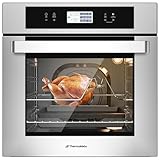
ThermoMate 24″ 2.6 Cu.Ft. with 12 Functions and 3D Heating
The ThermoMate is the spec-sheet king at $599.99. Twelve functions, 3D heating, 3100 watts, sensor touch controls, a child safety lock, and ETL certification give it the broadest capability envelope in this group. The 2.6-cubic-foot cavity is mid-range for capacity but the 3D heating system compensates by circulating air from multiple vectors. Owners who cook diverse dishes — from frozen meals to slow-roasted proteins — report the most consistent results here.
- Highest wattage (3100W) and most cooking functions for varied meal prep
- ETL certification and safety lock appeal to households with children
- Touch-panel interface has a learning curve and is less intuitive than knobs
If you bake the same three things weekly, the added complexity and $200 over the AMZCHEF 2.5 are wasted.
VIKIO HOME 24″ 2.83 Cu.Ft. Mechanical Knob Control
For buyers who distrust electronics, the VIKIO HOME at $396.09 is the largest-capacity option (2.83 cubic feet) with the simplest interface: mechanical knobs for temperature and mode selection. Eight cooking functions exist but are selected via rotary dial rather than touch. The low price and high volume make it appealing for landlords, accessory dwelling units, or anyone who wants no circuit board between them and their roast chicken.
- Largest interior capacity on this list at 2.83 cu ft
- Mechanical controls eliminate electronic failure points and ghost-input issues
- Temperature dial precision is coarser than digital panels, making tight-range baking harder
Skip this if you need precise 10-degree increments or programmable timers.
AMZCHEF 24″ 2.65 Cu.Ft. 5 Modes
Another AMZCHEF variant, this one trades the convection fan for a five-mode setup (bake, broil, convection bake, convection roast, and defrost) in a 2.65-cubic-foot cavity at $399.99. It shares the same price as the 2.72 model but offers a different feature mix. Owners like the reduced complexity — fewer modes mean fewer confusion points for households with multiple cooks. The stainless front and standard 24-inch footprint fit existing cutouts.
- Five modes cover 90 percent of home cooking without feature overload
- 2.65 cu ft splits the difference between the 2.5 and 2.83 competitors
- No dedicated pizza or ferment cycle limits niche use cases
Choose the 2.72-cu-ft AMZCHEF instead if interior height is your priority at the same price.
Empava 24″ 2.3 Cu.Ft. Convection
The smallest oven here at 2.3 cubic feet and $492.20, this Empava is designed for kitchens where the 24-inch width is available but a shallower cavity fits the counter geometry better. Convection is standard. Owners in European-style or extremely tight galley layouts appreciate that the reduced depth leaves more clearance behind the oven for wiring and gas lines (if venting adjacent). Heat distribution is good for its size.
- Shallower cavity provides installation flexibility in constrained cabinetry
- Convection fan compensates for reduced volume with rapid air cycling
- 2.3 cu ft cannot accommodate full-size sheet pans without rotation
Unless your cabinet depth is the binding constraint, any of the 2.5-cu-ft options are better values.
Buying Guide
Interior Capacity: Volume Versus Usable Space
Published cubic-footage numbers include the walls, light housing, and fan assembly. A 2.5-cu-ft oven with a flat floor and square walls fits more food than a 2.83-cu-ft oven with curved corners and a protruding rear fan shroud. Always check whether a standard half-sheet pan (18×13 inches) fits flat. If your baking is limited to 12-inch pizzas and loaf pans, the smaller 2.3-cu-ft Empava saves cabinet depth without sacrificing utility.
Power and Heating Design
Wattage alone is a weak predictor of baking quality. A 2800W single-element convection oven can outperform a 3100W unit with poor airflow. What matters is whether the oven uses multiple heating elements (top, bottom, rear ring) and whether the fan is axial or tangential. The ThermoMate’s “3D heating” claim refers to rear and side element combinations — verify owner photos confirm the layout before paying the premium.
Control Interface: Mechanical Versus Electronic
Mechanical knobs are immune to steam-induced ghost inputs and are easier to adjust while wearing oven mitts. Touch panels enable precise temperature targeting (±5°F) and programmable timers but introduce a circuit board that can fail in high-humidity environments. If your kitchen layout places the oven next to a boiling stockpot or a wet prep zone, mechanical controls reduce one failure mode. For precision bakers, digital panels are worth the trade-off.
Our Verdict
Our top pick is the AMZCHEF 24″ 2.5 Cu.Ft. Convection at $429.99. It delivers even heating, a practical interior, and a reliable interface at a price that leaves budget for a quality stone or a better pan set. The best value is the AMZCHEF 24″ 2.72 Cu.Ft. at $399.99 — the most capacity per dollar in this group, with the same 2800W convection motor. The condition under which the ThermoMate wins outright: you cook a wide variety of dishes weekly and need the safety lock, ETL certification, and twelve-function flexibility for a household that runs the oven daily.
FAQ
Can I install a 24-inch wall oven in a standard 27-inch cutout?
A 24-inch oven will fit inside a 27-inch opening but leaves a visible three-inch gap that requires trim panels or filler strips. These are inexpensive but must be rated for heat exposure. The reverse — a 27-inch oven in a 24-inch cutout — is not possible without cutting cabinetry.
Do single wall ovens need a dedicated circuit?
Yes. All eight models here draw between 2800 and 3100 watts, requiring a dedicated 20-amp or 30-amp circuit depending on the manufacturer’s wiring spec. Running one on a shared kitchen circuit will trip the breaker during preheat. Check the label on the oven’s rear before an electrician quotes the job.
Is convection worth the extra cost over a conventional bake-only oven?
For most home cooking, yes. Convection reduces bake times by roughly 10 to 15 percent and eliminates the need to rotate pans between upper and lower racks. The AMZCHEF and Empava models on this list include convection at prices under $500, making a conventional-only oven hard to justify unless you only toast or broil.
How long should a budget single wall oven last?
Expect five to eight years of daily use from ovens in the $400-$600 range before a heating element, fan motor, or control board fails. Stainless housings resist cosmetic wear better than painted interiors, but the internal coating on budget units may need re-seasoning after two years. Owners who clean spills promptly report significantly longer element life.



Write Your Review
No reviews yet. Be the first to share your experience!