
Key takeaways
- Bagel: heats the cut side more strongly while warming the outer side more gently.
- Defrost: adds time for frozen bread.
- Reheat: warms toast without restarting a full browning cycle.
- Cancel: stops the cycle immediately.
Choosing a toaster is easy until you discover that “wide slot” can mean different things from one model to another. Some toasters accept thick bakery bread but struggle with long sourdough slices. Others have two long slots that fit four standard slices, yet take up more counter depth than expected. Buyers also commonly compare only the number of slices, overlook the toaster’s actual exterior dimensions, or assume a higher wattage guarantees more even browning.
The most useful starting point is the question: what slot width to look for in a toaster? For everyday sandwich bread, about 1.25 inches is usually sufficient. For bagels, Texas toast, English muffins, thick-cut artisan bread, and homemade slices, look for slots measuring at least 1.5 inches wide. If you regularly toast unusually thick bread, a 1.6- to 1.7-inch opening gives you more practical clearance, provided the heating elements and carriage can handle the food safely.
Our top picks
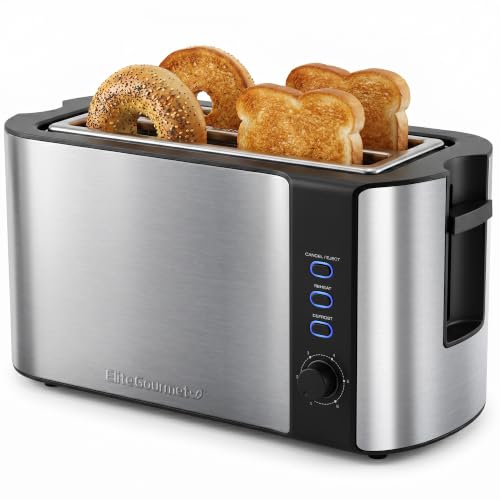

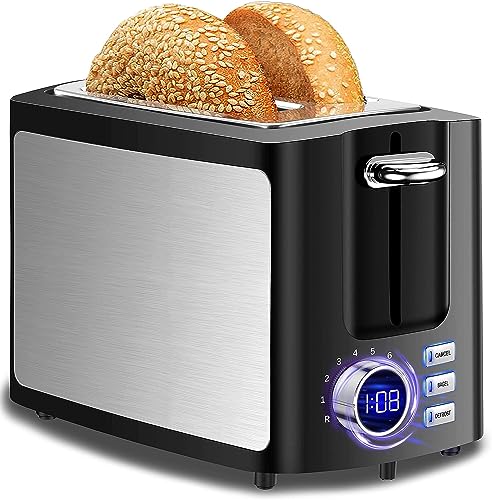

As an Amazon Associate we earn from qualifying purchases at no extra cost to you. Ratings are shown as listed on Amazon.
This 2026 buying guide explains which dimensions matter, how much power is appropriate, and what to expect at different prices. The goal is not to buy the largest toaster available, but to match slot size and overall design to your bread, counter, and morning routine.
Decide These 3 Things First
- What will you toast most often? Standard sliced bread generally works with 1.25- to 1.4-inch slots. Thick bagels, Texas toast, waffles, and bakery bread are better suited to 1.5 inches or wider. For long slices, look for a slot length of roughly 5.5 to 6 inches.
- How much counter space can you spare? A compact two-slice toaster may be about 10 to 12 inches wide, 6 to 7 inches deep, and 7 to 8 inches tall. Four-slice and long-slot models commonly run 12 to 16 inches wide and 7 to 8.5 inches deep. Measure with the lever fully raised and leave at least 4 inches above the toaster for ventilation and access.
- How much control do you need? A simple toaster with six shade settings may be adequate for one type of bread. If household members prefer different browning levels, choose independent controls, separate cancel buttons, and dedicated bagel and defrost functions.
Size: Measure the Slots and the Toaster
Slot width is only one part of usable capacity. Check the opening’s width, length, and depth, because a broad but short slot may not accommodate a full slice of sourdough. A useful general target is 1.5 inches wide by 5.5 inches long. Long-slot toasters may measure about 10 to 12 inches internally, allowing one long slice or two standard slices in each slot.
Two-slice long-slot designs are often a smart choice for couples or small kitchens. They can toast four narrow slices in some configurations while occupying less front-to-back space than a traditional four-slice toaster. A conventional four-slice toaster, however, is more convenient when several people need toast at once.
Check the outside dimensions, not just the product category. Typical weights range from 2.5 to 5 pounds for compact models and 4 to 7 pounds for larger stainless-steel or feature-heavy models. A lightweight toaster is easier to store, but a heavier base is often less likely to slide when you press the lever.
Material: Choose Surfaces That Suit Your Kitchen
Stainless steel, painted metal, and plastic are the most common exterior materials. Stainless steel can provide a substantial feel and usually resists discoloration, but it shows fingerprints and may become warm during use. Painted steel offers more color options and can be easier to wipe clean. Plastic-bodied models are often lighter and less expensive, though quality varies significantly.
The important distinction is between the exterior shell and the parts exposed to heat. Look for a cool-touch or insulated body, especially if children use the kitchen. Regardless of the casing, keep the toaster several inches away from curtains, cabinets, and other heat-sensitive surfaces. Do not choose a toaster solely because its exterior looks premium; the slot guides, lever, crumb tray, and cord storage affect daily usability more.
Construction: Inspect the Details That Affect Longevity
A well-built toaster should sit flat, have a lever that moves smoothly, and hold bread securely without requiring excessive force. Slot guides should center small and thick slices rather than allowing them to lean against one heating side. A removable crumb tray is essential; a tray that covers the full base is easier to empty than a small partial drawer.
Look for a cord length of approximately 24 to 36 inches, along with a cord-wrap area underneath. A shorter cord may limit placement, while an excessively loose cord creates clutter near the appliance. A raised-lift feature is useful for English muffins and smaller slices: it should raise the food high enough to remove it without reaching into the slot.
Four-slice models should ideally have two independent pairs of controls. This lets you toast white bread lightly while browning a bagel more deeply. If all four slots share one timer, the toaster may be less flexible for a mixed household.
Comfort and Performance: Focus on Control, Not Just Wattage
Most two-slice toasters use about 750 to 1,000 watts. Four-slice models commonly use 1,400 to 1,800 watts. Higher wattage can shorten heating time, but it does not automatically produce more even browning. Element placement, bread centering, timer calibration, and the selected shade setting matter just as much.
Six to seven browning settings provide enough range for most households. Digital displays may show a countdown, but a display is not a substitute for independent controls or clear markings. Useful functions include:
- Bagel: heats the cut side more strongly while warming the outer side more gently.
- Defrost: adds time for frozen bread.
- Reheat: warms toast without restarting a full browning cycle.
- Cancel: stops the cycle immediately.
For most kitchens, a toaster that finishes a cycle in roughly 2 to 4 minutes is practical. Actual time depends on bread thickness, moisture, starting temperature, and shade selection. Never treat a longer cycle as proof of poor performance without considering those variables.
Price Tiers: Spend for Capacity and Controls
Budget toasters generally cost about $20 to $40. In this range, you can find two-slice wide-slot models and basic four-slice or long-slot designs. Example products such as a $22.49 slim two-slice model, a $26.99 wide-slot toaster, and a $33.99 long-slot model illustrate the typical entry-level range. Expect plastic or mixed construction, six shade settings, and a limited feature set.
Midrange models usually cost $40 to $80. They may offer more consistent slot guides, sturdier levers, better crumb trays, independent four-slice controls, and a more substantial exterior. This tier makes sense if the toaster is used every day or if your household frequently switches between ordinary bread, bagels, and thick slices.
Premium models often begin around $80 and can exceed $150. You are primarily paying for finish, controls, design refinement, longer coverage, or specialized programs. Premium pricing is not automatically justified if you only toast standard bread once a week. A $34.99 extra-wide four-slice long-slot model may meet your needs better than an expensive appliance with features you will not use.
Warranty: Compare Coverage With the Price
Look for at least a one-year limited warranty on a budget toaster. A two-year warranty is more reassuring for a frequently used appliance, while some premium brands offer longer coverage. Read what the warranty excludes: cosmetic damage, misuse, commercial use, and damage caused by cleaning are common limitations.
Save the receipt and record the model number, usually found on a label underneath the toaster. A warranty is most useful when the manufacturer provides a clear replacement process and does not require you to pay disproportionate shipping costs. Also check whether the warranty applies to the original purchaser only.
Delivery and Assembly: Small Appliances Still Need Planning
Toasters require no assembly, but delivery details can affect the buying experience. Confirm that the package includes the toaster, crumb tray, and any instruction material before disposing of the box. Check the delivered dimensions if your toaster will sit inside a cabinet or appliance garage.
For online purchases, compare the total price after shipping and taxes, not just the listed price. A $30 toaster with a $10 delivery charge may not be a better value than a $35 model with free delivery. Inspect the housing, lever, cord, and slots as soon as it arrives. Return it if the body is cracked, the lever sticks, or the heating elements appear damaged. Do not test a visibly damaged toaster.
Spec Checklist
| Spec | Budget | Mid | Premium |
|---|---|---|---|
| Typical price | $20–$40 | $40–$80 | $80–$150+ |
| Slot width | 1.25–1.5 in. | 1.4–1.6 in. | 1.5–1.7 in. |
| Slot length | 5–6 in. | 5.5–6.5 in. | 6–12 in., depending on design |
| Power | 750–1,500 W | 800–1,800 W | 900–1,800 W |
| Browning settings | 5–6 | 6–7 | 6–9 or digital control |
| Controls | Cancel; sometimes bagel or defrost | Bagel, defrost, reheat, cancel | Independent controls and specialty programs |
| Warranty target | At least 1 year | 1–2 years | 2 years or more |
Red Flags
- A listing says “wide slot” but does not state the opening measurement.
- The product dimensions omit the height or do not account for the raised lever.
- A four-slice toaster has only one control set, limiting different browning levels.
- The crumb tray is not removable or is too small to cover the heating chamber.
- The toaster is unusually light and slides when the lever is pressed.
- There is no clear warranty, return window, manufacturer contact information, or model number.
- Marketing emphasizes wattage or a display without explaining slot dimensions and functions.
- The cord, housing, or lever arrives damaged. Do not continue using an appliance with visible electrical or mechanical damage.
FAQ
What slot width is best for most people?
A 1.5-inch slot is the most versatile target for many households. It accommodates standard bread, thicker slices, bagels, and most Texas toast without making the toaster excessively large. If you mainly eat ordinary sandwich bread, a 1.25- to 1.4-inch opening may be enough.
Are long slots better than four separate slots?
Neither design is universally better. Long slots are useful for sourdough, baguette-style slices, and compact kitchens because one slot may accept a long piece of bread. Four separate slots are more convenient when four standard slices need to be toasted simultaneously or when two pairs need different settings.
How many watts should a toaster have?
Choose roughly 750 to 1,000 watts for a two-slice toaster and 1,400 to 1,800 watts for a four-slice model. These ranges are appropriate for typical home use, but wattage alone does not predict browning quality. Slot guides, heating-element layout, controls, and the timer are equally important.
Can a wide-slot toaster toast thin bread?
Yes, provided the internal guides center the slice. Check reviews and product information for adjustable or self-centering slots. Thin bread should sit away from the heating elements rather than leaning against one side. A high-lift lever also makes small slices safer and easier to remove.




Write Your Review
No reviews yet. Be the first to share your experience!