
Key takeaways
- The listing gives a quart capacity but no exterior dimensions, weight, or minimum liquid requirement.
- The product calls itself a pressure canner without clearly stating which foods and jar sizes it supports.
- The lid has no visible locking indicator, pressure indicator, or automatic safety release.
- Replacement sealing rings and valves are unavailable or difficult to identify by model number.
- The seller promises dramatically faster cooking without explaining that heating and pressure-release time are separate.
- Reviews repeatedly mention warped inserts, leaking lids, error codes, or steam escaping around the rim.
- The cooker is too tall to open safely beneath your cabinets or too heavy to move when full.
Choosing an electric pressure cooker by quart size sounds simple until you discover that the advertised capacity is not the same as the amount of food you can safely cook. A cooker labeled 8 quarts does not give you 8 quarts of usable space, and an oversized model can waste counter space, electricity, and storage room when you usually cook for two.
The most common mistakes are buying based only on household size, treating “serves” claims as exact, and confusing a pressure cooker with a pressure canner. Buyers also overlook pot diameter, appliance height, minimum liquid requirements, and the weight of a full removable insert. Use the following guide to match capacity with your meals, kitchen, and budget.
Our top picks


As an Amazon Associate we earn from qualifying purchases at no extra cost to you. Ratings are shown as listed on Amazon.
Decide These 3 Things First
- How many people do you normally feed? A 3- to 4-quart cooker suits one or two people, while a 6-quart model is the most flexible choice for two to four servings. Choose 8 quarts or more for large families, batch cooking, or frequent entertaining.
- What will you cook most often? Soups, beans, chili, rice, and shredded meat need less space than whole chickens, large roasts, or multiple meal-prep portions. If you plan to cook bulky ingredients, prioritize pot diameter as well as quart capacity.
- Will you pressure cook, or pressure can? A multicooker may pressure cook food but not be approved for low-acid canning. Pressure canners are specialized appliances with different controls, capacities, and safety requirements. Do not select a canner simply because it has more quarts.
Size: Match Quart Capacity to Your Actual Cooking
For most homes, 6 quarts is the practical starting point. It typically holds about four to six servings of soup, stew, beans, or rice, although you must follow the fill lines. A 6-quart pot is also large enough for many whole chickens and common meal-prep recipes without becoming excessively bulky.
A 3- or 4-quart cooker is better for one or two people, side dishes, oatmeal, small batches of beans, and kitchens with limited storage. Its smaller footprint often measures roughly 11 to 13 inches wide and 10 to 12 inches tall, depending on the lid and controls.
Move to 8 quarts when you regularly feed four to six people, freeze portions, or cook large cuts of meat. Many 8-quart models are approximately 13 to 15 inches wide, 13 to 16 inches deep, and 13 to 16 inches tall. Check the height under cabinets before ordering.
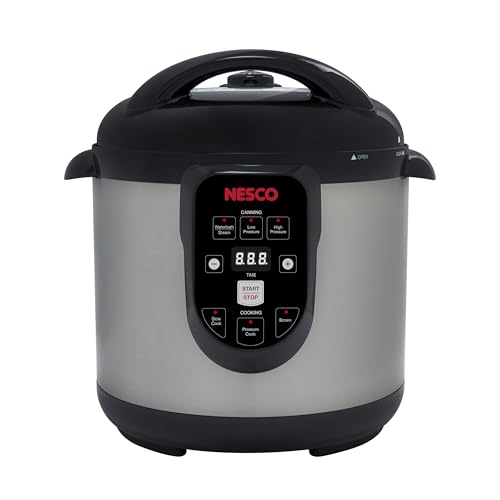
Models above 9 quarts are useful for large households and preservation work but are not automatically better. A 9.5-quart electric canner, such as the NESCO example, is a different proposition from an 8-quart countertop multicooker. A 23-quart digital pressure canner, such as the Presto example, may weigh more than 15 pounds before food and require substantial storage space. Also remember that pressure cookers generally should not be filled beyond two-thirds full, or one-half full for foods that expand, such as beans, grains, and pasta.
Material: Choose the Insert for Your Cooking Habits
Stainless steel is the most versatile insert material. A 6- or 8-quart stainless-steel pot typically weighs several pounds, resists scratching, and is suitable for browning, soups, stocks, and acidic ingredients. It may require more stirring to prevent sticking, but discoloration can usually be cleaned with ordinary kitchen products.
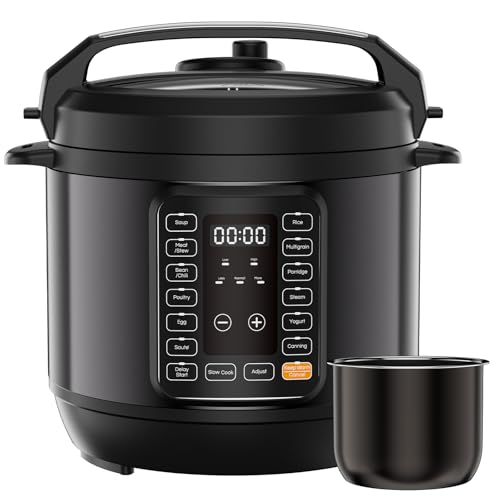
Nonstick inserts are convenient for rice, eggs, oatmeal, and quick cleanup. They are often lighter and less expensive, but the coating can eventually wear if you use metal utensils, abrasive cleaners, or stack accessories inside the pot. A ceramic-coated insert offers a similar low-stick advantage, as seen in some budget 8-quart models, but it still needs careful handling.
Look for a removable inner pot with clear maximum-fill markings and a flat base. A pot that is dishwasher-safe can save time, but confirm whether the manufacturer recommends hand-washing the lid, sealing ring, and pressure valve. Replacement sealing rings should be available separately; they are consumable parts rather than permanent components.
Construction: Evaluate the Lid, Base, and Safety Hardware
A reliable cooker should have a heavy, stable housing that does not flex when you lift the lid or insert. The outer shell may be plastic or stainless steel, but the cooker should sit firmly on nonslip feet. A 6-quart appliance commonly weighs about 10 to 15 pounds empty; an 8-quart model may weigh 12 to 18 pounds.
Inspect the lid mechanism before buying. The handle should be easy to grip, the locking indicator should be visible, and the lid should not feel loose when closed. Essential safety features include automatic pressure release protection, a lid lock while pressure remains, overheating protection, and a float valve or equivalent pressure indicator.
Construction also affects storage. Hinged lids are convenient but need more clearance around the appliance. Removable lids may be easier to wash but can be awkward to store. Measure the cooker with the lid open, not just the dimensions printed for the base.
Comfort and Performance: Look Beyond Preset Counts
“16-in-1” or “12 preset” labels sound impressive, but preset quantity does not guarantee better cooking. Prioritize controls that let you adjust pressure level, cooking time, temperature, delay start, and keep-warm duration. A large, readable display and buttons that can be understood without the manual are more useful than rarely used programs.
Wattage generally falls between 700 and 1,200 watts for home electric pressure cookers. Smaller 3- or 4-quart models may use about 700 to 900 watts, while many 6- and 8-quart units use 1,000 to 1,200 watts. Higher wattage can help the cooker heat a full pot, but it does not by itself prove faster pressure cooking or better results.
Allow for a natural pressure release when planning dinner. The recipe’s stated cooking time may exclude the 10 to 30 minutes needed for the cooker to reach pressure and release it. A quiet steam-release system, clear pressure indicator, and easy-to-clean condensation collector can make more difference in daily use than another preset.
Price Tiers: Pay for Capacity and Features You Will Use
Budget electric pressure cookers usually cost about $50 to $90. In this range, expect 6- to 8-quart capacities, roughly 700 to 1,000 watts, basic digital controls, and a nonstick or stainless insert. The DUMOS 8-quart example is listed around $59.91, while the COMFEE’ 8-quart example is around $92.99. Prices can change, so use them as category references rather than fixed targets.
Midrange cookers generally cost $90 to $180. They may offer sturdier construction, better displays, stainless-steel inserts, more precise programs, improved steam release, and easier access to replacement parts. The NESCO 9.5-quart pressure canner example is around $148, but its specialized preservation function makes it unsuitable as a direct comparison with a standard multicooker.
Premium or specialized appliances cost about $180 to $400 or more. This tier includes large-capacity canners, stronger materials, advanced controls, and dedicated preservation features. The Presto 23-quart digital pressure canner example is listed around $393.86. Buy this tier for a defined need, such as pressure canning, not simply because a larger number appears on the box.
Warranty: Check What Is Actually Covered
A one-year limited warranty is common, while two- or three-year coverage is more reassuring for a frequently used appliance. Read whether the warranty covers the heating base, control board, lid, inner pot, sealing ring, and pressure valve. Accessories and normal wear parts may be excluded.
Confirm that customer service can supply a replacement sealing ring, condensation cup, steam-release component, and inner pot. A cooker is difficult to justify if a $10 or $20 wear part makes the entire appliance unusable. Keep the receipt and record the model number, which is often printed on the bottom or rear label.
Delivery and Assembly: Plan for a Heavy, Tall Appliance
Most electric pressure cookers arrive assembled, but you will need to wash the insert, lid, sealing ring, and accessories before first use. Allow at least 6 inches of clearance around the steam-release area and keep the appliance away from overhead cabinets, unless the manual specifies otherwise.
For delivery, verify the shipping box dimensions and package weight rather than relying only on the appliance dimensions. A large canner may arrive in a box over 20 inches long and weigh more than 20 pounds. Check the appliance immediately for dents, a cracked lid, missing parts, or a warped insert. Never operate a damaged pressure vessel.
Spec Checklist
| Spec | Budget | Mid | Premium |
|---|---|---|---|
| Typical price | $50–$90 | $90–$180 | $180–$400+ |
| Useful capacity | 4–8 quarts | 6–9.5 quarts | 8–23 quarts, often specialized |
| Typical wattage | 700–1,000 watts | 900–1,200 watts | 1,000–1,500 watts, depending on type |
| Insert material | Nonstick or basic stainless steel | Stainless steel or ceramic-coated | Heavy stainless steel or specialized canning vessel |
| Empty appliance weight | 9–14 pounds | 11–18 pounds | 15–25+ pounds |
| Warranty target | 1 year | 1–2 years | 2–3 years |
Red Flags
- The listing gives a quart capacity but no exterior dimensions, weight, or minimum liquid requirement.
- The product calls itself a pressure canner without clearly stating which foods and jar sizes it supports.
- The lid has no visible locking indicator, pressure indicator, or automatic safety release.
- Replacement sealing rings and valves are unavailable or difficult to identify by model number.
- The seller promises dramatically faster cooking without explaining that heating and pressure-release time are separate.
- Reviews repeatedly mention warped inserts, leaking lids, error codes, or steam escaping around the rim.
- The cooker is too tall to open safely beneath your cabinets or too heavy to move when full.
FAQ
What quart size is best for two people?
A 3- to 4-quart cooker is adequate for small portions, but a 6-quart model is usually more versatile. Choose 6 quarts if you want leftovers, meal prep, or the option to cook a whole chicken or larger batch of beans.
Is an 8-quart pressure cooker better than a 6-quart model?
Only if you need the additional capacity. An 8-quart cooker is useful for four to six people, batch cooking, and bulky ingredients, but it takes more counter and storage space. For everyday meals for two to four people, 6 quarts is often easier to handle.
Can I use any electric pressure cooker for pressure canning?
No. Pressure cooking and pressure canning are not interchangeable. Use a model specifically designed and documented for pressure canning, and follow current tested canning directions. A standard multicooker may be appropriate for cooking food but not for preserving low-acid foods in jars.
How much food can I put in a pressure cooker?
Follow the marked fill lines and the manual. As a general safety rule, do not fill above two-thirds full, and limit expanding foods such as beans, grains, and pasta to one-half full. Leave enough room for steam to circulate and for food to expand without blocking the pressure-release system.




Write Your Review
No reviews yet. Be the first to share your experience!