
Key takeaways
- Best Wall-Mount Paper Towel Holders The best wall mount paper towel holder for most kitchens is a screw-mounted stainless-steel or reinforced-plastic model with an adjustable roll arm, at least 3 inches of wall clearance, and a one-handed tear feature; choose…
Best Wall-Mount Paper Towel Holders
The best wall mount paper towel holder for most kitchens is a screw-mounted stainless-steel or reinforced-plastic model with an adjustable roll arm, at least 3 inches of wall clearance, and a one-handed tear feature; choose an adhesive model only for light-duty use on a smooth, clean surface.
Quick recommendations by situation
| Kitchen situation | Best holder type | Why it fits | Typical budget |
|---|---|---|---|
| Renting or avoiding holes | Adhesive-mounted plastic or stainless steel | Fast installation and easy removal, but limited load capacity | $15–$35 |
| Frequent cooking and large rolls | Screw-mounted metal with adjustable arm | Most stable, better roll compatibility, reliable one-handed tearing | $25–$60 |
| Cabinet side or narrow backsplash | Compact vertical wall mount | Uses less horizontal space and keeps the roll away from the counter | $15–$40 |
| Humid kitchen or utility room | 304 stainless steel | Resists surface rust and tolerates repeated wiping | $30–$70 |
| Lowest-cost option | Adhesive plastic with a simple spindle | Inexpensive and lightweight, but less durable under repeated pulling | $10–$25 |
Mounting methods compared
Screw-mounted holders: the dependable choice
Screw mounting is the strongest option for a busy kitchen. It is appropriate for drywall when installed with suitable anchors, solid wood, tile with the correct drill bit, or the side of a cabinet. A properly installed holder can usually support a full paper towel roll weighing about 1.5 to 3 pounds, including the holder itself.
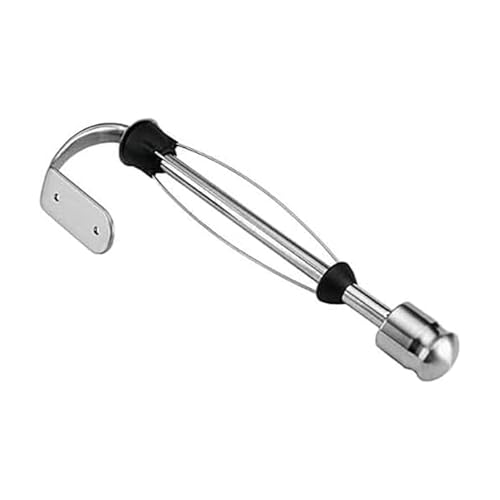
Kamenstein Perfect Tear Ratchet Paper Towel Holder Wall Mount Aluminum
Included for 'Best Wall-Mount Paper Towel Holders' as a relevant option in this category; details come from the product listing.
View on Amazon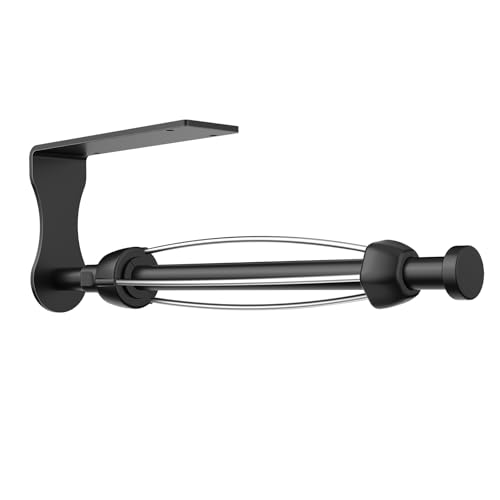
SetSail Paper Towel Holder, Single Hand Operable Paper Towel Holder Under Cabinet with Adjustable Damper, Easy Tear, Wall Mount, Self-Adhesive or Drilled for Kitchen Bathroom, Black
Included for 'Best Wall-Mount Paper Towel Holders' because the listing specifies Easy Tear and Wall Mount, details this guide uses to compare options.
View on Amazon
FISHCLOUD Paper Towel Holder Wall Mount - Self Adhesive No Drill or Drilling, SUS304 Stainless Steel - Kitchen, Bathroom, Sink, Pantry, Fridge(Black)
Included for 'Best Wall-Mount Paper Towel Holders' because the listing specifies Self Adhesive No Drill or Drilling and SUS304 Stainless Steel, details this guide uses to compare options.
View on Amazon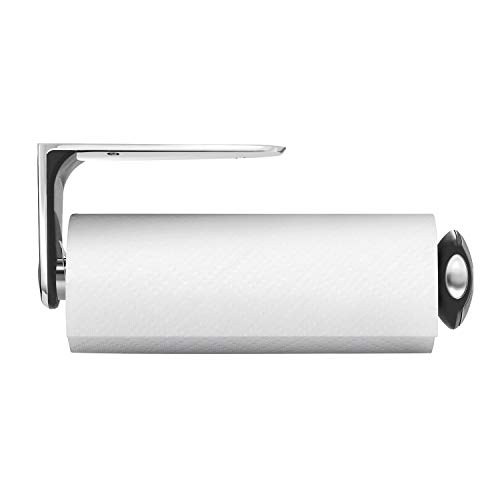
simplehuman Wall Mount Paper Towel Holder, Under-Cabinet or Wall Mounted Rack, Horizontal or Vertical Install, One-Handed Tear with Tension Spring, Quick-Release Knob, Brushed Stainless Steel
Included for 'Best Wall-Mount Paper Towel Holders' because the listing specifies Under-Cabinet or Wall Mounted Rack and Horizontal or Vertical Install, details this guide uses to compare options.
View on AmazonThe main advantage is not just weight capacity. A rigid base prevents the holder from twisting when you tear a sheet with one hand. Look for two mounting points spaced at least 1.5 inches apart rather than a single central screw. Two points reduce rotation and spread the pulling force across the wall.
Adhesive-mounted holders: convenient but surface-dependent
Adhesive holders work well on smooth, sealed surfaces such as glass, finished tile, metal, and glossy laminate. They are less reliable on painted drywall, textured tile, unfinished wood, dusty surfaces, or areas exposed to steam. The adhesive may hold the stationary holder but fail when a tight roll creates repeated sideways pulling.
Adhesive capacity varies widely, but a practical limit is about 1 to 2 pounds of total supported weight unless the manufacturer specifies otherwise. This can be enough for a compact roll, but it leaves little margin for a heavy jumbo roll. Clean the surface with an appropriate degreaser, let it dry fully, press firmly, and wait for the recommended curing period before loading the holder.
Suction and over-cabinet alternatives
Suction mounts are best reserved for smooth, nonporous surfaces and occasional use. Temperature changes and grease can weaken the seal. Over-cabinet models avoid drilling, but they can interfere with cabinet doors and usually provide less stable one-handed tearing. These are useful when installation is temporary, not when the holder will be pulled dozens of times per day.
Head-to-head: the features that affect daily use
| Feature | Good target | Why it matters |
|---|---|---|
| Roll width | Up to 11–12 inches | Fits most standard household rolls without rubbing against the wall |
| Roll diameter | At least 5 inches | Accommodates many full rolls; larger commercial-style rolls need more |
| Wall clearance | 3–4 inches from the wall | Prevents the roll from scraping the backsplash or nearby cabinet |
| Base width | At least 2.5 inches | Creates better leverage during one-handed tearing |
| Supported load | 2 pounds or more | Leaves a useful safety margin for a full, dense roll |
| Spindle diameter | About 1–1.25 inches | Works with most rolls while reducing excessive wobble |
One-handed tearing: what actually works
A one-handed tear depends on friction, rigidity, and the direction of the sheet. A holder with a weighted or rubberized base is more stable than a lightweight open frame. A spring-loaded tension arm or a slightly raised retaining bar adds resistance, allowing the sheet to separate instead of spinning the whole roll.
Be cautious with holders that grip too tightly. Excessive tension can rip thin paper unevenly, pull adhesive mounts from the wall, or make the roll difficult to rotate. Adjustable tension is preferable because a new full roll needs more control than a nearly empty roll.
For the most predictable tear, mount the holder so the paper feeds from the front or underside and the tearing edge is approximately 30–36 inches above the floor. This keeps the roll accessible without forcing you to reach over a hot pan or wet counter.
Stainless steel versus plastic durability
Stainless steel
Stainless steel is the better long-term material for a holder near a sink or cooking area. A 304 stainless-steel body resists everyday moisture, fingerprints, and repeated cleaning better than plated mild steel. Brushed finishes generally hide fine scratches more effectively than mirror-polished finishes.
Steel can still develop staining or rust-like marks if salt, harsh cleaners, or trapped moisture remain on the surface. Wipe it dry after cleaning, and avoid chlorine-based products unless the manufacturer specifically permits them. The first parts to wear are often the spindle end caps, rubber feet, adhesive pad, or spring—not the steel body itself.
Plastic
Reinforced ABS or similarly rigid plastic can be a sensible choice for a lighter roll. It will not rust, costs less, and is often easier to clean. Its weaknesses are flexing around the mounting points, cracking after repeated impact, and discoloration from sunlight or strong cleaners.
Choose plastic with a broad backplate and thick mounting ears. Very thin plastic frames may work when mounted under a cabinet, but they are more likely to twist during one-handed tearing on a wall.
Check clearance before buying
Measure the wall area rather than relying on the product’s overall width alone. Use this simple fit calculation:
Required horizontal space = roll width + 2 inches of side clearance.
For a 12-inch-wide roll, plan for at least 14 inches of unobstructed width. For depth, add the roll radius to the holder’s projection. A roll with a 5-inch diameter extends about 2.5 inches from its spindle; with a 1.5-inch holder projection, the front of the roll will sit about 4 inches from the wall.
Leave at least 1 inch from the nearest cabinet edge and avoid placing the roll where it can touch a cooktop, sink faucet, or backsplash seam. A holder that is technically compatible can still be annoying if the roll blocks a door or becomes damp from splashing.
Installation steps that prevent common failures
- Load a representative roll before marking the wall. Use the largest roll you expect to buy, not the smallest roll currently in the kitchen.
- Confirm the opening direction. Make sure the paper can be torn with your dominant hand without reaching across the cooking area.
- Mark both mounting points. Use a level and check for studs, plumbing, and electrical wiring before drilling.
- Use the correct fastener. Wood screws suit a cabinet or stud; drywall anchors are necessary where there is no solid backing; tile requires a tile-rated bit and appropriate anchor.
- Tighten until stable, not crushed. Over-tightening can deform plastic backplates or damage tile and drywall.
- For adhesive models, clean and cure. Remove grease, dry the surface, apply even pressure, and wait the full curing time before adding a roll.
- Test with a nearly full roll. Pull several sheets at different angles. If the base moves, improve the mounting before daily use.
Ownership costs and maintenance
The consumable cost is dominated by the paper, not the holder. For example, if a roll contains 100 sheets and costs $2.50, each sheet costs $0.025. A $35 holder used for 1,400 sheets adds only $0.025 per sheet if its cost is spread over 1,400 uses; after that, its cost per use falls below two cents. This is why a stable holder that reduces accidental tearing can be more economical than a cheaper model that wastes sheets.
Once a week, remove the roll and wipe the spindle, tension bar, and backplate. Paper dust collects around moving joints and can increase friction. Do not soak adhesive-mounted holders, and do not use abrasive pads on brushed metal. Replace a worn rubber tension strip or cracked spindle end cap when available; otherwise, replacing the holder is safer than accepting a roll that repeatedly falls or jams.
Bottom line
Choose a screw-mounted 304 stainless-steel holder with two mounting points, 3–4 inches of clearance, a 2-pound-or-greater capacity, and adjustable tension if you cook frequently or use large rolls. Choose reinforced plastic when low weight, low price, and rust-free cleaning matter most. Choose adhesive mounting only when the surface is smooth and the roll is light. The best wall mount paper towel holder is the one whose mounting method matches the wall, whose clearance matches the roll, and whose tension lets you tear cleanly without moving the base.





Write Your Review
No reviews yet. Be the first to share your experience!