
Key takeaways
- Measure the destination. Record usable width, depth, and height. For a drawer, check its interior with the drawer fully closed; for a cabinet door, check clearance with the door swinging shut.
- Count the jars you actually use. Add a little room for future additions rather than buying a rack based on a theoretical maximum capacity.
- Check loaded stability. Place heavier jars on lower tiers where possible. For mounted racks, follow the specified load limit and use the recommended fixing method.
- Clean according to the material. Wipe metal, wood, or plastic with a lightly damp cloth and dry thoroughly. Avoid soaking wooden racks or using abrasive cleaners that can damage coatings.
- Recheck fasteners and moving parts. Tighten loose hardware as directed, and keep carousel bases clear of crumbs. On door-mounted racks, confirm that jars remain seated after opening and closing the door.
Best Spice Racks for an Organized Kitchen
The best spice racks for a kitchen are the ones that fit your actual storage space and hold your jars securely: choose a tiered countertop rack for easy access, an expandable drawer insert for a shallow drawer, a cabinet-door rack when shelf space is limited, or a wall-mounted rack when you can install it safely. Before buying, measure the usable footprint, check jar compatibility, and count the spices you reach for regularly.
Choose by where the rack will live
Countertop: best for frequent cooking
A countertop rack keeps everyday seasonings visible and close to the cooking area. Tiered shelves make jars at the back easier to read, but the rack occupies permanent counter space and can collect grease near the stove. Leave some clearance from heat and splashes, and check that the base fits without blocking prep space.
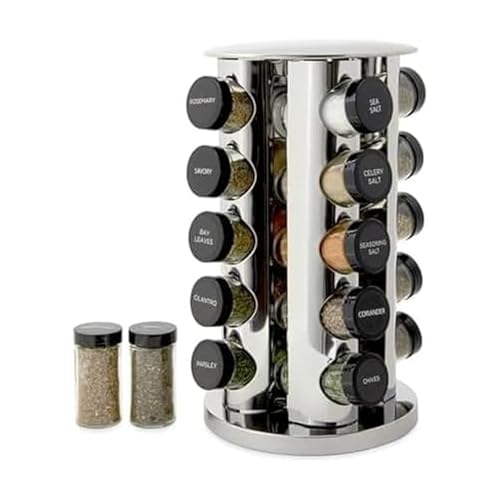
Kamenstein 20 Jar Revolving Countertop Spice Rack with Spices Included, FREE Spice Refills for 5 Years, Polished Stainless Steel with Black Caps, 30020
Included for 'Best Spice Racks for an Organized Kitchen' because the listing specifies FREE Spice Refills for 5 Years and Polished Stainless Steel with Black Caps, details this guide uses to compare options.
View on Amazon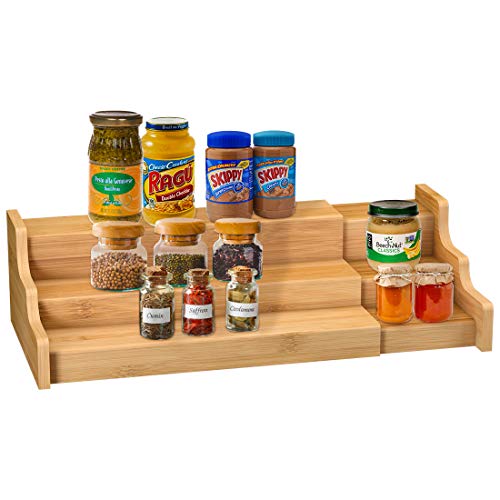
Spice Rack Kitchen Cabinet Organizer- 3 Tier Bamboo Expandable Display Shelf Yellow
Included for 'Best Spice Racks for an Organized Kitchen' as a relevant option in this category; details come from the product listing.
View on Amazon
Bunoxea Spice Rack Wall Mounted 4 Pack, For Spice Jars & Seasonings,Black
Included for 'Best Spice Racks for an Organized Kitchen' because the listing specifies For Spice Jars & Seasonings and Black, details this guide uses to compare options.
View on Amazon
McCormick Spice Rack, Two Tier Chrome, Featuring 16 Herbs & Spices for Everyday Cooking, Great Gift for Housewarming, Wedding & Bridal Shower, 26.09 oz
Included for 'Best Spice Racks for an Organized Kitchen' because the listing specifies Two Tier Chrome and Featuring 16 Herbs & Spices for Everyday Cooking, details this guide uses to compare options.
View on AmazonFor a small collection, a compact fixed rack is usually simpler than a rotating organizer. A carousel makes labels easy to scan from several directions, but its rotating base needs room to turn and can be awkward beneath low cabinets. Measure both the rack’s footprint and its height when loaded with your tallest jars.
Drawer: best for a clear counter and low shelves
Drawer inserts let you see labels from above and keep jars out of sight. They work best in a drawer deep enough for the rack plus the jars, with enough clearance for the drawer to close. Measure the interior—not the cabinet opening—and account for runners, dividers, and the drawer front.
Many inserts are designed for standard spice jars, but jar diameters and heights vary. An expandable rack can accommodate different drawer widths; it cannot make oversized jars fit a shallow drawer. Lay out your tallest and widest jars before choosing a fixed insert.
Cabinet: best when counter space is scarce
A freestanding tiered rack inside a cabinet requires no installation and can be moved when you reorganize. Its main drawback is vertical clearance: measure the space between shelves with the cabinet door closed, and confirm the rack will not block access to other items.
For narrow cabinets, a door-mounted rack can reclaim shelf space. Check the door’s thickness, hinge clearance, and the gap between the door and shelves before buying. Loaded racks add weight to the door, and jars may shift when it closes. A product’s advertised capacity is only useful if the jars fit without colliding or obstructing the door.
Wall-mounted: best for a dedicated display
A wall rack frees counters and drawers, but it needs a suitable mounting surface and enough depth to keep jars secure. Follow the manufacturer’s mounting instructions and use hardware appropriate for the wall. Adhesive mounting may be unsuitable for heavy, frequently used racks or textured surfaces. Keep the rack away from direct heat, steam, and spots where it could be bumped.
Compare common rack formats
The figures below are practical shopping ranges, not specifications for one particular product. Check the dimensions and load guidance for the exact rack you are considering.
| Format | Typical footprint or size | Typical capacity | Best fit | Key check |
|---|---|---|---|---|
| Countertop tiered rack | About 8–12 in. wide × 6–10 in. deep | 12–24 standard jars | Frequently used spices | Counter depth and height under cabinets |
| Rotating countertop carousel | About 8–10 in. diameter | 12–20 standard jars | Compact collections that need quick scanning | Room to rotate; jar diameter and height |
| Drawer insert | About 12–24 in. wide × 8–16 in. deep | 12–24 jars | Clear counters and top-down visibility | Interior drawer size and jar clearance |
| Cabinet-door rack | About 12–24 in. wide × 3–5 in. deep | 12–30 jars | Unused door space | Door, hinge, shelf, and jar clearance |
| Wall-mounted shelf | About 12–24 in. wide × 3–5 in. deep | 12–30 jars | A permanent, visible storage spot | Mounting surface, hardware, and load limit |
Capacity varies with jar size and spacing. A rack advertised for 24 jars may hold fewer if you use wide glass containers or keep extra room between labels for easy removal.
Check jar compatibility before capacity
“Standard spice jar” is not a reliable measurement. Compare the rack’s slot width, shelf depth, and vertical clearance with your own containers. Include any grinder tops or shaker lids, which may make jars taller than the rack’s listed capacity assumes.
If your spices come in mixed packaging, a rack with open shelves or adjustable dividers is more flexible than one with tightly sized circular holes. Transferring spices to uniform jars can improve the fit, but it adds work and requires clearly labeling each container. Keep the original best-before information or note purchase dates so you can rotate older spices forward.
Match the rack to your situation
| Your situation | Good starting choice | Why |
|---|---|---|
| Renting or avoiding installation | Countertop rack or drawer insert | No wall fixings; easy to relocate |
| Very limited counter space | Drawer insert or cabinet-door rack | Uses enclosed storage instead of prep area |
| Mixed jar sizes | Open tiered shelf or adjustable insert | Less dependence on uniform jar dimensions |
| Small, frequently used collection | Compact countertop rack or carousel | Prioritizes quick access over maximum capacity |
| Large collection and a suitable wall | Wall-mounted shelves | Can use vertical space, provided mounting is secure |
Measure, load, and maintain it well
- Measure the destination. Record usable width, depth, and height. For a drawer, check its interior with the drawer fully closed; for a cabinet door, check clearance with the door swinging shut.
- Count the jars you actually use. Add a little room for future additions rather than buying a rack based on a theoretical maximum capacity.
- Check loaded stability. Place heavier jars on lower tiers where possible. For mounted racks, follow the specified load limit and use the recommended fixing method.
- Clean according to the material. Wipe metal, wood, or plastic with a lightly damp cloth and dry thoroughly. Avoid soaking wooden racks or using abrasive cleaners that can damage coatings.
- Recheck fasteners and moving parts. Tighten loose hardware as directed, and keep carousel bases clear of crumbs. On door-mounted racks, confirm that jars remain seated after opening and closing the door.
The parts most likely to cause trouble are usually the ones under repeated movement or load: a carousel’s turning base, a drawer insert that slides against its contents, or mounting hardware supporting a full rack. Avoid overfilling, keep jars from pressing against cabinet doors, and reassess the fit if you change to larger containers.
What is the best choice overall?
For most kitchens, the best spice rack is not the one with the highest advertised capacity; it is the one that makes your usual jars visible without interfering with cooking or storage. Choose a tiered countertop rack for everyday access, a drawer insert for a clear counter, a door-mounted rack when the clearance works, or a wall-mounted shelf when you have a secure place to install it. A tape measure and a quick check of your jar dimensions can prevent the most common buying mistake: a rack that technically holds spices but does not fit your kitchen.





Write Your Review
No reviews yet. Be the first to share your experience!