
Key takeaways
- Best for heavy chopping: A thick, end-grain maple or walnut board, ideally about 2–3 inches thick. Its upright wood fibers are gentler on knife edges than a hard plastic surface, and the substantial weight helps it stay put. It is expensive and too heavy for some people to move easily.
- Best for everyday value: A 1.5–2-inch edge-grain maple board. It provides a stable, durable work surface without the cost or weight of a thick end-grain block.
- Best for easier upkeep: A reversible edge-grain board with no juice groove. It has fewer channels to scrub, costs less than many end-grain blocks, and is easier to flip for a clean work surface.
- Best for carving juicy foods: A board with a perimeter groove, provided the groove is wide and deep enough to catch runoff and does not take up too much usable cutting area.
- Best for a small kitchen: A board roughly 12 by 18 inches and no thicker than about 1.5 inches. It is easier to lift and store than a butcher-block-style slab, though it offers less room for large batches.
The best butcher block cutting boards for most everyday kitchens are edge-grain hardwood boards around 1.5–2 inches thick; choose end grain if you regularly do heavy chopping and are willing to pay more and keep up with oiling and occasional resurfacing. The right pick depends less on a “self-healing” claim than on how you cut, where the board will live, and how much maintenance you’ll actually do.
Quick picks by kitchen and cutting style
- Best for heavy chopping: A thick, end-grain maple or walnut board, ideally about 2–3 inches thick. Its upright wood fibers are gentler on knife edges than a hard plastic surface, and the substantial weight helps it stay put. It is expensive and too heavy for some people to move easily.
- Best for everyday value: A 1.5–2-inch edge-grain maple board. It provides a stable, durable work surface without the cost or weight of a thick end-grain block.
- Best for easier upkeep: A reversible edge-grain board with no juice groove. It has fewer channels to scrub, costs less than many end-grain blocks, and is easier to flip for a clean work surface.
- Best for carving juicy foods: A board with a perimeter groove, provided the groove is wide and deep enough to catch runoff and does not take up too much usable cutting area.
- Best for a small kitchen: A board roughly 12 by 18 inches and no thicker than about 1.5 inches. It is easier to lift and store than a butcher-block-style slab, though it offers less room for large batches.
End grain vs. edge grain: what changes in daily use?
Grain describes how the wood fibers meet the cutting surface. On an edge-grain board, the long sides of the wood strips face upward. On an end-grain board, the ends of the fibers face upward, creating a checkerboard-like surface.

American Walnut Wood Cutting Board, End Grain Butcher Block for Kitchen
Included for 'Best Butcher Block Cutting Boards for Everyday Kitchen Prep' because the listing specifies End Grain Butcher Block for Kitchen, details this guide uses to compare options.
View on Amazon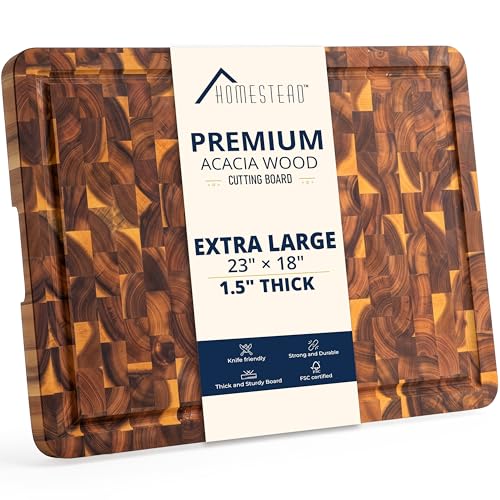
HOMESTEAD End Grain Acacia Wood Cutting Board 23x18x1.5, Reversible Butcher Block Board for Kitchen with Deep Juice Groove, Handles, Knife-Friendly Surface for Meat Chopping and Charcuterie Serving
Included for 'Best Butcher Block Cutting Boards for Everyday Kitchen Prep' because the listing specifies Handles, details this guide uses to compare options.
View on Amazon
Ironwood Acacia Wood Charleston 14" Square End Grain Chopping & Prep Board
Included for 'Best Butcher Block Cutting Boards for Everyday Kitchen Prep' as a relevant option in this category; details come from the product listing.
View on AmazonEnd grain is often preferred for frequent, forceful chopping because the knife enters between the upright fibers rather than cutting across their length. This can reduce visible knife marks and be gentler on an edge, though no wood board is immune to cuts. End-grain construction also uses more labor and can cost more. Its many glued joints need sound construction and consistent care; soaking or repeatedly letting the board dry unevenly can contribute to cracks or joint failure.
Edge grain is usually the practical choice for general meal prep. It tends to be less expensive, somewhat lighter, and simpler to maintain. Knife marks may show more readily than on end grain, especially with frequent chopping, but a well-made hardwood board can last for years when cleaned and dried properly.
Specs that matter more than “butcher block” on the label
| Board type or size | Typical dimensions | Best fit | Ownership trade-off |
|---|---|---|---|
| Compact edge grain | 12 × 18 × 1–1.5 in | Small counters, quick prep, lighter lifting | Less workspace; may slide unless stabilized |
| Everyday edge grain | 15 × 20 × 1.5–2 in | Routine chopping and general prep | Needs counter or cabinet space; still easier to handle than a thick block |
| Thick end grain | 16 × 22 × 2–3 in | Heavy chopping and a mostly stationary prep station | Heavy, costly, and more demanding to oil and move |
| Carving board with groove | About 15 × 20 × 1.5–2 in | Roasts, melons, and other juicy foods | Groove reduces flat cutting area and needs extra scrubbing |
These are useful size ranges, not specifications for a particular model; actual board dimensions and weights vary. Before buying, measure the counter space you can spare and check whether the board will fit in your sink or storage area. A board too large to wash or move comfortably may end up being used less often.
Thickness, grooves, and wood choice
Thickness is a stability-versus-handling choice. A heavier board is less likely to shift during forceful cutting, but it is harder to lift, wash, and store. For most home cooks, 1.5–2 inches offers a useful middle ground. A 2–3-inch board makes more sense if it will stay on the counter and heavy chopping is routine. Thickness alone does not guarantee stability: look for non-slip feet or plan to place a damp towel underneath.
A juice groove is useful for carving, not essential for chopping. It helps contain liquid near the perimeter, but a narrow or shallow groove may overflow. Grooves also trap scraps and require a brush or careful wiping. If you want a versatile prep surface, a reversible board without a groove leaves more room for cutting. Some cooks keep a grooved board for carving and a flat board for daily prep.
Hard maple is a dependable all-purpose choice. Walnut is also commonly used and has a darker appearance; cherry is another established option. Prioritize a board made from food-safe hardwood, with smooth edges and even, tight glue joints. Avoid boards with deep cracks, raised joints, or a finish that is not specified as food-safe.
Choose by frequency, space, and maintenance tolerance
| Your situation | Good starting choice | Why |
|---|---|---|
| Occasional prep, limited budget | Compact edge grain, about 1–1.5 in thick | Lower cost and easier storage; less board to maintain |
| Daily cooking, moderate chopping | Edge grain, about 1.5–2 in thick | Balances workspace, stability, and manageable weight |
| Frequent heavy chopping; board can stay out | End grain, about 2–3 in thick | Built for a substantial, durable work surface, with higher upkeep |
| Frequent carving of juicy foods | Grooved hardwood board, about 1.5–2 in thick | Contains runoff, though it needs more detailed cleaning |
Care that prevents premature wear
Wood boards are durable, but they are not dishwasher-safe. Heat and prolonged exposure to water can warp the board, open glue joints, or cause cracks. Clean it promptly after use:
- Scrape off scraps before washing so food does not collect in cuts or grooves.
- Wash both faces with warm water, mild dish soap, and a non-abrasive sponge. Clean a juice groove with a small brush.
- Rinse briefly and dry immediately. Stand the board on edge or use a rack so air reaches both faces; avoid leaving it flat and wet on the counter.
- Oil when the surface looks dry or pale. Use food-grade mineral oil or a board conditioner made for food-contact wood. Apply a thin coat, let it absorb, then wipe off excess. How often depends on use and climate; a fixed monthly schedule is only a starting point.
Do not soak a board, leave it beside a sink where one side stays wet, or use cooking oils such as olive oil for conditioning—they can turn rancid. If deep knife grooves become hard to clean, or the surface is badly rough, sanding and refinishing may restore it, but follow the maker’s care guidance. A board with a deep crack or separated glue joint is harder to clean reliably and may be due for replacement.
Bottom line
For most households, a 15 × 20-inch edge-grain hardwood board around 1.5–2 inches thick is the most balanced choice. Choose a thick end-grain board if heavy chopping is a regular part of your cooking and its weight and care are acceptable. Add a juice groove when carving liquids are a recurring problem—not simply because the feature sounds premium. The board you can clean, dry, and oil consistently is more likely to serve you well than the thickest or most elaborate option.


Write Your Review
No reviews yet. Be the first to share your experience!