
Key takeaways
- $10 fill / 7 uses = about $1.43 per fry session in oil, plus electricity (~1.7 kWh for heat-up + 30 min cooking = roughly $0.25-$0.40).
- A 1.1-liter compact fryer fill costs $2.30-$4.00 and lasts 3-4 uses = about $0.75-$1.00 per session, but makes one-third the food.
For most home cooks, the best deep fryer for home is the T-fal FR8000 with oil filtration, because it holds 3.5 liters of oil, filters and stores oil automatically, and has a locking lid with a carbon filter that cuts splatter and odor better than open-pot fryers.
If you fry once a month or less, want easy cleanup, and do not want your kitchen smelling like fast food for two days, an enclosed electric fryer with a filter lid and a drain system will beat a basic fry-pot every time. Below we compare the best rated deep fryers for different home situations, including a small fryer for home kitchens, plus top options for fish, chicken wings, and french fries.
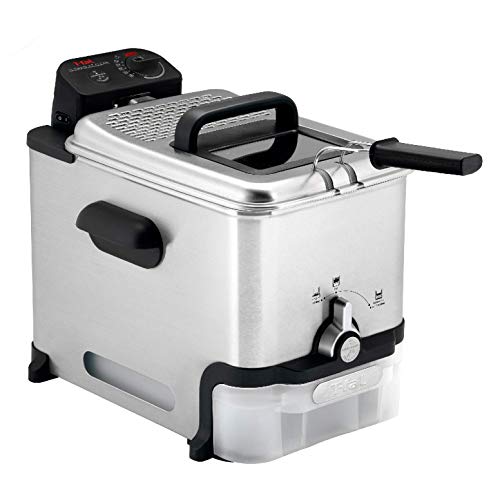
T-fal Deep Fryer with Basket, 3.5L, 1700W, Oil Filtration, Temp Control
Included for 'Best Deep Fryer for Home Use Without the Mess' because the listing specifies 3.5L and 1700W, details this guide uses to compare options.
View on Amazon
T-fal EZ Clean Compact Electric Deep Fryer with Basket, 1.8L Oil Capacity
Included for 'Best Deep Fryer for Home Use Without the Mess' because the listing specifies 1.8L Oil Capacity, details this guide uses to compare options.
View on Amazon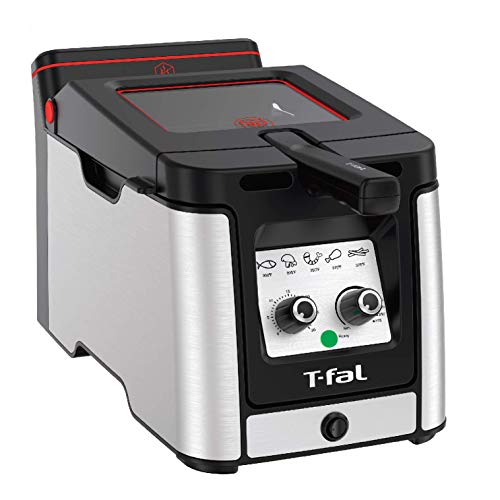
T-fal FR600D5A Electric Deep Fryer with Basket, 3.5L Oil, 1800W, Odor Filtration
Included for 'Best Deep Fryer for Home Use Without the Mess' because the listing specifies 3.5L Oil and 1800W, details this guide uses to compare options.
View on Amazon
De’Longhi Livenza Deep Fryer with EasyClean System, Cool Zone, Adjustable Thermostat, Dishwasher-Safe Parts, Large Capacity, Easy Oil Draining, Stainless Steel
Included for 'Best Deep Fryer for Home Use Without the Mess' because the listing specifies Cool Zone and Adjustable Thermostat, details this guide uses to compare options.
View on AmazonBest Deep Fryers Compared
| Model | Oil Capacity | Food Capacity | Power | Footprint (W x D x H) | Weight Empty | Odor / Splatter Control |
|---|---|---|---|---|---|---|
| T-fal FR8000 Deep Fryer with Oil Filtration | 3.5 L (118 oz) | 2.65 lb / 1.2 kg | 1700W | 17.5 x 13.5 x 11 in | ~10.3 lb | Locking lid + replaceable carbon filter, automatic oil filtration box |
| T-fal Ultimate EZ Clean Stainless | 3.5 L (118 oz) | 2.65 lb / 1.2 kg | 1700W | 17.1 x 12.6 x 10.9 in | ~9.9 lb | Locking lid + carbon filter, oil drains from front valve into container |
| Cuisinart CDF-100 Compact | 1.1 L (38 oz) | 0.75 lb / 0.34 kg | 1000W | 10.2 x 8.0 x 8.5 in | ~7.7 lb | Vented lid (no carbon filter), small batch = less splatter |
| Presto FryDaddy 05420 | ~1.1 L (4 cups melt to ~32 oz fry level) | ~4 cups / ~0.9 lb fries | 1200W | 8.4 x 8.1 x 8.0 in | ~3.5 lb | Open pot + snap-on lid for storage only, no filter |
| De’Longhi Roto Deep Fryer D28313UX | 2.8 L (95 oz) but uses ~1.7 L for operation | 2.0 lb / 0.9 kg with tilted rotating basket | 1800W | 15.9 x 11.8 x 10.5 in | ~11.9 lb | Sealed lid + carbon filter, rotating basket uses less oil |
| Hamilton Beach 35021 Triple Basket | 4.7 L (19 cups) | Up to 12 cups / ~2.5 lb | 1800W | 15.0 x 12.0 x 10.5 in | ~12.5 lb | Vented lid with filter, 3 baskets for separating foods |
Numbers are manufacturer specs for 2026 North American 120V models. Usable food capacity is lower for bulky foods like bone-in wings than for fries.
What Actually Controls Mess at Home
Best rated deep fryers are not rated on crispiness alone. In a home kitchen, mess comes from four places: splatter during frying, odor after frying, oil disposal, and countertop storage.
1. Oil capacity vs. batch size
For french fries and chicken wings, oil temperature recovery matters more than basket size. A good rule is a 3:1 to 4:1 oil-to-food ratio by weight. For example, 1 lb of frozen fries needs at least 3 liters of oil at 375°F to stay above 325°F after loading. Small 1-liter fryers work for 1-2 servings but will steam frozen food if overloaded, producing soggy fries and more bubbling spillover.
For fish, a wider, shallower tank is better than a tall narrow one. Fillets need to lie flat without folding. The Hamilton Beach 35021 and T-fal FR8000 have wider rectangular baskets that fit 4-5 fish fillets at once, while compact round pots fold the breading.
2. Odor filters and lids
Look for a locking lid with a replaceable carbon filter if you fry indoors weekly. T-fal and De’Longhi both use this system. It does not eliminate odor, but it cuts airborne grease by trapping steam and letting it condense. Open-pot fryers like the Presto FryDaddy and basic stainless stockpot kits will ventilate your whole house. If you use one, fry near a range hood on high and close bedroom doors.
3. Cleanup effort
This is where enclosed fryers win. The T-fal FR8000 drains oil through a filter screen into a plastic box underneath after it cools. You pull the box out and pour oil into a bottle for reuse or disposal. The T-fal Ultimate EZ Clean does the same with a front spigot. Without this, you are lifting a 7-9 lb pot of warm oil to pour through cheesecloth, which is where most spills happen.
Dishwasher-safe baskets and enamel pots help, but the heating element housing is usually wipe-only. Avoid immersing the control panel. Carbon filters need replacement every 10-15 uses and are a recurring consumable.
4. Countertop footprint
A full-size 3.5-liter fryer takes about 1.7 sq ft of counter and needs 4 inches clearance on all sides for steam. Measure before you buy. If you have under 24 inches of counter depth or live in an apartment, a small fryer for home use under 11 x 9 inches like the Cuisinart CDF-100 or Presto FryDaddy can be stored in a cabinet and set on the stove (off) while in use.
Our Picks by Cooking Situation
Best overall for home: T-fal FR8000
The FR8000 solves the two reasons people stop deep frying: disposing of oil and cleaning the pot. After cooking, turn the dial to oil filtration and the cooled oil drains through a mesh filter into a sealed container. The fryer separates crumbs that cause bitter oil and smoking. It fries excellent french fries in two 1.2-lb batches and holds 8-10 chicken wings per batch without crowding. The stainless pot is nonstick-coated and the lid, basket, and oil box lift out for sink washing. Downsides: it is bulky to store and the nonstick coating will scratch if you use metal utensils.
Best small fryer for home or couples: Cuisinart CDF-100 Compact
If you fry for one or two people and hate storing a large appliance, the 1.1-liter Cuisinart is the most practical small fryer. It heats in about 8 minutes, uses less than half the oil of a full-size model, and fits in a standard cabinet. It is ideal for a single batch of fish fillets, 2 servings of fries, or 6 wings. It is not the best fryer for chicken wings for a family, because you will need three batches, and later batches sit while earlier ones cool. It also has no carbon filter, so odor control is average.
Best fryer for fish with less lingering smell: De’Longhi Roto D28313UX
Fish leaves the strongest odor because of high water content and thin breading. The De’Longhi Roto is the best fryer for fish indoors because the sealed lid with carbon filter stays closed during cooking and the tilted rotating basket bastes fish in less oil. You use about 1.7 liters instead of 2.8 liters, so there is less oil to go rancid. The lower oil level also means less bubbling over with beer batter. Do not use very wet batter in any basket fryer; let batter set 60 seconds before lowering fully or it will stick.
Best fryer for chicken wings: Hamilton Beach 35021
Wings need high, stable heat and space so skin renders crisp. The Hamilton Beach 35021 is the best fryer for chicken wings for groups because the 19-cup tank holds temperature better and the three baskets let you separate hot wings, plain wings, and fries or onion rings. Fry 2 lb of thawed, patted-dry wings at 375°F for 10-12 minutes. Do not overfill past the basket half line. The tradeoff is the largest footprint and the most oil to buy upfront.
Best fryer for french fries on a budget: Presto FryDaddy
The Presto FryDaddy remains popular because it has no thermostat dial to fail – it holds around 375°F automatically – and it costs within the lowest general market range for electric fryers. It makes excellent french fries for 2-3 people if you cut fries thin (1/4 inch) and fry from a double-cook method: blanch at 325°F equivalent by lifting the unit off cycle briefly, then crisp. It is messy by design with no active filter and no drain, so melt shortening in it, cool completely, then pour. Best used occasionally in a ventilated space or garage.
Decision Matrix: Which Type Fits You
| Your Situation | Choose This Type | Why |
|---|---|---|
| Apartment, fry 1-2x per month, limited storage | Compact 1.0-1.5 L enclosed fryer | Less oil to buy and store, fits in cabinet, fast heat-up |
| Family of 4+, wings and fries weekly | 3.5-4.7 L with 1700-1800W | Maintains temp for frozen foods, fewer batches |
| Odor-sensitive home, open plan kitchen | Sealed lid + carbon filter model | Only type that meaningfully reduces grease film and smell |
| Mostly fish and battered foods | Wide tank with filter lid, or Roto-style | Prevents folding, reduces oil use and splatter |
| Tight budget, occasional use | Basic open-pot electric (FryDaddy type) | Low upfront cost, but plan for manual oil filtering |
Oil Cost Per Use: A Worked Calculation
Oil is the hidden cost of home frying. A 3.5-liter fryer needs about 0.93 gallons. At a general market range of $8 to $14 per gallon for peanut or canola oil in 2026, a full fill costs $7.50 to $13.00.
If you filter after each use and only fry potatoes and wings (not fish), that oil lasts 6-8 uses before it darkens, smokes below 375°F, or tastes bitter. That is:
- $10 fill / 7 uses = about $1.43 per fry session in oil, plus electricity (~1.7 kWh for heat-up + 30 min cooking = roughly $0.25-$0.40).
- A 1.1-liter compact fryer fill costs $2.30-$4.00 and lasts 3-4 uses = about $0.75-$1.00 per session, but makes one-third the food.
To extend oil life: maintain 350-375°F, do not salt over the pot, skim crumbs after each batch, filter while oil is still warm (110-120°F), and store in a cool dark container. Discard if it foams excessively, smells fishy after filtering, or does not reach temperature without smoking. Check with your city for cooking oil recycling – do not pour down the drain.
Durability and Ownership Realities
What wears first is not the heating element but the nonstick pot coating and the lid gasket. Scraping frozen blocks across the coating, using metal tongs inside the pot, and dishwasher detergent on high heat shorten coating life to 1-2 years. Hand wash with a soft sponge and lower food with the basket, not by dropping.
Common mistakes that cause a mess: filling past the MAX line with frozen food, frying with the lid open on a filter model, reusing fish oil for donuts or fries, and moving the fryer while oil is warm. Always cool at least 2 hours before filtering or moving. Keep the magnetic breakaway cord (on T-fal and Presto models) unobstructed so it can detach if snagged.
Consumables to budget for: replacement carbon filters (usually packs of 2-3), oil filter screens, and fresh oil. If your fryer smells rancid even when empty, the filter and lid seal need replacement and the pot needs a boil-out with water and baking soda – not oven cleaner.
FAQ
Can I reuse deep fryer oil?
Yes, for 3-8 uses if you filter out crumbs and do not overheat. Fry mild foods first (fries, vegetables), then chicken, then fish last. Discard cloudy, dark, or foamy oil. People with seed oil sensitivities or heart conditions should talk to a clinician or dietitian about frequency of fried foods; this is general kitchen information, not medical advice.
What temperature for wings vs. fries?
Fresh cut fries: soak 30 minutes, dry, fry at 375°F for 3-4 minutes, rest, then refry 2-3 minutes. Frozen fries: 375°F for 4-6 minutes in small batches. Thawed wings: 375°F for 10-12 minutes to 165°F internal. Fish fillets: 350-360°F for 4-6 minutes until golden and flaky.
How do I fry without making the house smell?
Use a sealed fryer with a carbon filter, run the range hood, fry closer to a window with cross-ventilation, change the filter regularly, and clean grease from the lid after each use. No home fryer is odor-free, but enclosed filtration models leave significantly less residue than open pots.

Write Your Review
No reviews yet. Be the first to share your experience!