
Our Top Picks
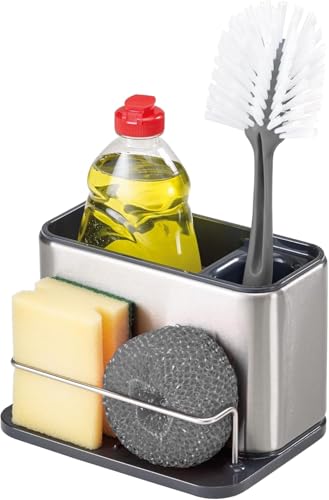
 HapiRm Multifunctional Sponge Holder with Unique M-Shapedwith M-shaped Holder0.33 poundsCheck on Amazon


Disclosure: As an Amazon Associate, I earn from qualifying purchases.
The area around a kitchen sink collects clutter faster than almost anywhere else in the room. A wet sponge on the counter, a brush balanced on the faucet, a soap bottle leaving rings on the worktop — within a week the whole zone looks untidy and stays damp. A good sink organizer gives every washing-up tool a defined home, lifts sponges off wet surfaces so they dry between uses, and channels drips somewhere sensible instead of letting them pool under a soggy sponge.
The catch is that “sink organizer” covers several different designs: countertop caddies, caddies that hang inside the sink, suction-mounted holders, and over-faucet racks. The right choice depends on your sink layout, how much counter depth you can spare, and how many tools you need to store. This guide compares five well-regarded options, explains what separates a hygienic design from a mildew trap, and is frank about the weak points — because a caddy that traps standing water can end up grimier than the sponge pile it replaced.
How to Choose a Kitchen Sink Organizer
Pick the mounting style that fits your sink
Countertop caddies are the most flexible: they sit behind or beside the faucet, hold the most items, and need no installation. Their cost is counter space, so measure the depth behind your faucet first — many kitchens have less than six inches there. Hanging caddies hook over the sink divider or inside wall, keeping counters clear, but only suit sinks whose divider matches the hanger. In-sink suction or adhesive holders are the most compact option, though they hold the least. Over-faucet racks need clearance around the faucet body and spray hose, so measure before assuming one will fit.
Drainage matters more than looks
A sponge stored in a puddle stays wet, smells sooner, and grows mildew. Look for open slats, raised bases, sloped floors, or drip trays that actually empty somewhere. A removable drip tray with a pour spout is easy to empty; a sloped base that sends water back into the sink is even better, because there is nothing to remember. Sealed-bottom caddies are the worst design — whatever the material, plan on tipping them out and washing them weekly.
Material: stainless grades are not all equal
Stainless steel is the default for a reason, but grades differ. 304-grade steel resists rust well in a constantly wet environment. Cheaper ungraded steel can develop rust spots within months, especially around welds and scratches, and listings do not always state the grade. Plastic caddies never rust and are usually dishwasher-safe, but can stain and hold odors over time.
Suction cups: know their limits
Suction mounting is convenient and drill-free, but suction cups fail predictably in some conditions. They lose grip on textured, porous, or matte surfaces, on curved walls, and gradually in humidity as air creeps under the cup. If your sink is fireclay, textured composite, or heavily curved, prefer adhesive-mounted or countertop designs. Where suction is used, clean both surfaces before mounting and expect to re-seat the cups occasionally.
Count your tools before you size up
List what genuinely lives at your sink: usually a sponge, a brush, dish soap, and maybe hand soap, a stopper, and a dish cloth. A caddy sized for exactly that list stays tidy; an oversized one becomes a dumping ground. Tall brush holders matter for long-handled brushes, and a rail for hanging a dish cloth is worth having if you use cloths daily.
The 5 Best Kitchen Sink Organizers
OXO Good Grips Stainless Steel Sink Caddy

The OXO Sink Caddy is the classic countertop answer: a brushed stainless body with a ventilated divider that separates a sponge from brushes, and a drip tray underneath with a pour spout, so collected water can be tipped into the sink without dismantling anything. The tray and divider come apart for washing, which makes the weekly clean quick.
Specs
- Type: Countertop caddy
- Material: Stainless steel body with plastic drip tray
- Compartments: Divided main well with ventilated sponge divider, tall section for brushes and utensils
- Drainage: Removable drip tray with pour spout; ventilation holes in divider for airflow
- Dimensions: Approximately 8.3 x 5.5 x 5.6 inches
Pros:
– Drip tray pour spout empties water without removing the whole caddy
– Ventilated divider helps sponges dry faster
– Separates into pieces for thorough washing
Cons:
– Footprint too deep for narrow counter strips behind some faucets
– Tray still needs regular emptying or it becomes the mildew source
Who it suits: Households with enough counter depth behind the faucet who want one durable, easy-clean home for sponge, brushes, and soap.
simplehuman Sink Caddy
simplehuman’s caddy takes the opposite approach: it hangs inside the sink. Suction cups grip the sink wall while an adjustable wire ledge hanger hooks over the divider, so the caddy stays put without drilling and your counter stays clear. A pop-out silicone brush holder extends to fit longer brushes, and holes throughout the body let water drain straight back into the basin.
Specs
- Type: Hanging in-sink caddy (suction cups plus adjustable wire ledge hanger)
- Material: Brushed stainless steel with plastic and silicone components
- Compartments: Sponge well plus extendable pop-out brush holder
- Drainage: Open, perforated body drains directly into the sink
- Dimensions: Approximately 9 x 5.5 x 7 inches (model KT1116)
Pros:
– Frees the counter entirely — ideal for small kitchens
– Drains straight into the sink, so there is no tray to empty
– Adjustable hanger fits a range of divider widths
– Brush holder extends for long-handled brushes
Cons:
– Suction cups can slip on textured or curved sink walls
– Takes up basin space, which matters in small single bowls
Who it suits: Small kitchens and anyone who wants the counter completely clear and is willing to check the suction cups now and then.
Joseph Joseph Surface Sink Caddy
The Surface caddy (model 85134) is a countertop organizer with a neat drainage trick: its base is sloped, so water from sponges and brushes runs off the front lip back into the sink instead of collecting in a tray. The fingerprint-proof stainless finish keeps it looking cleaner between wipes, and an integrated rail gives a dish cloth somewhere to hang and dry. Inside, a removable sponge plate and a dedicated brush section keep items separated.
Specs
- Type: Countertop caddy
- Material: Fingerprint-proof stainless steel with plastic internal fittings
- Compartments: Main compartment with removable sponge plate, brush holder section, integrated dish-cloth hanging rail
- Drainage: Sloped base channels water back into the sink; no drip tray
- Dimensions: Approximately 7 x 5 x 5.3 inches
Pros:
– Self-draining sloped base means no tray to empty or scrub
– Dish-cloth rail is useful if you use cloths daily
– Fingerprint-resistant finish hides smudges
Cons:
– Must sit at the sink edge for the drainage slope to work
– Smaller capacity than the largest countertop caddies
– Drainage lip drips onto the counter if positioned too far back
Who it suits: Anyone who hates emptying drip trays and wants a compact, tidy countertop caddy with a place to hang the dish cloth.
Cisily Sponge Holder for Kitchen Sink
Cisily’s countertop caddy is built from 304 stainless steel — the grade you want for permanent wet duty. A tall brush holder keeps long brushes upright, a divider baffle separates sponges from bottles, and the base has a rotating spout that directs drained water into the sink rather than across the counter. The 9.25-inch version offers generous capacity in a single row along the back of the sink.
Specs
- Type: Countertop caddy
- Material: 304 stainless steel
- Compartments: Sponge section with divider baffle, high brush holder, room for soap bottles
- Drainage: Sloped base with rotating drain spout that directs water into the sink
- Dimensions: 9.25 x 3.97 x 6.37 inches (9.25-inch size)
Pros:
– 304-grade steel resists rust better than ungraded alternatives
– Rotating spout controls where drained water goes
– Tall brush holder suits long-handled brushes
Cons:
– Spout must be aimed correctly or water lands on the counter
– Black finish can show limescale marks in hard-water areas
Who it suits: Busy kitchens with a full set of brushes, sponges, and bottles that want rust-resistant steel and directed drainage in a slim footprint.
HapiRm Multifunctional Sponge Holder
The HapiRm holder is the minimalist option: a compact stainless caddy that mounts inside the sink using either suction cups or adhesive hooks, both included, so you can choose the fixing that suits your sink surface. Its M-shaped divider cradles a sponge while leaving room for a brush, stopper, or scraper. Because it sits inside the basin, everything drains directly into the sink and the counter stays bare.
Specs
- Type: In-sink caddy with two installation methods (suction cups or adhesive hooks)
- Material: Stainless steel
- Compartments: M-shaped divider section for sponge, plus space for brush, stopper, and scraper
- Drainage: Open design drains directly into the sink
- Dimensions: 6.49 x 3.14 x 2.95 inches
Pros:
– Two mounting options cover more sink surfaces than suction alone
– Very compact — suits small sinks and minimalist setups
– Adhesive option works where suction cups will not
Cons:
– Smallest capacity in this guide — sponge plus one or two small items
– Adhesive pads are effectively single-position; repositioning needs new pads
Who it suits: Small sinks, renters who cannot drill, and minimalists who only need a sponge and brush off the counter and out of the puddle.
Comparison Table
| Product | Type | Material | Drainage | Standout Feature |
|---|---|---|---|---|
| OXO Good Grips Sink Caddy | Countertop | Stainless steel, plastic tray | Drip tray with pour spout | Ventilated divider, easy to dismantle |
| simplehuman Sink Caddy | Hanging in-sink | Stainless steel, silicone | Drains into sink | Adjustable divider hanger, pop-out brush holder |
| Joseph Joseph Surface | Countertop | Stainless steel | Sloped self-draining base | No tray to empty, dish-cloth rail |
| Cisily Sponge Holder | Countertop | 304 stainless steel | Rotating drain spout | Tall brush holder, slim depth |
| HapiRm Sponge Holder | In-sink | Stainless steel | Drains into sink | Suction or adhesive mounting |
Frequently Asked Questions
How do I stop my sink caddy growing mildew?
Empty or drain it at least weekly and wash it with hot soapy water, paying attention to corners and drip trays where slime builds up. Let sponges dry upright in a ventilated section rather than flat in a puddle, and wring them out after use. If black spots appear on plastic or silicone parts, a soak in diluted white vinegar usually shifts them. No design is maintenance-free — drainage slows mildew, it does not remove the need to clean.
Will a suction caddy work on my sink?
Suction cups hold best on smooth, non-porous surfaces: glazed stainless steel and smooth ceramic are ideal. They struggle on textured composite, matte stone, rough fireclay, and strongly curved walls, and loosen faster in steamy conditions. If your sink falls into the difficult category, choose an adhesive-mounted holder, a hanging caddy with a mechanical hanger, or a countertop model instead.
Is stainless steel or plastic better for a sink organizer?
Stainless steel — ideally 304 grade — looks better for longer and will not stain, but cheap ungraded steel can develop rust spots in a permanently wet spot, especially at welds. Plastic never rusts and is usually dishwasher-safe, which makes deep cleaning easier, though it can pick up odors. For most kitchens either works; the drainage design and your cleaning routine matter more than the material.
How much counter space do I need for a countertop caddy?
Measure the strip between your faucet base and the backsplash before ordering. Slim caddies need roughly four inches of depth; full-size models need five and a half or more, plus clearance for the faucet lever and spray hose to move. If you have less than four inches, a hanging or in-sink design is the practical answer rather than a caddy that will constantly be knocked.
Conclusion
The best kitchen sink organizer is the one whose drainage you will actually keep on top of and whose mounting style matches your sink. For most people with reasonable counter depth, the OXO Good Grips Sink Caddy is the safest all-round choice, with its pour-spout tray and ventilated divider. If counter space is precious, the simplehuman hanging caddy or the compact HapiRm holder move everything into the basin instead. Joseph Joseph’s Surface removes the drip-tray chore with its self-draining slope, while the Cisily brings 304-grade steel and a tall brush holder for tool-heavy sinks. Whichever style you pick, measure first, favor open drainage over sealed bases, and give the caddy a weekly wash — that habit, more than any feature, keeps the sink area hygienic.
FAQ
How do I stop my sink caddy growing mildew?
Will a suction caddy work on my sink?
Is stainless steel or plastic better for a sink organizer?
How much counter space do I need for a countertop caddy?
More from Amazon
Programs that pair well with the guide above. Offers and eligibility are set by Amazon and may change.
Set up recurring deliveries of everyday items on eligible products. Terms and savings are set by Amazon.
Explore Subscribe & SaveCollect the home and kitchen items you want in one registry that guests can shop from.
Create a wedding registryFree shipping on eligible items, Prime Video and more. Eligible new members can start with a free trial.
Start a Prime free trialAudiobooks and podcasts to listen to on the go. Eligible new members can start with a free trial.
Try Audible freeAs an Amazon Associate we earn from qualifying purchases.


Write Your Review
No reviews yet. Be the first to share your experience!