
Key takeaways
- Weight: Heavier racquets are usually more stable and powerful, while lighter racquets are faster to swing. The listed weight is not the whole story; strings, grip tape, and the bumper guard add several grams.
- Head size: A 105–110-square-inch head enlarges the effective hitting area and helps on defensive contact. A 100–105-square-inch head typically feels more precise but demands better timing.
- Balance: Head-light frames feel nimble. Head-heavy frames feel powerful. Even-balance frames are the middle ground and the most adaptable for mixed doubles, singles, and casual play.
- Shaft and throat design: A longer or more open throat can contribute to reach and string movement, while a more compact throat may feel firmer and more controlled. These features matter, but they should not override a poor weight or grip fit.
The best racquetball racquets balance head size, weight, and balance rather than simply maximizing power: choose a 165–175-gram head-light racquet for quick control, a 175–185-gram even-balance model for all-around play, or a 185–200-gram head-heavy model for easier power.
Best racquetball racquets by playing situation
| Player or situation | Recommended specification | Why it works | Trade-off |
|---|---|---|---|
| New or occasional player | 175–185 g; 105–110 in² head; even balance | Forgiving sweet spot with manageable swing weight | Less explosive than a heavier head-heavy frame |
| Control-focused tournament player | 160–175 g; 100–105 in² head; 1–2 cm head-light | Fast preparation, precise angles, easier defensive reactions | Off-center hits lose more pace |
| Power player or back-court hitter | 185–200 g; 105–110 in² head; slightly head-heavy | Greater plow-through and depth with a shorter swing | Slower at the front wall and harder to redirect quickly |
| Frequent league or tournament use | 170–185 g; reinforced graphite frame; replaceable bumper guard | Useful compromise between speed, stability, and service life | Usually costs more than entry-level aluminum models |
| Small budget | 175–195 g; 105 in² or larger; aluminum or basic graphite composite | Affordable, durable, and forgiving while learning | More vibration and less refined balance |
Our top racquet categories
Best overall: a 175–185-gram even-balance graphite racquet
For most recreational and intermediate players, this is the safest choice. An even-balance racquet puts its mass near the middle, so it supplies enough stability against hard shots without feeling sluggish when you move forward. A 105–110 square-inch head also gives a useful margin for imperfect contact.

HEAD CPS Heat Racquetball Racquet
Included for 'Best Racquetball Racquets for Control and Power' as a relevant option in this category; details come from the product listing.
View on Amazon
HEAD Intelligence G.165 Racquetball Racket - Pre-Strung Head Heavy Balance Racquet
Included for 'Best Racquetball Racquets for Control and Power' because the listing specifies Pre-Strung Head Heavy Balance Racquet, details this guide uses to compare options.
View on Amazon
HEAD MX Cyclone Racquetball Racquet
Included for 'Best Racquetball Racquets for Control and Power' as a relevant option in this category; details come from the product listing.
View on Amazon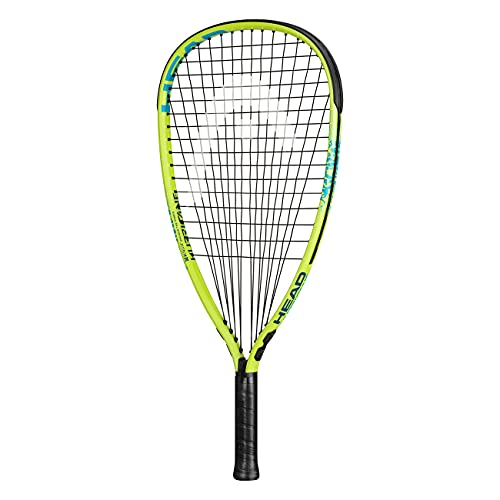
HEAD MX Hurricane Racquetball Pack
Included for 'Best Racquetball Racquets for Control and Power' as a relevant option in this category; details come from the product listing.
View on AmazonLook at established racquetball ranges from brands such as HEAD, Ektelon, Gearbox, and Wilson, then select the model closest to these specifications. A graphite or graphite-composite frame is preferable if you play weekly because it generally offers a cleaner response and lower weight than inexpensive aluminum construction.
Best for control: a 160–175-gram head-light racquet
Head-light designs place less mass toward the tip. They accelerate quickly, making them suitable for players who rely on compact swings, passing shots, pinch shots, and rapid exchanges near the front wall. The lighter frame is also easier to reposition after a defensive shot.
The cost is stability. If your swing is late or you frequently strike near the frame, a very light racquet can twist more and send the ball off line. For that reason, a 100–105-square-inch head is often a better control choice than an extra-small head: it preserves precision without making clean contact unnecessarily difficult.
Best for power: a 185–200-gram head-heavy racquet
A heavier, slightly head-heavy racquet can produce depth and pace with less effort because more mass travels behind the ball. This can suit a player with a shorter swing, a strong back-court game, or a preference for driving the ball deep rather than creating sharp angles.
Do not select the heaviest frame solely because it promises power. Added weight increases fatigue and slows preparation. If you play long matches or have a fast opponent who keeps the ball tight, an even-balance 180-gram racquet may produce better results than a 195-gram head-heavy model.
How weight, head size, and balance work together
- Weight: Heavier racquets are usually more stable and powerful, while lighter racquets are faster to swing. The listed weight is not the whole story; strings, grip tape, and the bumper guard add several grams.
- Head size: A 105–110-square-inch head enlarges the effective hitting area and helps on defensive contact. A 100–105-square-inch head typically feels more precise but demands better timing.
- Balance: Head-light frames feel nimble. Head-heavy frames feel powerful. Even-balance frames are the middle ground and the most adaptable for mixed doubles, singles, and casual play.
- Shaft and throat design: A longer or more open throat can contribute to reach and string movement, while a more compact throat may feel firmer and more controlled. These features matter, but they should not override a poor weight or grip fit.
Grip size and grip options
A grip that is too large makes wrist and finger movement harder; one that is too small can force you to squeeze the handle, reducing comfort and control. Many adult players begin with a medium grip and adjust it with an overgrip. Because manufacturers measure handles differently, compare the actual circumference when possible rather than relying only on labels such as “small” or “medium.”
To check the fit, hold the racquet in your normal forehand grip. There should be a small gap—roughly the width of a pencil—between your fingertips and the heel of your hand. If the handle feels nearly buried in your palm, it is probably too small; if your fingers cannot wrap comfortably around it, it is too large.
A replacement grip changes more than comfort. A tacky grip helps prevent slipping during sweaty games, while a cushioned grip can reduce harsh feedback. An overgrip commonly adds about 5–8 grams and slightly increases handle circumference, so account for that when comparing a light control racquet with a heavier model.
Durability and ownership costs
The strings, bumper guard, and grip usually wear before the graphite frame. Frequent wall contact can flatten or crack the bumper guard, exposing the frame edge. Replace a damaged guard or protective tape promptly rather than continuing to scrape the frame against the wall.
Keep the racquet in a ventilated cover, away from a hot car or damp locker. Heat can soften adhesives and accelerate grommet damage. Wipe the handle and frame with a lightly damp cloth; avoid soaking the grommets or using solvent-based cleaners.
String tension is another durability and performance decision. A mid-range tension around 55–60 pounds is a sensible starting point for many adult players, but the racquet’s recommended range should take priority. Lower tension can provide more rebound and a softer feel; higher tension can improve directional control while reducing forgiveness. Restring when the response becomes noticeably dull, the strings move excessively, or the frame receives a significant impact.
A practical value calculation
Suppose a $120 racquet lasts three years for a player who plays twice a week. At approximately 100 playing weeks, the frame costs about $1.20 per week before strings and grips. If a cheaper $55 racquet lasts only one year, its frame cost is about $1.06 per week. The cheaper choice is not automatically better value once premature replacement, uncomfortable vibration, or unsuitable balance is included.
For a frequent player, durability features can matter more than a small initial saving. Budget separately for replacement grips and periodic restringing, and choose a frame with a replaceable bumper and readily available grommets when possible.
What to choose in 2026
Choose a 175–185-gram even-balance graphite racquet if you want one dependable option for learning and all-around play. Move to a 160–175-gram head-light model when quick handling and shot placement are more important than maximum pace. Choose a 185–200-gram slightly head-heavy frame when you need easier depth and can comfortably manage the additional swing weight.
Before buying, check the manufacturer’s listed weight, head area, balance description, recommended string range, grip availability, and warranty. A racquet that fits your swing and hand will outperform a more expensive model whose specifications look impressive but make you late to the ball.
Frequently asked questions
Is a heavier racquet always more powerful?
No. It can transfer more energy when swung at the same speed, but a frame that is too heavy may slow your swing. Effective power depends on weight, balance, swing speed, contact quality, and string setup.
Should beginners use a large head?
Usually, yes. A 105–110-square-inch head offers a larger forgiving area while timing develops. Once consistent contact becomes easy, a player can move toward a smaller head for a more precise feel.
How often should a racquetball racquet be replaced?
Replace it when the frame is cracked, badly warped, or no longer holds tension—not simply because it has reached a particular age. A regularly used racquet may need grips and strings several times before the frame itself needs replacement.

Write Your Review
No reviews yet. Be the first to share your experience!