
Key takeaways
- Pro: Covers the most common residential and automotive gauge range in one pass.
- Pro: Lowest electric price in this roundup, making it an easy upgrade from hand tools.
- Con: Single-channel design requires manual blade repositioning when switching between vastly different diameters.
What's inside
Stripping insulation from scrap wire by hand is one of those tasks that looks simple until you have hundreds of feet to process. Pliers slip, blades chew through copper, and an afternoon disappears into repetitive wrist work. A dedicated wire stripper machine converts that grind into a feed-and-collect operation, and the right model can triple your output while leaving the conductor undamaged.
The best wire stripper machines on the market in 2026 span a wide range—from drill-powered hand cranks under thirty dollars to multi-channel electric units approaching three hundred and forty. What separates the genuinely useful models from the frustrating ones comes down to a handful of factors: the actual gauge range they handle reliably, how well the blade assembly tolerates mixed-diameter scrap, and whether the build quality justifies the asking price when you compare owner-reported longevity against the cost. Below, we weigh those factors across eight machines using published specifications, current pricing, and aggregated owner feedback.
As an Amazon Associate we earn from qualifying purchases at no extra cost to you. Product prices and availability are accurate as of the date shown and are subject to change.




Quick Picks
| Product | Best for | Price |
|---|---|---|
| VEVOR 0.06″-0.98″ Electric | Small-scale recyclers on a tight budget | $154.32 |
| VEVOR 0.06″-1.5″ Electric | Higher-volume jobs needing wider range | $248.13 |
| Trivd Frol Manual | Occasional use without power access | $35.99 |
| CREWORKS 180W Electric | Cable recycling with five channels | $159.99 |
| VEVOR 11-Channel Electric | Professional recyclers wanting top throughput | $339.90 |
| CREWORKS 7-Channel Electric | Mid-range power with seven-blade versatility | $179.99 |
| Hizmivos Manual Drill-Powered | Lowest-cost entry into machine stripping | $27.99 |
| CREWORKS Manual Drill-Powered | DIY recyclers who want a sturdier hand crank | $59.99 |
How We Picked
We narrowed this category using four criteria drawn from spec sheets and owner reviews. First, the usable gauge range: a machine rated 0.06″ to 0.98″ covers most common household and automotive wire, while larger ranges handle industrial cable. Second, channel and blade configuration—more channels generally mean fewer manual adjustments between mixed-diameter bundles, and owner feedback consistently flags models with limited channels as annoying on varied scrap. Third, motor wattage relative to price, since a low-power motor that stalls on thicker insulation erodes any cost advantage. Fourth, build quality as reported by owners after sustained use, because thin cast housings and cheap gear sets are the primary failure points in budget machines.
The 8 Best Wire Stripper Machines in 2026
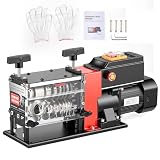
VEVOR 0.06″-0.98″ Electric Wire Stripping Machine
This is the entry point for anyone who wants electric stripping without crossing the two-hundred-dollar mark. Owners buying it for garage-scale copper recovery appreciate that it handles the full spread of common household wire without adjustment fuss. The compact footprint suits workbenches where space is limited.
- Pro: Covers the most common residential and automotive gauge range in one pass.
- Pro: Lowest electric price in this roundup, making it an easy upgrade from hand tools.
- Con: Single-channel design requires manual blade repositioning when switching between vastly different diameters.
Skip this if your scrap stream includes cable thicker than roughly one inch in diameter or if you process enough volume to justify multi-channel convenience.
VEVOR 0.06″-1.5″ Electric Wire Stripping Machine
Stretching the upper range to a full inch and a half puts thicker industrial cable in play, and owners report it handles mixed bundles with fewer stalls than the narrower VEVOR. The extra capacity justifies the price bump for recyclers who occasionally encounter larger conductors.
- Pro: Widest single-machine range in the VEVOR lineup at this price tier.
- Pro: Owners note the heavier frame reduces vibration during extended runs.
- Con: Priced roughly a hundred dollars above the narrower model for a range increase some buyers never need.
Skip this if your scrap is exclusively fine wire under one inch; the extra capacity adds cost without added utility.
Trivd Frol Manual Wire Stripping Machine
At under thirty-six dollars, this manual unit removes the need for any power source, making it viable for field recyclers or anyone whose workshop lacks a convenient outlet. Owners value the simplicity—no motor to burn out, no cord to tangle.
- Pro: Completely portable with zero electricity dependency.
- Pro: Lowest price among dedicated machines that require no drill attachment.
- Con: Hand-cranking becomes tiring on anything beyond small batches, and owners report slower throughput than even the cheapest electric option.
Skip this if you regularly process more than a few pounds of scrap per session; the labor cost will outweigh the savings.
CREWORKS 180W Electric Wire Stripper Machine
The 180-watt motor gives this machine headroom on stubborn insulation, and the five-channel layout lets owners set different blade gaps simultaneously for mixed-diameter scrap. Cable recyclers operating small yards cite the channel setup as the reason they chose it over single-channel competitors.
- Pro: Five channels reduce mid-session adjustments when processing varied cable diameters.
- Pro: The 180-watt rating sits above most competitors in this price bracket, which owners confirm as fewer stalls on thick insulation.
- Con: Slightly larger footprint than comparable single-channel units, so bench space matters.
Skip this if you only handle a narrow diameter band; the multi-channel advantage disappears and you are paying for capability you will not use.
VEVOR 11-Channel Electric Wire Stripping Machine
With eleven channels and ten blades, this is the highest-capacity machine in our roundup, aimed squarely at professional recyclers who sort large volumes of mixed scrap daily. Owners running commercial yards report that the channel breadth cuts setup time between batches dramatically.
- Pro: Eleven channels mean you can dial in settings for a wide spectrum of diameters at once.
- Pro: Ten-blade assembly provides redundancy—if one blade dulls, the machine keeps producing clean cuts.
- Con: The price is the highest here, and the bulk demands a dedicated work surface.
Skip this unless your daily volume genuinely warrants the throughput; for hobby-scale recycling it is overbuilt and overpriced relative to mid-tier options.
CREWORKS 7-Channel Electric Wire Stripper Machine
Seven channels at sixty watts position this as a middle ground between the bare-minimum single-channel machines and the eleven-channel flagship. Owners running side recycling operations report it handles daily mixed batches without the premium cost of the top-tier VEVOR.
- Pro: Seven blades cover a practical diameter spread without requiring constant channel switching.
- Pro: The sixty-watt motor keeps energy draw modest for a machine in this class.
- Con: Some owners note the lower wattage can struggle on very thick or hardened insulation compared to 180-watt rivals.
Skip this if your scrap frequently includes heavy industrial cable with stiff insulation; the wattage ceiling may frustrate you over time.
Hizmivos Manual Drill-Powered Wire Stripping Machine
At under twenty-eight dollars, this is the absolute cheapest path into machine-assisted stripping. You bolt it to a cordless drill and let the tool’s motor do the cranking work, which owners say turns a tedious hand-crank job into a manageable one.
- Pro: Lowest price in the entire roundup by a wide margin.
- Pro: Eliminates hand fatigue versus a pure manual crank by leveraging your existing drill.
- Con: Performance is only as good as the drill you pair with, and the unit offers no independent speed control.
Skip this if you need consistent results across varied diameters without babysitting drill speed; dedicated electric machines offer far more repeatable output.
CREWORKS Manual Drill-Powered Wire Stripper Machine
Twice the price of the Hizmivos but built with a heavier housing and a 1.5-to-25-millimeter range, this drill-powered unit targets DIY recyclers who want something more substantial than the cheapest option but still do not want a dedicated electric machine. Owners appreciate the beefier construction compared to the budget alternative.
- Pro: More robust housing than the entry-level drill-powered option, with owner-reported longer service life.
- Pro: Handles wire up to 25 millimeters, covering nearly all common scrap without a motor.
- Con: Still dependent on your drill’s power and speed control, adding an external variable that dedicated machines eliminate.
Skip this if you already own an electric stripper or plan to process volume; the incremental cost over the Hizmivos buys durability but not throughput.
Buying Guide
Gauge Range and Channel Count
The stated diameter range tells you what the machine can physically accept, but the number of channels determines how much convenience you get when switching between sizes. A single-channel machine forces you to stop, loosen the blade assembly, reset the gap, and retighten every time your scrap diameter shifts noticeably. Multi-channel machines let you assign a fixed gap to each channel and simply route wire to the correct one, cutting setup interruptions to near zero. For mixed-diameter scrap streams, prioritizing channel count often matters more than raw wattage.
Motor Wattage and Stall Risk
Wattage is the most honest proxy a spec sheet gives you for sustained cutting force. Low-wattage motors stall when they encounter hardened PVC, crimped insulation, or a slightly oversized conductor mid-bundle. Owners of budget electric machines frequently report stalling on their first full batch, then discovering that feeding wire more slowly or pre-sorting by diameter solves the issue. If your scrap is unpredictable, err toward higher wattage or multi-channel designs that let you dedicate a robust setting to the tough bundles.
Build Quality and Longevity Signals
Thin cast-aluminum housings crack under vibration over months of use, and plastic gear sets wear faster than metal ones when the motor labors on thick insulation. Owner reviews on lower-cost machines consistently mention housing cracks and gear stripping after high-volume sessions. You do not need industrial-grade construction for casual recycling, but if you plan to process wire regularly, compare the weight and housing material across options and treat a heavier frame as a durability signal worth paying for.
Our Verdict
Our top pick is the CREWORKS 180W Electric Wire Stripper Machine. It delivers five channels and ample motor headroom at a price that sits well below the premium multi-channel options, and owner feedback consistently highlights reliable throughput on mixed residential and light-commercial scrap. For budget buyers, the Trivd Frol Manual at just under thirty-six dollars offers the most complete standalone stripping experience without any power dependency. However, the Hizmivos Drill-Powered wins outright if you already own a capable cordless drill and simply want the cheapest possible path into machine-assisted stripping at under twenty-eight dollars.
FAQ
Can a wire stripper machine handle any type of insulation?
Most machines cut standard PVC, rubber, and Teflon insulation without issue, but hardened or UV-degraded insulation increases stall risk on lower-wattage models. Pre-sorting heavily weathered cable and running it through a dedicated channel with a wider gap helps maintain consistent output.
What is the difference between channels and blades?
A channel is an independent cutting groove with its own blade gap setting. Blades refer to the actual cutting edges within those channels. A machine with ten blades and eleven channels typically means one channel shares a blade or operates as a guide, which is why channel count and blade count are not always equal.
Do drill-powered machines perform as well as electric ones?
No. Drill-powered units inherit the limitations of whatever drill you attach them to, including fixed speed ranges and no independent torque control. For occasional small batches they are adequate, but sustained or varied-diameter work exposes the gap between drill-powered and purpose-built electric machines.
Is it worth upgrading from hand pliers to a machine?
For anyone processing more than a few pounds of scrap per session, yes. The time saved and the reduced risk of nicking the conductor—nickel wire sells for less—add up quickly, and even the cheapest machine in this list pays for itself within a few recycling trips.







Write Your Review
No reviews yet. Be the first to share your experience!