
Our Top Picks
 AMZCHEF Espresso Machine With Grinder44 Grind Settings12.5 x 10.82 x 13.38 inches13.89 poundsCheck on Amazon
 SHARDOR Conical Burr Espresso Coffee Grinder Electric withmedium7.4 x 4.9 x 13.5 Inches4.85 poundsCheck on Amazon
 Hamilton Beach Custom Grind Electric Coffee Grinder For4-14 Cups4 x 4 x 8 inches2 PoundsCheck on Amazon
The best espresso grinder on a budget is the Baratza Encore ESP for most home setups: it keeps the 40mm conical burrs of the proven Encore and dedicates settings 1 to 20 to the espresso range. If you want the cheapest way into real espresso grinding, the Timemore Chestnut C3 ESP hand grinder offers about 23 micron clicks for a small outlay, and if you want a timer and the widest range, the Breville Smart Grinder Pro is the step up. The Gevi 35-setting burr grinder is the lowest-cost electric, best matched to a pressurized basket, and the Eureka Mignon Notte and Fellow Opus 2 are the stretch picks for people who want stepless dialing.
Budget espresso grinders force trade-offs, and the trick is knowing which features to give up and which to protect. A timer, a big hopper and a nice color are conveniences you can live without. Burr quality, small adjustment steps and low retention are the specs that decide whether your shots are consistent. This guide ranks six grinders sold in the shop catalog by what they give you per step up the ladder, and it includes a table of what you can skip and what you cannot. It is research-based: we did not personally use these grinders, and sources are listed at the end.
AMZCHEF Espresso Machine With Grinder, Temp Control, 44 Grind Settings | Hot & Cold Brew, Cappuccinos & Lattes, Built-in Grinder, Milk Frother, Touch Screen, Easy to Clean, Compact Design, Silver
Chosen because it specifies Temp Control and 44 Grind Settings.
Check Price on Amazon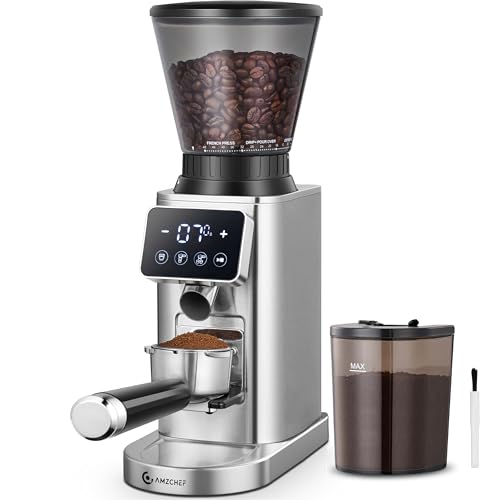
AMZCHEF Burr Coffee Grinder, 48 Settings, Less Static Mess, Metallic Silver | 40mm Burr, Low Retention, 0.5s LED Timer, Stainless Steel Body, Fit 51-54/58 Espresso Portafilter, Cleaning Brush Included
Chosen because it specifies 48 Settings and Less Static Mess.
Check Price on AmazonSHARDOR Conical Burr Espresso Coffee Grinder Electric with Precision Timer 2.0, Touchscreen Adjustable Burr Mill with 51 Precise Settings for Home Use, Anti-static, Stainless Steel
Chosen because it specifies Anti-static and Stainless Steel.
Check Price on AmazonHamilton Beach Custom Grind Electric Coffee Grinder For Up To 14 Cups | Grinds Beans, Spices & More | Hands-Free Operation, Auto Shutoff | Easy-Clean Removable Chamber | Stainless Steel
Chosen because it specifies Grinds Beans and Spices & More.
Check Price on AmazonTop Picks at a Glance
- Best Overall Budget Electric: Baratza Encore ESP, with a dedicated espresso range and a dosing cup included.
- Best Cheapest Real Espresso Option: Timemore Chestnut C3 ESP, a hand grinder with about 23 micron clicks.
- Best Step-Up With a Timer: Breville Smart Grinder Pro, with 60 settings and portafilter cradles.
- Best Lowest-Cost Electric Try: Gevi 35-setting burr grinder, with espresso at the fine end of the dial.
- Best Stepless Stretch: Eureka Mignon Notte, with 50mm flat burrs and a metal case.
- Best Flexible Stretch: Fellow Opus 2, with 48mm conical burrs, a stepless dial and a 30g espresso cup.
Comparison Table
| Product | Best for | Key specs | Watch for | Price tier |
|---|---|---|---|---|
| Gevi 35-setting burr grinder | Pressurized baskets, tight budgets | Conical burr; 35 settings; 240g bean box; 200W | Coarse espresso steps | Budget |
| Timemore Chestnut C3 ESP | Beginners with time to grind | 38mm S2C burr; about 23 micron clicks; about 20 to 25g | A minute per dose | Budget to mid-range |
| Baratza Encore ESP | First serious espresso grinder | 40mm burrs; settings 1 to 20 espresso; 8 oz hopper | Stepped, no timer | Mid-range |
| Breville Smart Grinder Pro | Repeatable doses by time | 60 settings; 18 oz hopper; 0.2 second timer | Tall and bulky | Premium |
| Eureka Mignon Notte | Stepless dialing | 50mm flat burrs; about 150g hopper; manual dosing | No timer | Premium |
| Fellow Opus 2 | Filter plus espresso in one | 48mm conical burrs; stepless; 100g bin; 30g espresso cup | Average filter per one reviewer | Premium |
What You Can Skip and What You Cannot
A budget is a series of choices. The table below sorts common grinder features into things that matter for espresso and things that mostly do not.
| Feature | Skip or protect? | Why |
|---|---|---|
| Small adjustment steps (about 25 microns or finer) | Protect | Without them you cannot correct a fast or slow shot |
| Burr quality and alignment | Protect | Uneven particles cause channeling and mixed flavors |
| Low retention | Protect if you can | Old grounds in the chute change the first shot |
| Digital timer | Skip | A scale is more precise than time-based dosing |
| Big hopper | Skip | Beans stay fresher in a sealed jar |
| Color and finish | Skip | No effect on the cup |
| Portafilter cradle | Nice to have | Speeds up dosing but is not essential |
| Warranty and parts | Protect | A cheap grinder with no support is expensive to replace |
The first row is the key. Espresso is extremely sensitive: a change of a few tens of microns can move a shot by several seconds. A grinder that jumps in 60 or 90 micron steps in the espresso range will always feel imprecise, no matter how nice the case looks.
1. Gevi 35-Setting Burr Grinder: Lowest-Cost Electric
- Conical hardened stainless steel burrs with a removable upper burr
- 35 grind settings: espresso roughly 1 to 15, drip 15 to 25, pour over and press 25 to 35
- Bean box up to 240g and grounds container up to 130g per the maker; one review gives a smaller hopper figure
- 200W motor; 1 to 14 cup selection
- One listing mentions a cradle for a 51mm portafilter; portafilter not included
Best for: machines with pressurized baskets, where a less precise grind is forgiven. Skip if: you use a standard basket and want to dial in carefully.
The Gevi is the cheapest electric burr in this guide that lists espresso on its dial. With only about 15 positions across the espresso range, the steps are coarse for a standard basket, which is why it pairs best with a pressurized basket on an entry machine. It also covers drip and press, so a household that makes lattes and a pot of drip can use one grinder for both. The removable upper burr is a real plus for cleaning.
Pros: low cost; removable burr; covers espresso and filter. Cons: coarse espresso steps; hopper figures conflict; plastic build.
2. Timemore Chestnut C3 ESP: Cheapest Real Espresso Option
- 38mm hardened stainless steel S2C 660 conical burr
- 30 clicks per rotation, about 23 microns per click
- Capacity listed from 20g to 25g, so an 18g dose is near the limit
- All-metal aluminum body, 52mm diameter; weight listed 530g to 700g
- Internal adjustment; a Pro version adds about 36 levels and a folding handle
Best for: beginners who want a fine, repeatable espresso grind for a small outlay and have a minute to spare. Skip if: you make several drinks back to back.
The C3 ESP shows why many budget espresso guides point to hand grinders. For the price of a cheap electric, you get a better burr and finer steps. A reviewer reports about 1 minute 12 seconds for 17 grams at around 20 clicks, so budget about a minute for each shot. The internal adjustment means you open the grinder to change the setting, so mark your number in a notebook.
Pros: fine clicks; metal body; portable; low cost. Cons: a minute per shot; small capacity; internal adjustment.
3. Baratza Encore ESP: Best Overall Budget Electric
- 40mm conical M2 steel burrs with a quick-release cone
- Settings 1 to 20 for espresso in small steps; 21 to 40 for filter in larger steps
- Hopper 8 oz (230g); grounds bin 5 oz (142g); 24g dosing cup
- 54mm anti-static dosing cup with a 58mm adapter included
- About 70W and 7 lb
Best for: the first serious espresso grinder for a home machine with 54 or 58mm baskets. Skip if: you want a stepless dial or a timer.
The Encore ESP gets its budget crown from a smart design choice: it reuses the proven Encore platform and spends its effort on the espresso range. Reviewers quote about 20 microns per click in the espresso range, though we have not verified that against Baratza’s chart. The conical burrs are replaceable and the grinder is built to be opened for cleaning. It lacks a timer, so you dose by weighing, which is the better method anyway.
Pros: dedicated espresso range; dosing cup included; supported parts; good reputation. Cons: stepped; no timer; moderate retention.
4. Breville Smart Grinder Pro: Best Step-Up With a Timer
- 60 grind settings from espresso to French press
- 18 oz (450g) hopper with a lock
- Stainless steel conical burrs with an adjustable upper burr
- Digital timer in 0.2 second increments
- Cradles for 50 to 54mm and 58mm portafilters, plus a sealable grounds container
Best for: households that want repeatable doses and a wide range without a premium grinder price. Skip if: your counter has less than 16 inches of clearance.
The Smart Grinder Pro is the grinder most often paired with Breville’s own espresso machines. Sixty settings give fine steps at the espresso end, and the cradles hold the portafilter while it grinds. Time-based dosing works well after you calibrate it with a scale. Burr diameter is not clearly stated in the sources we checked, so it is not listed here.
Pros: many settings; timer; cradles; large hopper. Cons: tall; plastic hopper; time-based dosing varies with beans.
5. Eureka Mignon Notte: Stepless Stretch
- 50mm flat steel burrs with stepless adjustment
- Round hopper listed at 150g (5.5 oz) by Seattle Coffee Gear; other retailers differ
- Manual dosing: the grinder runs while the portafilter holds the button
- Metal casing; weight about 12 to 15 pounds depending on source
- Burrs can be removed for cleaning without losing the setting
Best for: espresso-first buyers who want stepless adjustment in a quiet, solid body. Skip if: you want a timer or a big hopper.
The Notte is the budget end of the dedicated espresso grinder class. Stepless means you can make the smallest correction your hand can make, and the metal case keeps the grinder stable. The compromise is convenience: there is no timer, and the hopper is small. Wattage and speed figures differ by retailer, so they are not listed here.
Pros: stepless; metal build; cleanable burrs. Cons: no timer; small hopper; higher cost.
6. Fellow Opus 2: Flexible Stretch
- 48mm stainless steel conical burrs; stepless external dial
- 100g single-dose bin; reduced-retention grind path
- Two magnetic catch cups: 100g standard and 30g espresso dosing cup (fits 54 and 58mm portafilters)
- Two-year warranty; some sources state 110g hopper, so confirm
Best for: households that brew filter and espresso and want one grinder. Skip if: filter quality is your top priority; one reviewer calls filter performance average.
The Opus 2 is a redesign of the original Opus, which had 41 settings and 40mm burrs. The new version moves to 48mm burrs and a stepless dial, which suits espresso. One reviewer measured retention at 0.1 to 0.2 grams, which is low for a conical grinder, though we have only that single report. Noise figures vary widely by source, so we do not list them.
Pros: stepless; low retention per one reviewer; espresso cup; warranty. Cons: premium cost for a budget list; conflicting specs; filter average per one review.
Also Consider
- KINGrinder K6: a hand grinder with a 48mm burr, 60 clicks per rotation and 16 micron steps; fast and precise but heavy.
- 1Zpresso Q: a compact hand grinder with 38mm burrs and about 25 micron clicks; capacity is only 15 to 20g.
- IAGREEA and AMZCHEF 48-setting burr grinders: low-cost electrics with limited independent coverage; specs beyond the title are not listed.
- Baratza Encore (non-ESP): a filter-focused grinder if your machine uses pressurized baskets.
How We Chose
We began with grinders in the shop catalog and kept the ones that offer an espresso range or fine steps at a budget-friendly tier. We compared maker pages, retailer spec tables and independent reviews such as Portafilter Co, Seattle Coffee Gear and Brew Coffee Home. We favored small steps, burr size, cleanability and warranty, and we flagged conflicts between sources. This is a research-based guide and we did not personally use these grinders. We use price tiers rather than exact amounts.
A Worked Example: Cost Per Shot and Dial-In Waste
Dialing in a new bag costs beans. If you throw away three shots at 18 grams each, that is 54 grams, or about a fifth of a 250 gram bag. A grinder with larger steps takes more shots to find the right setting, while a grinder with fine steps can find it in two or three. Over a year, if you buy a new bag every two weeks, you might dial in 26 bags. Saving two shots per bag is 36 grams times 26, nearly a kilogram of coffee. That is a good reason to prioritize small steps even on a tight budget.
Now compare ownership. A hand grinder has no motor to fail, so its cost per year is low if you accept the minute of grinding. A budget electric might last several years with cleaning, and a premium one longer. A reasonable approach is to compare cost per year and cost per shot, and to be honest about how many shots you make each day.
Your First Week: A Step-by-Step Dial-In Plan
Owning the right grinder is half the job; the other half is learning to dial it in. Here is a simple plan that works with any grinder in this guide and protects your beans.
- Day one: set the baseline. Weigh 18 grams of beans. Set the grinder to the middle of its espresso range. On the Encore ESP that is around setting 8 to 10, on the C3 ESP about 20 clicks from closed, and on the Gevi roughly setting 8. Pull a shot and record the time and the output weight.
- Judge the time first. If the shot runs under 20 seconds for 36 grams, the grind is too coarse. If it runs past 35 seconds or drips, it is too fine. Move one step finer or coarser only.
- Taste second. Sour and thin points to a fast shot; bitter and dry points to a slow one. Time and taste together tell you which way to go.
- Change one variable. Keep the dose, the tamp and the water the same until the shot lands in the 25 to 30 second window.
- Record the number. Write the setting on the bag or in your phone. When the beans age, you will usually need to go slightly finer, so check weekly.
- Re-dial with each new bag. Different roasts and ages behave differently, so expect to adjust again, but with a fine-step grinder you will get there in two or three shots.
If you cannot find a window where the shot tastes balanced, check the basics before blaming the grinder: fresh beans (roasted within a few weeks), consistent dose, level tamp and a clean basket. Machines with pressurized baskets give a forgiving shot and may mask the difference between settings, which is why the Gevi pairs best with them.
Match the Grinder to the Machine You Own
| Machine type | Grinder needs | Sensible budget pick | Why |
|---|---|---|---|
| Pod-style or pressurized-basket pump machine | Low | Gevi 35-setting | Pressurized baskets forgive coarse steps |
| Entry pump machine with a standard 51 to 54mm basket | Medium to high | Baratza Encore ESP or Timemore C3 ESP | Small steps in the espresso range |
| Semi-automatic machine with a 58mm portafilter | High | Breville Smart Grinder Pro or Eureka Mignon Notte | Cradles or stepless dial for tight control |
| Manual lever or stovetop moka pot | Medium | Timemore C3 ESP or Encore ESP | Fine clicks without going to the extreme |
This table is a starting point rather than a rule. If you plan to upgrade your machine within a year, buy the grinder you would want with the better machine. A grinder tends to outlast several machines, and a good one carries over.
Cleaning and Upkeep on a Budget
A budget grinder stays budget-friendly if you maintain it. Brush the burrs and chute weekly, and wipe the dosing cup so old grounds do not mix with the next dose. Every month or two, remove the upper burr where the manufacturer allows it (the Encore ESP has a quick-release cone and the Gevi has a removable upper burr) and clean the lower burr carrier. Do not wash steel burrs under water. For hand grinders, unscrew the burr stack, brush it and reassemble, taking care to return the adjustment ring to its previous position so you do not lose your dialed-in number.
Replace burrs when shots start to run faster at the same setting or when the grounds look uneven. Steel burrs generally last for years of home use, and some budget grinders sell replacements. That is another reason to value a manufacturer with spare parts over a no-name unit.
Buying Guide
Step Size
Look for steps of about 25 microns or finer in the espresso range. Stepless dials are the most flexible, though stepped grinders with enough positions are easier to repeat.
Burr Size and Type
Conical burrs of 38 to 48mm are common at the budget level. Flat burrs of 50mm and larger appear at higher tiers. Bigger burrs grind faster and may produce clearer flavor.
Retention
Retention is coffee trapped inside the grinder. Hand grinders and single-dose designs have little. For hopper grinders, purge a few grams when you switch beans.
Dosing
Weigh doses to 0.1 gram. A timer or cradle helps but a scale is more accurate.
Warranty and Parts
Prefer grinders with replaceable burrs and a warranty of two years or more. Budget grinders without support are costly to replace.
Common Mistakes
- Buying a grinder with large steps, then blaming the machine for inconsistent shots.
- Paying for a big hopper and a timer instead of finer steps.
- Using stale beans: dialing in cannot fix old coffee.
- Changing grind, dose and tamp at the same time.
Frequently Asked Questions
What is the best espresso grinder on a budget?
The Baratza Encore ESP is the usual budget pick for electric grinders. The Timemore C3 ESP is the budget pick for hand grinders.
Can I use a regular burr grinder for espresso?
Only with a pressurized basket, and results are limited. Regular drip burrs lack fine steps.
Is a hand grinder good for espresso?
Yes. Quality hand grinders like the Timemore C3 ESP and KINGrinder K6 offer fine steps and good burrs. The cost is effort and time.
Do I need a stepless grinder?
No. A stepped grinder with fine increments works well. Stepless gives more flexibility but needs marks to repeat settings.
How much should I spend on a budget espresso grinder?
Many espresso enthusiasts suggest spending as much on the grinder as on an entry machine. If you must choose, favor the grinder.
What dose should I use?
A common starting point is 18 grams in and 36 grams out in 25 to 30 seconds, adjusted to your basket and taste.
Which budget espresso grinder is easiest to clean?
Models with removable upper burrs, like the Gevi and Encore ESP, are straightforward. Hand grinders are simple to disassemble.
Should I buy a used grinder to save money?
It can work, but check the burrs, the motor and the warranty. A used grinder with worn burrs will give uneven shots, and replacements add to the cost. Sellers who can show recent cleaning and who name the burr age are a better bet. A new entry grinder with a warranty is often the safer choice.
Does a bigger burr always mean a better grinder?
Not always. Larger burrs tend to grind faster and can produce clearer flavor, but build quality, alignment and step size matter just as much. A well-made 38mm hand grinder can beat a poorly aligned 50mm electric one.
Which One Should You Buy?
Buy the Baratza Encore ESP if you want a reliable budget electric with an espresso range. Buy the Timemore Chestnut C3 ESP if you want the cheapest real espresso grinder and can spare a minute. The Breville Smart Grinder Pro suits those who want a timer and a wide range, the Gevi is a low-cost option for pressurized baskets, and the Eureka Mignon Notte and Fellow Opus 2 are the stretch picks for stepless dialing. Protect step size and burr quality, and skip the extras.
Sources
- Baratza Encore ESP retailer and maker specifications
- Breville Smart Grinder Pro instruction booklet
- Eureka Mignon Notte product guide from Seattle Coffee Gear
- Timemore Chestnut C3 ESP listings and Brew Coffee Home review
- Fellow Opus 2 review coverage from Portafilter Co and Cafe and Crema
- Gevi burr grinder product pages
Last updated: October 2026
Write Your Review
No reviews yet. Be the first to share your experience!