
Key takeaways
- Adjustable Handheld Mandolines: Best for quick jobs and small kitchens. Models like the OXO Good Grips Handheld Mandoline Slicer and the Fullstar Handheld Mandoline Vegetable Slicer are lightweight, store in a drawer, and are ideal for slicing one or two cucumbers, radishes, or lemons. Most handhelds offer 3 to 4 thickness settings, typically from 1.0mm to about 4.5mm.
- Full-Size Flatbed & Stand Mandolines: Best for volume, precision, and versatility. The Gramercy Mandoline Slicer with 12 slice settings and the Mueller Pro-Series All-in-One 12 Blade Mandoline Slicer let you dial thickness from 1mm for potato crisps up to 9mm for thick gratin slices, and include dedicated julienne and waffle-cut blades.
- Safety-Focused Enclosed Models: Best for beginners or anyone nervous about an exposed blade. The ONCE FOR ALL Upgrade Safe Mandoline Slicer Plus uses a food pusher and enclosed chute so your hand never passes over the blade, while the Fullstar Essential Mandoline Vegetable Slicer offers a similar guarded design with interchangeable blades.
What's inside
In 2026, a mandoline slicer remains the fastest way to get paper-thin potato chips, uniform cucumber rounds, and restaurant-perfect julienne carrots in seconds — if you use it correctly. A sharp, well-adjusted mandoline can slice ten times faster than a knife and with far better consistency, but its razor-sharp blade demands respect and proper technique.
This guide walks you through choosing the right style, setting it up safely, and mastering the cuts that make a mandoline indispensable. Whether you are considering a full-size adjustable model or a compact handheld option, you will learn how to get professional results while keeping your fingers safe.
As an Amazon Associate we earn from qualifying purchases at no extra cost to you. Product prices and availability are accurate as of the date shown and are subject to change.


⚡ Save on Your Next PC — Amazon Prime
Prime members get fast free shipping on the systems above, plus early access to Prime Day & Black Friday PC deals. New members get a 30-day free trial.
Watch: How to Use a Mandoline Slicer Safely and Effectively — Video Review
1. Choose the Right Type of Mandoline for Your Kitchen
Not all mandolines work the same way. Your cooking style, hand strength, and storage space should determine which design you choose.
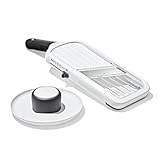
- Adjustable Handheld Mandolines: Best for quick jobs and small kitchens. Models like the OXO Good Grips Handheld Mandoline Slicer and the Fullstar Handheld Mandoline Vegetable Slicer are lightweight, store in a drawer, and are ideal for slicing one or two cucumbers, radishes, or lemons. Most handhelds offer 3 to 4 thickness settings, typically from 1.0mm to about 4.5mm.
- Full-Size Flatbed & Stand Mandolines: Best for volume, precision, and versatility. The Gramercy Mandoline Slicer with 12 slice settings and the Mueller Pro-Series All-in-One 12 Blade Mandoline Slicer let you dial thickness from 1mm for potato crisps up to 9mm for thick gratin slices, and include dedicated julienne and waffle-cut blades.
- Safety-Focused Enclosed Models: Best for beginners or anyone nervous about an exposed blade. The ONCE FOR ALL Upgrade Safe Mandoline Slicer Plus uses a food pusher and enclosed chute so your hand never passes over the blade, while the Fullstar Essential Mandoline Vegetable Slicer offers a similar guarded design with interchangeable blades.
2. Set Up for Safe, Stable Slicing
Most mandoline injuries happen because the slicer slips or the user slices without a guard. Set up correctly every time before you cut.
- Lock it down: Place your mandoline on a clean, dry cutting board. Put a damp paper towel or non-slip mat under the board. If your model has fold-out legs or a non-slip base — as the Gramercy Mandoline Slicer and Mueller Pro-Series do — make sure all four points are fully engaged and wobble-free.
- Check the blade and thickness: Always adjust thickness with the blade facing away from you. Start at 2mm for your first test slices, then adjust thinner or thicker. Never change settings while food is on the runway.
- Always use protection: Use the included food holder, safety pusher, or a cut-resistant glove rated ANSI A4 or higher. If a potato or onion becomes too small to hold securely (under about 1.5 inches), discard it or save it for stock. Never hold the food with bare fingertips past the guard.
- Maintain a flat, dry runway: Wipe starch or juice off the mandoline surface between batches. A wet surface increases drag and makes you push harder, which reduces control.
3. Master the Core Techniques
Speed comes last. Consistent pressure and smooth motion come first.
- The Glide, Not the Chop: Use long, even strokes from the top of the runway to the bottom. Let the weight of the food holder do the work. Apply light, steady downward pressure — about the same force you would use to spread butter — and keep your wrist locked. Forcing or sawing creates uneven slices and increases slip risk.
- Straight Slices (1mm – 3mm): Perfect for scalloped potatoes, zucchini ribbons, and apple chips. Keep the food flat against the runway. For long vegetables like cucumbers, cut them in half lengthwise first to create a stable flat side.
- Julienne and Matchsticks: Install the julienne comb blade first. On models like the Fullstar Essential Mandoline Vegetable Slicer or the Mueller Pro-Series All-in-One, the julienne blades click in perpendicular to the main blade. Run the food through once to create strips. For a fine 3mm julienne, use firm vegetables like carrots and jicama.
- Waffle and Crinkle Cuts: Use the waffle blade and rotate the vegetable 90 degrees after each slice. This works best with a thickness of 3.5mm to 4.5mm and with starchy potatoes that hold their shape.
4. Clean, Sharpen, and Store Properly
A mandoline is only as good as its edge. A dull blade is actually more dangerous because it requires more force.
- Clean immediately after use: Rinse the frame and blades under warm running water immediately to prevent starch from drying. Use a soft brush — never a sponge with bare fingers — to sweep debris away from the blade edge. Most stainless steel blades, including those on the ONCE FOR ALL Upgrade Safe Mandoline Slicer Plus, are hand-wash only to preserve sharpness.
- Dry and protect the blade: Towel dry, then air dry completely before storing. Store with the blade guard or safety pusher locked in place. Never store loose in a drawer where the edge can be nicked.
- Check sharpness twice a year: If a tomato skins instead of slicing cleanly at 2mm, the blade needs replacement. Most manufacturers sell replacement blades; fixed-blade handhelds like the OXO Good Grips Handheld Mandoline Slicer are designed to be replaced as a unit when dull after 2-3 years of home use.
Tips
- Chill soft produce for 15-20 minutes in the freezer before slicing. Semi-firm tomatoes, mozzarella, and ripe mangoes slice much more cleanly when cold.
- Slice at a 30 to 45-degree angle for larger, more dramatic planks of cucumber or diagonally cut carrots for stir-fries.
- Work over a large bowl or sheet pan to catch slices neatly and to avoid reaching across the blade to collect them.
- If you are right-handed, position the mandoline with the top slightly angled to your left — this keeps your slicing arm in a natural, controlled path and improves visibility.
Frequently Asked Questions
What thickness should I use for different foods?
For potato chips and dehydrated vegetable crisps, use 1.0mm to 1.5mm. For gratins, sandwiches, and fruit tarts, 2mm to 3mm is ideal. For coleslaw and stir-fry, set julienne to 3mm. Start thin and test on one piece before committing the whole batch.
Do I really need a cut-resistant glove?
Yes, if you are not using a fully enclosed safety pusher. Even professionals use them. A food holder protects you until the food gets small, but a Level 5 cut-resistant glove protects your holding hand the entire time. An enclosed model like the ONCE FOR ALL Upgrade Safe Mandoline Slicer Plus is the best alternative if you prefer not to wear a glove.
Why are my slices uneven or sticking?
Uneven slices are usually caused by inconsistent pressure or varying speed. Sticking is caused by starch or a wet runway. Use a firm, even glide without pausing mid-stroke, and wipe the runway clean between every 4-5 slices when cutting potatoes.
Handheld vs. full-size mandoline: which is better for beginners?
Beginners often do best with either an enclosed safety model or a simple handheld. The Fullstar Handheld Mandoline Vegetable Slicer and OXO Good Grips Handheld Mandoline Slicer are intuitive and less intimidating for small tasks. If you cook large batches regularly, a guarded full-size system like the Gramercy Mandoline Slicer or Fullstar Essential Mandoline Vegetable Slicer gives you more thickness control with added safety features.
Conclusion
A mandoline turns tedious knife work into fast, precise prep, but safe habits are what make it a joy to use. Choose a stable, well-guarded model that fits your kitchen, always use the hand guard or a cut-resistant glove, and focus on smooth, light, consistent strokes. With the right setup and technique, you will get perfectly even slices in a fraction of the time — safely every time.






Write Your Review
No reviews yet. Be the first to share your experience!