
Key takeaways
- Amps = Watts divided by Volts. On a standard U.S. 120V outlet, 800W = 6.7 amps, 1,000W = 8.3 amps, 1,200W = 10 amps, 1,500W = 12.5 amps, 1,700W = 14.2 amps.
- A typical kitchen or dorm circuit is 15 amps / 1,800 watts total. A 1,500-watt air fryer plus a 900-watt microwave running together will trip it.
- Many RV outlets share a 15-amp branch, and a 30-amp RV service is shared across the whole rig. A 1,000-watt fryer leaves about 6 to 7 amps for a fridge, lights, and laptop.
- If you run on an inverter or portable power station, check continuous output, not peak. A 1,000-watt inverter will struggle with a 1,200-watt fryer even if it claims 2,000-watt peak.
The lowest wattage air fryer you can reliably buy in 2026 is an 800 to 1,000-watt 2-quart compact model, typically from DASH or Elite Gourmet, and it will run on a 15-amp kitchen or RV circuit without tripping a breaker if nothing else high-draw is running.
For most people in a dorm, RV, or older kitchen, the best low wattage air fryer is not the absolute lowest-watt model, but a 1,000 to 1,200-watt 2 to 4-quart unit. You get breaker-friendly operation with only a 15 to 25% cooking time penalty versus a standard 1,500 to 1,700-watt family-size air fryer. The most energy efficient air fryer is usually a small, well-insulated 2 to 3-quart basket model, because it heats less empty space and finishes single servings faster.
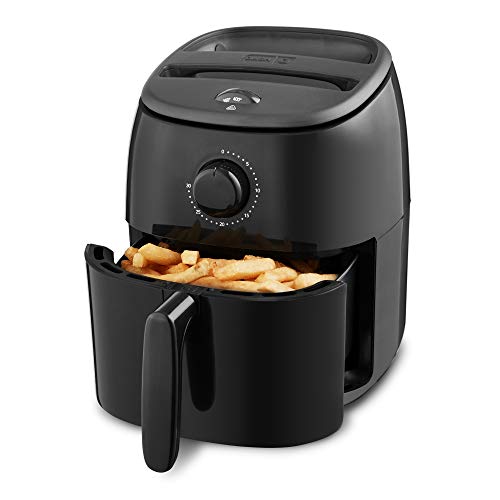
Dash Tasti-Crisp Small Air Fryer, 2.6 Quart, 1-2 People, Black
Included for 'Lowest Wattage Air Fryers for RVs and Small Kitchens' because the listing specifies 2.6 Quart and 1-2 People, details this guide uses to compare options.
View on Amazon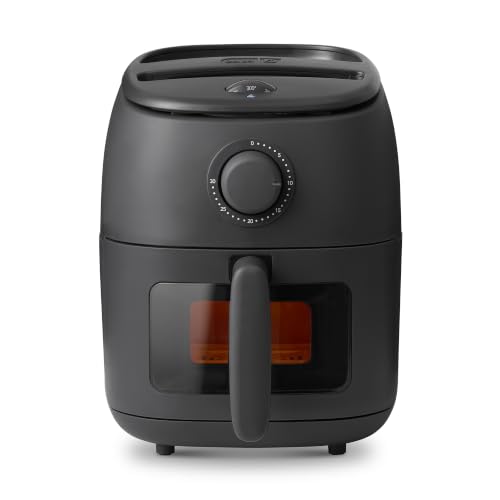
Dash 2.6QT Infrared Small Analog Air Fryer-Compact Mini Air fryer with Ceramic Nonstick Coating, Viewing Window, Easy Dial Controls & Cool-Touch Handle- Dishwasher Safe Parts
Included for 'Lowest Wattage Air Fryers for RVs and Small Kitchens' because the listing specifies Viewing Window, details this guide uses to compare options.
View on Amazon
CHEFMAN 2 Qt Mini Air Fryer – Digital Space-Saving Compact Air Fryer with Nonstick and Dishwasher Safe Basket, Quick & Easy Meals in Minutes, Features Digital Timer and Shake Reminder – Black
Included for 'Lowest Wattage Air Fryers for RVs and Small Kitchens' because the listing specifies Quick & Easy Meals in Minutes and Features Digital Timer and Shake Reminder, details this guide uses to compare options.
View on AmazonActual wattage vs. label wattage: what to expect
Rated wattage is the maximum draw on high heat. In real use, air fryers cycle the heating element on and off to hold temperature, so average draw is lower. A 1,000-watt compact fryer may pull 950 to 1,020 watts during heat-up at 400°F, then cycle down to an average of 650 to 750 watts over a 15-minute cook. A 1,500-watt Ninja or COSORI does the same thing at a higher level, averaging around 1,000 to 1,100 watts over the same cook.
That cycling is why low-wattage models are slower but not dramatically more efficient per meal. They use fewer watts per minute, but run for more minutes. Where they win is peak load: they stay under breaker limits and inverter limits in RVs and vans.
Use this quick breaker math before you buy:
- Amps = Watts divided by Volts. On a standard U.S. 120V outlet, 800W = 6.7 amps, 1,000W = 8.3 amps, 1,200W = 10 amps, 1,500W = 12.5 amps, 1,700W = 14.2 amps.
- A typical kitchen or dorm circuit is 15 amps / 1,800 watts total. A 1,500-watt air fryer plus a 900-watt microwave running together will trip it.
- Many RV outlets share a 15-amp branch, and a 30-amp RV service is shared across the whole rig. A 1,000-watt fryer leaves about 6 to 7 amps for a fridge, lights, and laptop.
- If you run on an inverter or portable power station, check continuous output, not peak. A 1,000-watt inverter will struggle with a 1,200-watt fryer even if it claims 2,000-watt peak.
Lowest wattage air fryers compared
These are the common breaker-friendly types sold by established brands like DASH, Elite Gourmet, Gourmia, Instant, Ninja, and COSORI. Specs vary slightly by year and color variant, but capacities and wattage classes below have been stable.
| Type / Example class | Rated wattage | Capacity | Amps at 120V | Approx. footprint | Best for |
|---|---|---|---|---|---|
| Personal 2-qt compact, e.g. DASH Compact, Elite Gourmet Personal | 800 – 1,000W | 2.0 – 2.1 qt, 1-2 servings | 6.7 – 8.3A | 9 x 11 in. | Dorms, truck campers, solo RV use |
| Small 2-qt to 3-qt digital, e.g. DASH Tasti-Crisp 2.6-qt | 1,000 – 1,200W | 2.6 – 3.0 qt, 1-2 servings | 8.3 – 10.0A | 10 x 12 in. | Best balance for small kitchens |
| Compact 4-qt basket, e.g. Gourmia 4-qt, Instant Vortex Mini 4-in-1 4-qt | 1,300 – 1,400W | 4.0 qt, 2-3 servings | 10.8 – 11.7A | 11.5 x 13 in. | Couples who need real capacity |
| Standard 4-qt to 5.5-qt, e.g. Ninja AF101 4-qt, COSORI Pro 5.8-qt class | 1,500 – 1,700W | 4.0 – 5.8 qt, 3-5 servings | 12.5 – 14.2A | 12 x 14 in. and larger | Not ideal for 15A shared circuits |
The true wattage floor is about 800 watts for new basket models. Anything advertised far below that is usually a 12V car / truck cooker or a multi-function thermoelectric lunch box, not a true 400°F air fryer.
Cooking time penalty: how much slower is low wattage?
Expect frozen fries, wings, nuggets, and roasted vegetables to take 20 to 40% longer in an 800 to 1,000-watt fryer compared to a 1,500-watt+ model, plus 3 to 5 minutes preheat. The gap is largest for dense frozen foods and smallest for reheats and small fresh items.
As a practical example based on common recipe times:
- Frozen shoestring fries, half basket: 18 to 20 minutes at 1,550W vs. 24 to 27 minutes at 1,000W. Shake twice instead of once.
- Frozen chicken nuggets, single layer: 10 to 12 minutes at 1,500W vs. 13 to 16 minutes at 900W.
- Fresh broccoli or green beans with oil: 8 to 10 minutes vs. 11 to 13 minutes. Low-watt units brown less aggressively, so add 1 to 2 minutes for crispness.
- Thick chicken breast or pork chop: low-watt compacts often struggle. Add 8 to 12 minutes and check internal temperature with a thermometer. For regular meat cooking, a 1,200 to 1,300-watt 4-quart is a better minimum.
To reduce the penalty, cook in a true single layer, preheat fully, pat food dry, use only 1 to 2 teaspoons of oil, and avoid overfilling. Overfilling a 2-quart fryer hurts crisping more than low wattage does.
Which one should you buy? Match it to your situation
| Your situation | Pick this | Why |
|---|---|---|
| Dorm with strict 15A breaker, 1 person | 800 – 1,000W 2-qt manual or digital compact | Lowest peak draw, tiny counter space, enough for snacks and reheats |
| RV / van / 30A shore power or inverter | 1,000W 2-qt to 2.6-qt, or 1,200W max if inverter is 1,500W continuous | Leaves headroom for fridge and converter; easier to store while moving |
| Older kitchen where breaker trips often | 1,000 – 1,200W 2.6 – 3-qt | Runs with lights and fridge on same circuit; still crisps well for two people |
| Couple cooking full meals 4+ times per week | 1,300 – 1,400W 4-qt compact | Cooks 2 chicken breasts or 1 lb vegetables at once; dedicated outlet preferred |
| Low electric bill is main goal, normal wiring | 2.5 – 4-qt insulated basket model, any 1,200 – 1,500W brand | Total energy per meal matters more than watt rating; small basket wastes less heat |
In general market ranges, 2-quart 800 to 1,000-watt models are the most affordable, usually in the budget compact tier. Moving to a 2.6 to 4-quart digital model with presets and keep-warm typically adds modest cost but saves time if you cook daily.
Worked example: energy cost and RV runtime
Take a 1,000-watt 2-quart fryer cooking frozen fries for 25 minutes with cycling averaging 700 watts:
- Energy used = 0.70 kW x 0.42 hours = 0.29 kWh per batch.
- At a typical U.S. residential rate of 15 to 22 cents per kWh, that batch costs about 4 to 6 cents in electricity.
- A 1,500-watt model doing the same food in 19 minutes at ~1,050W average uses 0.33 kWh, or about 5 to 7 cents. The larger unit is not much more expensive per meal.
- For RV battery use: 0.29 kWh from a 12V system needs about 24 amp-hours before inverter losses. With 15% inverter loss, plan on about 28 amp-hours from the battery per batch. That is manageable for one meal on a 200Ah lithium setup, but heavy for daily use without solar or shore power.
The takeaway: buy low wattage to protect breakers and inverters, not to slash your electric bill. Portion size and avoiding a full-size oven matter more for energy savings.
Small-space ownership realities
Low-wattage compacts are simple, but small baskets show wear faster because food and oil sit closer to the coating.
- What wears first: the basket nonstick and the crisper plate feet / rubber bumpers. Flaking usually starts at corners and where the rack slides. Hand wash after cooling, avoid metal utensils and aerosol spray oils, and replace a badly flaking basket rather than lining it with foil that blocks airflow.
- Cleaning: wipe the heating element housing monthly. In RVs, grease buildup attracts dust and odors in a small space. A 10-minute 350°F empty heat with a vinegar-water tray underneath, followed by wiping, prevents sticky residue better than harsh degreasers.
- Common mistakes: using an extension cord or power strip, which can overheat with sustained 8 to 10-amp draw; cooking on an unlevel RV counter, which pools oil on one side; and storing the unit with the cord wrapped tightly around the hot housing, which cracks insulation over time.
- Ventilation: leave 5 inches behind and above the exhaust. In dorms and RVs, crack a vent or window for fish, bacon, and frozen breaded foods. Low-watt units run longer, so they release steam and smell longer.
If you have limited storage, choose a square basket over a round one in the same quart rating. It fits bread slices and meal-prep containers better and usually has a smaller vertical footprint for cabinets or RV bunks.
Final picks by priority
If breaker safety is absolute, get an 800 to 1,000-watt 2-quart compact. If you want the best low wattage air fryer for everyday cooking for two, step up to a 1,000 to 1,200-watt 2.6 to 3-quart model. If you regularly cook raw meat or full dinners, do not go below 1,200 to 1,300 watts and a true 4-quart basket, and plan to run it on a dedicated outlet with other large appliances off.
For general wellness, air frying can reduce added oil compared to deep frying, but overall nutrition depends on what you cook and how often. If you are managing a health condition or sodium intake, check with a healthcare professional or dietitian about how fried-style foods fit your needs.




Write Your Review
No reviews yet. Be the first to share your experience!