
Key takeaways
- Look for high-carbon stainless steel: German steel such as EN1.4116 (used in the MOSFiATA 8″ Super Sharp Professional Chef’s Knife) is prized for toughness and easy maintenance, while Japanese high-carbon stainless (found in the imarku Japanese Chef Knife and imarku Santoku Knife) can be hardened to a higher Rockwell for extreme sharpness.
- Check Rockwell Hardness (HRC): Aim for 58-60 HRC for a versatile Western-style chef’s knife and 60-62 HRC for a Japanese-style blade. Softer than 56 HRC dulls quickly; harder than 62 HRC can be brittle and difficult to sharpen without a whetstone.
- Stain resistance matters: If you want low maintenance, avoid pure high-carbon (non-stainless) steel unless you are willing to hand-wash and oil the blade. High-carbon stainless sets like the HOSHANHO 3 Pieces Knife Set give you Japanese sharpness without the reactivity.
What's inside
- Watch: What to Look For in a High-Quality Chef’s Knife — Video Review
- 1. Blade Steel and Hardness: What Holds an Edge
- 2. Blade Geometry and Size: Finding the Right Shape
- 3. Handle Comfort, Balance, and Control
- 4. Construction and Craftsmanship
- 5. Maintenance: Keeping a Sharp Knife Sharp
- Tips
- Frequently Asked Questions
- Conclusion
- Related Articles
A great chef’s knife does 90% of the work in your kitchen, from breaking down a butternut squash to finely mincing herbs. But with thousands of options ranging from $20 to $300, choosing one that actually holds an edge, feels balanced, and lasts for years comes down to a few measurable details — not marketing claims.
- Watch: What to Look For in a High-Quality Chef’s Knife — Video Review
- 1. Blade Steel and Hardness: What Holds an Edge
- 2. Blade Geometry and Size: Finding the Right Shape
- 3. Handle Comfort, Balance, and Control
- 4. Construction and Craftsmanship
- 5. Maintenance: Keeping a Sharp Knife Sharp
- Tips
- Frequently Asked Questions
- Conclusion
- Related Articles
In this 2026 guide, we break down exactly what separates a high-quality chef’s knife from an average one. You will learn how to evaluate steel, geometry, handle design, and construction so you can choose with confidence, whether you want a single versatile workhorse or a complete starter set.
As an Amazon Associate we earn from qualifying purchases at no extra cost to you. Product prices and availability are accurate as of the date shown and are subject to change.




⚡ Save on Your Next PC — Amazon Prime
Prime members get fast free shipping on the systems above, plus early access to Prime Day & Black Friday PC deals. New members get a 30-day free trial.
Watch: What to Look For in a High-Quality Chef’s Knife — Video Review
1. Blade Steel and Hardness: What Holds an Edge
Steel determines sharpness, edge retention, and how easy the knife is to maintain. For home cooks, high-carbon stainless steel is the sweet spot — it offers the sharpness and hardness of carbon steel with much better corrosion resistance.
- Look for high-carbon stainless steel: German steel such as EN1.4116 (used in the MOSFiATA 8″ Super Sharp Professional Chef’s Knife) is prized for toughness and easy maintenance, while Japanese high-carbon stainless (found in the imarku Japanese Chef Knife and imarku Santoku Knife) can be hardened to a higher Rockwell for extreme sharpness.
- Check Rockwell Hardness (HRC): Aim for 58-60 HRC for a versatile Western-style chef’s knife and 60-62 HRC for a Japanese-style blade. Softer than 56 HRC dulls quickly; harder than 62 HRC can be brittle and difficult to sharpen without a whetstone.
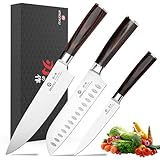
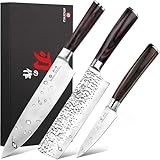
- Stain resistance matters: If you want low maintenance, avoid pure high-carbon (non-stainless) steel unless you are willing to hand-wash and oil the blade. High-carbon stainless sets like the HOSHANHO 3 Pieces Knife Set give you Japanese sharpness without the reactivity.
2. Blade Geometry and Size: Finding the Right Shape
Geometry affects how the knife cuts, not just how sharp it is. An 8-inch chef’s knife is the most versatile length for most adults — long enough to slice a watermelon or portion a roast, yet nimble enough for onions and garlic. A 7-inch Santoku is an excellent alternative if you have smaller hands or a compact kitchen.
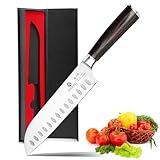
- Blade length: 8 inches is the standard for all-purpose work. If you are under 5’4″ or have limited board space, consider a 7-inch option like the imarku Santoku Knife 7 Inch for better control.
- Edge angle: Japanese knives are typically sharpened to 15 degrees per side (30 degrees total) for razor-like precision, while German knives are often 18-20 degrees per side for durability. A 15-degree edge slices more cleanly but needs more frequent honing.
- Blade profile: A gently curved belly is ideal for rock-chopping, while a flatter profile (common on Santoku knives) excels at push-cuts and precise vegetable work. The imarku 3 Pieces Knife Set is useful here because it includes different profiles to cover both techniques.
- Thickness and grind: Look for a blade that tapers from a 2.0-2.5mm spine to a thin edge. A full taper and hand-polished edge reduce wedging in dense foods like potatoes and carrots.
3. Handle Comfort, Balance, and Control
You will hold this knife thousands of times a year, so ergonomics matter as much as steel. A high-quality handle should feel secure when wet, prevent fatigue, and place the balance point right where the blade meets the handle.
- Material: Pakkawood, as seen on the imarku 3 Pieces Knife Set with Ergonomic Pakkawood Handle, offers the warmth of wood with resin-stabilized water resistance. Micarta, used on the MOSFiATA 8″ Super Sharp Professional Chef’s Knife, is even more durable and grippy when wet — ideal if you rarely dry your hands while cooking.
- Shape and grip: Hold the knife in a pinch grip (thumb and forefinger on the blade). Your fingers should not feel cramped against a bulky bolster. An ergonomic, slightly contoured handle reduces pressure points during long prep sessions.
- Balance: A well-balanced 8-inch chef’s knife typically weighs 200-280 grams. The balance point should be at or just in front of the bolster. Blade-heavy knives feel tiring; handle-heavy knives feel imprecise.
- Bolster and finger guard: A full bolster adds heft but makes sharpening harder. A half-bolster or integrated finger guard, like on the MOSFiATA model, gives you safety without interfering with sharpening the full edge.
4. Construction and Craftsmanship
Construction determines durability and how the knife ages. In 2026, most quality knives at under $100 use excellent factory construction, but there are still details to check.
- Forged vs. stamped: Forged blades are generally thicker, harder, and better balanced. Stamped blades are lighter and more affordable. Both can be excellent — the imarku Japanese Chef Knife-Sharp Kitchen Knife 8 Inch uses forged high-carbon steel to achieve a hard, thin edge at a competitive price.
- Tang: A full tang (steel runs the full length of the handle) provides strength and balance. Look for visible rivets or a seamless handle construction.
- Fit and finish: Run your finger along the spine and choil (the heel where blade meets handle). Edges should be smooth and slightly rounded, not sharp. No gaps should exist where the handle meets the steel, which can trap food and moisture.
5. Maintenance: Keeping a Sharp Knife Sharp
Even the best steel will dull with use. A high-quality knife should be easy to keep sharp with simple tools, not require professional service after every few weeks.
- Honing vs. sharpening: Hone with a rod or included sharpener weekly to realign the edge; sharpen on a whetstone or with the included sharpener (like the one paired with the MOSFiATA 8″ Super Sharp Professional Chef’s Knife) every 3-6 months depending on use.
- Care: Always hand-wash and dry immediately. Even stainless steel can pit if left wet or put in a dishwasher. Store on a magnetic strip or in a blade guard, not loose in a drawer.
- Sets vs. single knife: If you are building a kitchen from scratch, a curated set such as the HOSHANHO 3 Pieces Knife Set or the imarku 3 Pieces Knife Set with High Carbon Stainless Steel offers a matched chef’s knife, Santoku, and paring knife with consistent steel and handles — often for less than buying each individually.
Tips
- Try the pinch-grip test: If you cannot comfortably pinch the blade just in front of the handle for 30 seconds, the handle geometry is wrong for you.
- Cut a sheet of paper after sharpening: A sharp 8-inch chef’s knife should slice printer paper cleanly without tearing — a quick way to test a new edge.
- Use a soft cutting board: End-grain wood or soft plastic preserves a 15-degree edge far longer than bamboo, glass, or ceramic.
- Match the knife to your cooking style: Choose a versatile 8-inch chef’s knife for rock-chopping and protein work, and add a 7-inch Santoku like the imarku Santoku Knife if you do mostly vegetable prep and want less rocking motion.
Frequently Asked Questions
What is the best size for a first chef’s knife?
For most home cooks, an 8-inch chef’s knife is the best all-purpose choice. It provides enough edge length for slicing and enough knuckle clearance for safe chopping. Cooks with smaller hands, smaller boards, or who prefer push-cutting may find the 7-inch Santoku more comfortable and easier to control.
What is the difference between Japanese and German steel?
Japanese high-carbon stainless steel is typically hardened to 60-62 HRC and ground to a thinner, more acute 15-degree angle for maximum sharpness and precision — great for vegetables and fine work. German steel like EN1.4116 is usually 56-58 HRC and slightly softer and tougher, making it more forgiving, easier to hone, and less prone to chipping if you cut around bones or frozen foods.
Is a knife set worth it or should I buy one good chef’s knife?
If you only cook occasionally, start with one excellent 8-inch chef’s knife such as the imarku Japanese Chef Knife or MOSFiATA 8″ Super Sharp Professional Chef’s Knife. If you cook daily, a 3-piece set like the HOSHANHO 3 Pieces Knife Set or imarku 3 Pieces Knife Set gives you a chef’s knife, Santoku, and small utility knife that share the same steel and balance, covering nearly all tasks without redundancy.
How often should I sharpen my chef’s knife?
Hone your knife with a honing rod or the included sharpener every 2-3 uses to keep the edge aligned. True sharpening that removes metal and restores the bevel is needed every 3-6 months for a home cook (or after 40-60 hours of cutting). Harder Japanese blades hold their edge longer but should be sharpened on a whetstone rather than a pull-through sharpener to protect the fine edge.
Conclusion
A high-quality chef’s knife is defined by hard, high-carbon stainless steel, thoughtful geometry, a comfortable and well-balanced handle, and solid construction — not by price alone. Prioritize an 8-inch blade with 58-61 HRC hardness, a 15-20 degree edge, and a handle material like Pakkawood or Micarta that feels secure in your hand. Whether you choose a single workhorse like the imarku Japanese Chef Knife or invest in a versatile trio like the HOSHANHO 3 Pieces Knife Set, the right knife will make prep faster, safer, and far more enjoyable for years to come.



Write Your Review
No reviews yet. Be the first to share your experience!