
Key takeaways
- Smoother results: Stronger motors and better blade systems can reduce icy chunks, fibrous greens, and partially blended fruit.
- Better with demanding ingredients: Premium models are generally more capable with frozen fruit, ice, dates, nuts, and thick shakes than very small entry-level blenders.
- Faster daily routine: One-touch programs, travel lids, and dishwasher-safe parts can save time when you blend every morning.
- More durable construction: Heavier bases, stronger cup threads, and better seals may hold up better under frequent use.
- Greater capacity flexibility: Many higher-priced models include cups in the 20- to 32-ounce range, making them practical for a large smoothie or two smaller portions.
- More control: Pulse settings and variable speeds are useful when you want to control texture instead of relying on one automatic cycle.
- Potentially better service: A longer warranty and replacement cups or blades can make an expensive blender less frustrating to own.
What's inside
The Short Answer
Is a high end personal blender worth the money? Usually, yes—but only if you make thick smoothies, frozen drinks, protein shakes, or single-serve blends several times a week and want better speed, convenience, and durability than a $30 to $70 model can provide.
For occasional smoothies, a basic personal blender is the smarter buy. Spending $100 to $200, and sometimes more, will not make every drink dramatically better. The value comes from using the blender often enough to benefit from stronger blending, sturdier parts, quieter operation, better controls, and a more useful warranty.
As an Amazon Associate we earn from qualifying purchases at no extra cost to you. Product prices and availability are accurate as of the date shown and are subject to change.

What You Actually Get
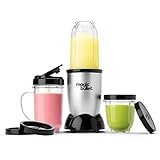
A high-end personal blender is typically designed for one or two servings, with a cup capacity of about 18 to 32 ounces. Most include a motor in the roughly 700- to 1,200-watt range, though wattage alone is not a reliable measure of performance. Blade design, motor control, cup shape, and the blender’s ability to maintain speed under load matter just as much.
Compared with an entry-level model, a premium machine may handle frozen fruit, ice, leafy greens, nut butter, and dense protein shakes with fewer pauses or shakes from the user. Some models use preset programs, pulse controls, or automatic shutoff sensors. Others include insulated cups, travel lids, multiple blade assemblies, or a separate larger blending jar.
Build quality is another important difference. A budget blender may rely heavily on lightweight plastic and a small motor base. A more expensive model often feels more secure on the counter, uses thicker cups, and has a better-designed blade connection. Those improvements can matter if you blend daily, carry the cup to work, or frequently use hard or frozen ingredients.
Expect a personal blender to take up approximately 5 to 8 inches of counter width and 5 to 8 inches of depth. Depending on the cup and base, the assembled height can be 12 to 18 inches, which may be too tall to fit beneath some kitchen cabinets. Premium models can also weigh 5 to 10 pounds, compared with roughly 2 to 5 pounds for simpler machines. Check the base and cup dimensions before buying, especially if you plan to store it in a cabinet.
The most useful upgrade is often consistency rather than raw speed. A high-end blender may produce a smoother drink from frozen berries, spinach, ice, and seeds without requiring as much liquid. That can create thicker smoothies, but it also means the blender needs enough time and space to circulate ingredients. No personal blender performs well when the cup is overfilled.
Pros
- Smoother results: Stronger motors and better blade systems can reduce icy chunks, fibrous greens, and partially blended fruit.
- Better with demanding ingredients: Premium models are generally more capable with frozen fruit, ice, dates, nuts, and thick shakes than very small entry-level blenders.
- Faster daily routine: One-touch programs, travel lids, and dishwasher-safe parts can save time when you blend every morning.
- More durable construction: Heavier bases, stronger cup threads, and better seals may hold up better under frequent use.
- Greater capacity flexibility: Many higher-priced models include cups in the 20- to 32-ounce range, making them practical for a large smoothie or two smaller portions.
- More control: Pulse settings and variable speeds are useful when you want to control texture instead of relying on one automatic cycle.
- Potentially better service: A longer warranty and replacement cups or blades can make an expensive blender less frustrating to own.
Cons
- Higher upfront cost: A premium personal blender commonly costs about $100 to $200, while some specialty models cost $250 or more.
- Limited capacity: Even an expensive personal blender is not a replacement for a full-size 48- to 72-ounce blender when you cook for a family.
- Noise remains an issue: A stronger motor can blend more effectively but may still be loud, particularly when crushing ice.
- More parts to clean: Extra cups, lids, gaskets, and blade assemblies add convenience but also create more pieces that can retain food or odors.
- Marketing can be misleading: A high wattage number does not guarantee a smoother blend, and preset programs are not necessarily better than manual controls.
- Thick mixtures require technique: Frozen ingredients still need adequate liquid and correct loading. A premium motor cannot compensate for a tightly packed, dry cup.
- Replacement costs add up: Specialty cups and blade attachments can be expensive, particularly if they are proprietary.
Who Should Buy It
A high-end personal blender makes sense for someone who blends at least four or five times per week. It is especially worthwhile if your recipes regularly include frozen fruit, ice, leafy greens, protein powder, dates, or nut-based ingredients. Daily users are more likely to notice a premium machine’s smoother results and easier cleanup.
It is also a good choice for people who want a dependable morning routine. A cup that doubles as a travel container, a reliable start button, and a dishwasher-safe lid can be worth more than a higher top speed. If you have limited counter space, choose a model with a compact base and a cup height that fits your cabinets.
Consider the purchase if you live alone or with one other person and rarely need more than 20 to 32 ounces at once. A personal blender can be less cumbersome than a full-size machine, and premium models are often easier to keep accessible rather than hidden in a cabinet.
Who Should Skip It
Skip the upgrade if you make a smoothie once a week, mainly blend soft fruit, or are shopping for the lowest possible cost. A basic model can handle yogurt, milk, bananas, and fresh berries without a premium motor.
You should also skip it if you need to make soup, batter, sauces, or multiple servings at once. Personal blender cups are too small for many family-size recipes, and hot liquids can be unsafe in sealed blending containers unless the manufacturer specifically permits them.
Finally, do not buy a premium personal blender solely because the box lists a large wattage number. Read the warranty, cup capacity, cleaning instructions, replacement-part availability, and maximum recommended blend time. Those details are more useful predictors of ownership satisfaction.
Cheaper Alternatives
| Option | Cost | Trade-off |
|---|---|---|
| Magic Bullet Personal Blender, 250 watts, 22-ounce cup | About $30 | Very affordable and compact, but less suited to frequent ice crushing, dense mixtures, or large frozen blends. |
| Ninja Nutri-Plus Personal Blender, 900 watts, three 20-ounce cups | About $70 | More powerful and versatile than basic models, but it may lack the refinement, controls, and long-term parts support of a premium machine. |
| Midrange personal blender | About $60 to $100 | Often offers a useful balance of power and price, though construction, noise control, and warranty coverage vary widely. |
| Full-size countertop blender on sale | About $80 to $150 | Provides more capacity and recipe flexibility, but takes up more space and is less convenient for one-person drinks. |
The $29.98 Magic Bullet is a sensible choice for simple shakes and occasional food prep. The $69.97 Ninja Nutri-Plus is a stronger value for regular smoothie drinkers who want more power and several cups without reaching premium pricing. Either can be the better purchase than a high-end blender if your recipes are straightforward.
FAQ
How much should I spend on a high-end personal blender?
Plan on approximately $100 to $200 for a reputable high-end personal blender. Above $200, you are often paying for specialty features, accessories, design, or a broader warranty rather than a proportional improvement in every smoothie. Compare the cup system, warranty length, replacement-part cost, and cleaning process before focusing on the price alone.
Is a high-wattage personal blender automatically better?
No. Wattage describes electrical power, not the finished texture of a smoothie. A well-designed 700- or 900-watt blender can outperform a poorly engineered model with a larger advertised number. Look for a blade design that matches your ingredients, a cup that encourages circulation, useful speed controls, and clear guidance about ice and frozen foods.
Can a personal blender crush ice and frozen fruit?
Many can, but performance depends on the recipe and the manufacturer’s instructions. Use some liquid, avoid packing the cup tightly, and add frozen ingredients in manageable amounts. A premium model is more likely to produce a smooth result quickly, but it is not a commercial ice crusher. For frequent frozen cocktails or large batches, a full-size blender is usually the better tool.
What is the best reason to upgrade in 2026?
The best reason is consistent, convenient daily use. If a stronger personal blender helps you make a smooth breakfast quickly, clean up easily, and avoid replacing a cheap motor every year, the added cost can be justified. If you are only hoping for a marginally smoother occasional smoothie, keep the money and choose a reliable model in the $30 to $70 range.


Write Your Review
No reviews yet. Be the first to share your experience!