
Key takeaways
- Less hands-on effort: The mixer can combine ingredients and work the dough while you prepare starter, clean up, or weigh the next ingredients.
- Useful for larger batches: A suitable full-size model can mix dough for multiple loaves in one bowl, reducing repeated manual work.
- More consistency: Using the same speed and mixing time can make your process easier to repeat from bake to bake.
- Helpful for difficult doughs: Low-hydration sourdough, whole-grain dough, and recipes containing seeds can be tiring to mix by hand.
- Versatility beyond bread: A stand mixer can usually handle cakes, cookies, whipped cream, mashed potatoes, and other kitchen tasks.
- Accessibility: Motorized mixing can make sourdough more practical for bakers with limited hand, wrist, or shoulder strength.
What's inside
The Short Answer
No—unless you plan to make sourdough frequently or mix large, stiff batches. For most home bakers, sourdough can be mixed effectively by hand with a bowl and dough whisk, then developed through stretch-and-folds during the first few hours of fermentation. A stand mixer becomes worthwhile when you bake several loaves at a time, want a faster and more repeatable mixing process, or find hand kneading physically uncomfortable.
The key distinction is that sourdough does not require intensive kneading in the same way some enriched breads do. Time, hydration, and folds do much of the work. A mixer is a convenience and capacity tool—not a requirement for good bread.
As an Amazon Associate we earn from qualifying purchases at no extra cost to you. Product prices and availability are accurate as of the date shown and are subject to change.

What You Actually Get
A stand mixer gives you a motorized mixing bowl, dough hook, and hands-free operation. For sourdough, you typically add the flour, water, starter, and salt to the bowl, mix until no dry flour remains, rest the dough, and then mix briefly again or finish with folds. The machine can also knead the dough until it becomes smoother and more elastic.
That sounds simple, but sourdough dough has a few traits that matter when choosing a mixer. It is often relatively wet, sticky, and heavy. A standard 4.5- to 5-quart home mixer may handle a single loaf comfortably, but its practical dough capacity is much lower than the bowl’s advertised volume. Depending on the recipe and flour, a reasonable working range may be about 1 to 2 pounds of dough. A mixer with a 6- to 8-quart bowl may handle two or more loaves, but you still need to check the manufacturer’s dough-capacity guidance rather than relying on bowl size alone.
Motor wattage is also an imperfect buying metric. A mixer advertised at 800 watts may have plenty of power for a home batch, but gearing, thermal protection, dough-hook design, and the machine’s weight affect real-world performance. A heavier mixer, often around 20 to 30 pounds, is less likely to walk across the counter with stiff dough. It also takes more space to store. Many full-size models are roughly 10 to 16 inches wide and 12 to 17 inches tall, with the head raised, so measure beneath cabinets before buying.
For comparison, an 8-quart commercial-style mixer such as the 8.4QT Commercial Stand Mixer listed at $384.99 offers an 800-watt motor, an 8-liter stainless steel bowl, and a dough hook, whisk, and beater. That capacity may appeal to frequent bakers, but it is much more machine than a beginner needs for one boule. It also requires a permanent countertop location or a strong storage shelf.
Pros
- Less hands-on effort: The mixer can combine ingredients and work the dough while you prepare starter, clean up, or weigh the next ingredients.
- Useful for larger batches: A suitable full-size model can mix dough for multiple loaves in one bowl, reducing repeated manual work.
- More consistency: Using the same speed and mixing time can make your process easier to repeat from bake to bake.
- Helpful for difficult doughs: Low-hydration sourdough, whole-grain dough, and recipes containing seeds can be tiring to mix by hand.
- Versatility beyond bread: A stand mixer can usually handle cakes, cookies, whipped cream, mashed potatoes, and other kitchen tasks.
- Accessibility: Motorized mixing can make sourdough more practical for bakers with limited hand, wrist, or shoulder strength.
Cons
- It is expensive for a task that does not require it: A capable stand mixer commonly costs about $250 to $500, while basic hand tools may cost less than $20.
- It takes up substantial space: A large mixer can occupy a permanent footprint of about 1 square foot or more and may weigh enough that moving it is inconvenient.
- It can overwork the dough: High-speed mixing can heat and tighten sourdough. The dough hook is usually best used at low speed, with pauses when necessary.
- It may not replace folds: Sourdough often benefits from stretch-and-folds or coil folds during bulk fermentation, even if the mixer performs the initial kneading.
- Small batches can be awkward: Some large bowls and hooks do not efficiently gather a small amount of dough, leaving ingredients smeared around the sides.
- Noise and cleanup are real considerations: A motor, bowl, hook, and splash-prone dough can be more cumbersome than mixing in one bowl by hand.
Who Should Buy It
A stand mixer makes sense if you bake sourdough at least once or twice a week, regularly make two or more loaves, or prepare other recipes that justify the appliance. It is particularly useful for households that want a repeatable workflow: mix in the machine, ferment in a covered container, shape by hand, and bake.
Look for a stable, full-size model with a dough hook, a bowl of at least 5 quarts for ordinary home batches, and clear guidance for bread-dough capacity. If you often make large batches, a 7- or 8-quart machine may be more comfortable, but confirm that it can also mix smaller quantities efficiently. A model around 800 watts can be a reasonable target for demanding home use, though wattage alone should not determine your choice.
Choose a stand mixer with a low-speed setting, overload protection, and a bowl that locks securely. If possible, consider the machine’s weight, warranty, replacement parts, and whether the bowl and attachments are easy to clean. A feature-heavy mixer is not automatically better for sourdough; stable construction and appropriate capacity matter more.
Who Should Skip It
Skip the stand mixer if you are learning sourdough, bake one small loaf at a time, or have limited counter and storage space. Hand mixing gives you useful tactile feedback: you can feel whether the flour is fully hydrated, notice how the dough changes during resting, and learn how hydration affects handling.
You should also skip it if the only reason you are considering one is that a recipe says to knead for several minutes. Sourdough recipes vary, and many rely on an initial mix followed by rest and folds. A mixer will not fix an inaccurate scale, weak starter, incorrect fermentation temperature, or underproofing.
Cheaper Alternatives
| Option | Cost | Trade-off |
|---|---|---|
| Danish dough whisk | About $9 | Very inexpensive and effective for combining wet dough; it does not knead hands-free. |
| Bench scraper and sturdy bowl | About $10–$30 | Excellent for folding, dividing, and shaping; requires manual mixing and some counter space. |
| Hand mixing and stretch-and-folds | $0 if you already own a bowl | Slowest option, but it provides the most tactile control and works well for one or two loaves. |
| Used 4.5- to 5-quart stand mixer | About $75–$200 | Lower cost and suitable for many home batches, but condition, attachments, and dough capacity vary. |
| 8-quart commercial-style stand mixer | About $350–$450 | Higher capacity and stability, but expensive, heavy, and excessive for occasional single-loaf baking. |
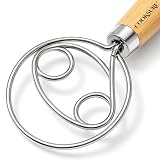
A Danish dough whisk is arguably the best first purchase. The COOKSURE 13-inch model, listed at $8.93, has a wooden handle and a 304 stainless steel hook. Its open-loop design cuts through thick dough more easily than a standard spoon, while the long handle keeps your hands cleaner. It will not make the process hands-free, but it can combine flour and water in under a minute without stressing a motor or scraping a mixer bowl.
FAQ
Can I make sourdough without kneading?
Yes. Mix until the ingredients are combined, let the dough rest, and use a series of stretch-and-folds or coil folds during bulk fermentation. The exact number depends on the recipe, flour, hydration, and dough strength. The dough should become smoother and hold its shape progressively rather than remaining slack and shaggy.
Is a stand mixer better than hand mixing for sourdough?
It is faster and less physically demanding, but not inherently better. Hand mixing often gives beginners more control and helps them recognize changes in dough texture. A mixer is better for capacity, convenience, and repeatability; hand mixing is better for low cost, small batches, and learning.
What size stand mixer do I need for one loaf?
A 4.5- to 5-quart mixer is generally sufficient for a typical single loaf, provided the recipe falls within the manufacturer’s dough-capacity limits. Do not fill the bowl based only on its liquid volume. A 6- to 8-quart mixer is more appropriate when you routinely make multiple loaves, but it may be less efficient for very small batches.
Will a stand mixer damage sourdough?
It can if used aggressively. Mix at low speed, avoid running the dough hook continuously for long periods, and monitor the dough’s temperature. Sourdough does not need maximum speed. Stop once the dough is cohesive and has developed the desired strength, then use folds during fermentation if the recipe calls for them.



Write Your Review
No reviews yet. Be the first to share your experience!