
Key takeaways
- Confusing coffee cups with household cups: A 12-cup label means roughly 60 fluid ounces, not twelve 8-ounce mugs.
- Measuring only the machine’s base: Include the handle, power cord, open lid, and space needed to remove the filter basket.
- Ignoring cabinet clearance: A machine may fit when closed but be impossible to fill without pulling it forward.
- Buying a replacement by capacity alone: Two carafes with the same cup rating may have different openings, lids, and warming-plate bases.
- Choosing the biggest size automatically: Extra capacity can mean more wasted coffee, a larger footprint, and a longer brewing cycle.
- Forgetting mug size: If your usual mug holds 12 to 16 ounces, calculate servings from the total fluid-ounce capacity rather than the cup label.
What's inside
Choosing the right carafe size is less about the number printed on the box and more about how much coffee you actually serve, how much counter space you have, and whether the carafe must fit beneath an upper cabinet. If you are asking, “what size coffee maker carafe do I need,” start by treating a coffee-maker “cup” as 5 fluid ounces—not the 8-ounce cup used for most drink measurements.
The Short Answer
A 10- to 12-cup carafe is the best all-purpose choice for most households. It brews approximately 50 to 60 fluid ounces, or about four to seven ordinary 8-ounce mugs depending on how full you pour them. Choose a 4- to 5-cup model for one or two coffee drinkers, an 8- to 10-cup model for a couple or small family, and a 14-cup model for frequent entertaining or a large household.
As an Amazon Associate we earn from qualifying purchases at no extra cost to you. Product prices and availability are accurate as of the date shown and are subject to change.
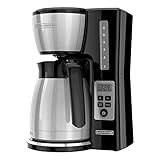

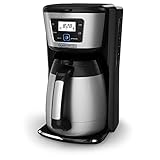

Remember that a larger carafe usually means a larger coffee maker. A 12-cup drip machine may occupy approximately 9 to 11 inches wide by 8 to 10 inches deep, with a height of 12 to 14 inches when its lid is closed. Many models need additional clearance above the machine so you can remove the brew basket or pour water into the reservoir.
For price planning, basic 12-cup drip coffee makers commonly range from about $35 to $65, while thermal models and feature-rich machines often cost approximately $60 to $85 or more. Replacement carafes can range from about $20 to $45, depending on the brand, capacity, lid, handle, and whether the model is glass or insulated stainless steel.
Standard Sizes
The measurements below describe common size categories, not a universal standard. The carafe itself may be narrower than the coffee maker, and the machine’s water reservoir can make the overall footprint larger. Always confirm the manufacturer’s dimensions before buying for a tight space.
| Carafe size | Approximate brew volume | Typical servings | Common carafe dimensions (W × D × H) | Typical coffee-maker footprint |
|---|---|---|---|---|
| 4 to 5 cups | 20 to 25 fl oz (591 to 739 mL) | 1 to 3 mugs | 6.0 × 5.0 × 7.5 in (15.2 × 12.7 × 19.1 cm) | 7 to 8 × 6 to 8 in (17.8 to 20.3 × 15.2 to 20.3 cm) |
| 8 to 10 cups | 40 to 50 fl oz (1.18 to 1.48 L) | 3 to 6 mugs | 7.0 × 6.0 × 8.5 in (17.8 × 15.2 × 21.6 cm) | 8 to 10 × 8 to 9 in (20.3 to 25.4 × 20.3 to 22.9 cm) |
| 12 cups | 60 fl oz (1.77 L) | 4 to 7 mugs | 8.0 × 6.5 × 9.0 in (20.3 × 16.5 × 22.9 cm) | 9 to 11 × 8 to 10 in (22.9 to 27.9 × 20.3 to 25.4 cm) |
| 14 cups | 70 fl oz (2.07 L) | 5 to 8 mugs | 8.5 × 7.0 × 9.5 in (21.6 × 17.8 × 24.1 cm) | 10 to 12 × 9 to 11 in (25.4 to 30.5 × 22.9 to 27.9 cm) |
A “cup” measurement on the water reservoir is based on a 5-fluid-ounce serving. A 12-cup machine therefore holds about 60 fluid ounces, not 96 fluid ounces. If everyone in your home drinks a large travel mug, a 12-cup machine may produce only three or four full servings.
How to Measure Your Space
- Measure the available width. Use a tape measure from the nearest wall, backsplash, or cabinet edge to the edge of the counter. Leave at least 1 inch of side clearance when possible, especially if the machine vents warm air from the sides.
- Measure the usable depth. Measure from the backsplash to the front edge of the counter. Add room for the carafe handle and enough space to remove it without striking a wall or another appliance. A machine listed as 9 inches deep may need 11 to 13 inches of practical working space.
- Check the height with cabinets. Measure from the counter to the underside of the upper cabinet. Compare that number with the machine’s height, then account for the open brew basket or water reservoir. A top-loading model may need 4 to 8 additional inches of clearance.
- Measure the cabinet-to-counter gap in use. If the maker must slide forward before you fill it, measure the counter depth and the available clearance in front of the machine. This is particularly important for a 12- or 14-cup machine.
- Locate the outlet. Keep the cord from crossing the sink, cooktop, or a walkway. Most household drip coffee makers use approximately 900 to 1,200 watts, so avoid overloading a small power strip with other heat-producing appliances.
- Measure a replacement carafe carefully. Record the carafe’s overall width, depth, height, handle projection, lid position, and the diameter of the opening that sits on the warming plate. Capacity alone does not guarantee compatibility.
By Room or Use Case
Small kitchen or apartment
A 4- to 5-cup machine is usually easiest to live with when counter space is limited. It can fit into a footprint of approximately 7 by 7 inches and may weigh around 3 to 6 pounds before adding water. This size is suitable for one large mug or two modest cups, but it may feel restrictive if you host guests often.
Everyday family kitchen
An 8- to 12-cup carafe is the most flexible choice for a household with two or more coffee drinkers. A 10-cup model offers a little more capacity without always reaching the footprint of the largest machines. A 12-cup machine is a better pick if people refill mugs throughout the morning or if you want extra coffee for an insulated travel tumbler.
Home office or work-from-home setup
Choose based on how many people drink coffee during the same work period. A 5-cup brewer may be enough for one person and reduces leftover coffee. For a shared office, a 10- or 12-cup thermal model can keep coffee warm without relying as heavily on a hot plate. Check the carafe’s height and handle clearance if the machine sits beneath shelves.
Entertaining and large households
A 14-cup carafe is useful when several people want coffee at once, but it takes more time to brew and occupies more counter space. Look for a wide, stable base, a clearly marked water reservoir, and a comfortable handle. If you regularly serve more than 10 people, brewing a second batch may be more practical than keeping an oversized machine on the counter every day.
Replacement carafe shopping
Do not choose only by the printed capacity. For example, a replacement carafe advertised for a 14-cup Cuisinart machine may cost about $20 to $30, while an entire 12-cup brewer may range from approximately $35 for a basic drip model to $85 for a thermal model. Compare the model number, lid design, pour spout, handle position, and bottom shape before ordering.
Common Sizing Mistakes
- Confusing coffee cups with household cups: A 12-cup label means roughly 60 fluid ounces, not twelve 8-ounce mugs.
- Measuring only the machine’s base: Include the handle, power cord, open lid, and space needed to remove the filter basket.
- Ignoring cabinet clearance: A machine may fit when closed but be impossible to fill without pulling it forward.
- Buying a replacement by capacity alone: Two carafes with the same cup rating may have different openings, lids, and warming-plate bases.
- Choosing the biggest size automatically: Extra capacity can mean more wasted coffee, a larger footprint, and a longer brewing cycle.
- Forgetting mug size: If your usual mug holds 12 to 16 ounces, calculate servings from the total fluid-ounce capacity rather than the cup label.
FAQ
Is a 12-cup coffee maker really 12 cups?
It makes approximately 60 fluid ounces because coffee-machine cups are typically 5 fluid ounces. That equals about seven 8-ounce cups or four to five large 12-ounce mugs, depending on how much coffee you pour and how much water is absorbed by the grounds.
What size carafe is best for two people?
An 8- to 10-cup carafe is usually the best balance for two people. Choose 5 cups if both drink one modest serving, or 12 cups if you each drink several mugs, fill travel cups, or want coffee left for later.
Are thermal carafes better than glass carafes?
Thermal carafes do not require a hot plate and can help preserve coffee without continuously heating it. They are often heavier and more expensive, with replacement prices commonly higher than comparable glass carafes. Glass is generally easier to inspect and replace, but it depends on a warming plate.
Can I use a larger replacement carafe?
Usually not. A larger carafe may not sit correctly on the warming plate, may interfere with the brew basket, or may exceed the machine’s water and brewing capacity. Use the exact compatible model or a replacement specifically listed for your coffee maker.




Write Your Review
No reviews yet. Be the first to share your experience!