
Choosing a drip coffee maker with a thermal carafe looks simple until you compare capacity, insulation, controls, and counter space. A common mistake is to focus on cup count alone. “12 cups” usually means 5-ounce coffee-maker cups, not twelve 8-ounce mugs. Another is assuming every stainless-steel carafe keeps coffee hot for the same length of time. Insulation design, lid fit, brew temperature, and how often the lid is opened all matter.
Shoppers also sometimes pay for features they will not use, overlook the height needed to open the water reservoir, or choose a machine that is awkward to pour from. This guide explains how to choose a drip coffee maker with thermal carafe by separating the specifications that affect daily use from the ones that mainly sound impressive. The goal is a machine that brews enough coffee, stays comfortably hot, and fits your routine without wasting counter space or money.
Our top picks
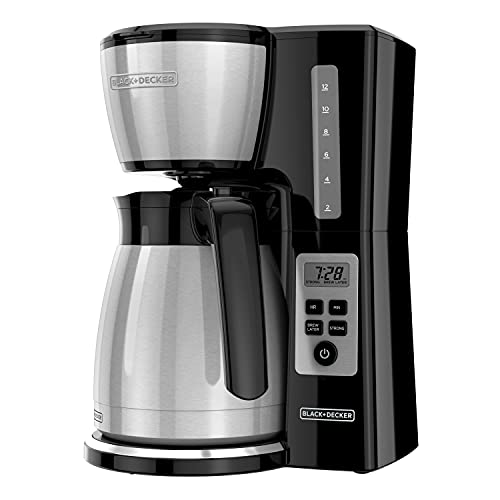 BLACK+DECKER 12 Cup Thermal Programmable Coffee Maker
- Double-walled 4-layer carafe keeps coffee hot for up…
- Program the 24-hour auto brew to enjoy fresh…
- Exclusive showerhead design evenly saturates coffee grounds for…
 Cuisinart 12-Cup Coffee Maker
- Trust that your second cup tastes as good…
- PerfecTemp brews at a higher temperature, and the…
- The thermal carafe locks in flavor without the…
 BLACK+DECKER 12-Cup Thermal Coffeemaker
- Please refer to user guide or user manual…
- Wide-Mouth Carafe Opening - The carafe is designed…
- No-Drip Perfect Pour Spout - Don’t put up…
| Product | Key specs | |
|---|---|---|
| BLACK+DECKER 12 Cup Thermal Programmable Coffee Maker | Double-walled 4-layer carafe keeps coffee hot for up… Program the 24-hour auto brew to enjoy fresh… Exclusive showerhead design evenly saturates coffee grounds for… | Check price |
| Cuisinart 12-Cup Coffee Maker | Trust that your second cup tastes as good… PerfecTemp brews at a higher temperature, and the… The thermal carafe locks in flavor without the… | Check price |
| BLACK+DECKER 12-Cup Thermal Coffeemaker | Please refer to user guide or user manual… Wide-Mouth Carafe Opening - The carafe is designed… No-Drip Perfect Pour Spout - Don’t put up… | Check price |
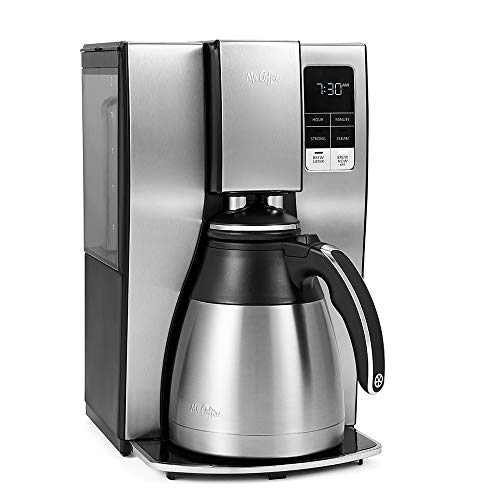 Mr. Coffee 10-Cup Programmable Coffee Maker | This Mr Brew a bolder cup of coffee with the… This Mr | Check price |
As an Amazon Associate we earn from qualifying purchases at no extra cost to you.
Decide These 3 Things First
- How much coffee do you actually brew? A 10- to 12-cup machine generally makes about 50 to 60 fluid ounces using the industry’s 5-ounce cup measurement. That is roughly six to seven standard 8-ounce mugs. If you usually make two or three mugs, a 4- to 6-cup model may be more practical and fresher.
- How long will the coffee sit? Thermal carafes are most useful when you drink coffee over several hours, take it to a meeting, or want to avoid a hot plate. If you finish a pot within 30 minutes, insulation may be less important than a compact footprint or lower price.
- Which controls will you use every day? A programmable start time, brew-strength setting, small-batch setting, and audible alert can be useful. Extra buttons are not automatically better if they make the machine difficult to program at 6 a.m.
Size: Match Capacity to Mugs and Counter Space
For most households, a 10- or 12-cup brewer is the sensible starting point. Expect a full-size machine to measure approximately 9 to 11 inches wide, 10 to 13 inches deep, and 13 to 16 inches high, depending on the carafe and control panel. It may need another 3 to 5 inches of vertical clearance if the lid or brew basket swings upward.
Capacity is more useful when translated into real servings. A 10-cup machine typically produces about 50 fluid ounces, while a 12-cup model produces about 60 ounces. That makes either size suitable for a family, a home office, or entertaining. For one or two coffee drinkers, consider a machine with a dedicated 1- to 4-cup setting rather than filling a large reservoir and storing leftovers.
Measure the counter from front to back, then check whether the water reservoir is removable or accessible under a cabinet. A brewer that fits its footprint but cannot be opened comfortably is not a good fit.
Material: Look Beyond “Stainless Steel”
Most thermal carafes use a stainless-steel outer shell with a vacuum-insulated interior. Stainless steel is durable and does not shatter like glass, but the grade and construction are less important to daily use than the lid and pouring design. A well-sealed lid reduces heat loss and helps prevent spills when the carafe is carried.
Look for a wide opening that allows hand washing or a bottle brush to reach the interior. Some carafes have narrow necks that are difficult to clean, allowing coffee oils to build up. A removable lid is helpful, but confirm that it locks securely and can be reassembled without forcing the gasket.
Plastic parts are common around the filter basket, reservoir, and handle. That is not necessarily a quality problem. Check whether the handle feels rigid, whether the reservoir markings are easy to read, and whether the brew basket has a reliable drip-stop valve. A stainless exterior may look premium while the important wear parts remain inexpensive plastic.
Construction: Insulation and Fit Matter Most
A thermal carafe should close firmly and pour without requiring the lid to be removed. Compare the lid mechanism carefully: push-button, lever, and twist-lock designs can all work, but the button should not feel loose and the seal should not require excessive force. The spout should deliver a controlled stream rather than dribbling down the side.
The brewer itself should have a stable base, a filter basket that slides into place easily, and a reservoir that does not flex when filled. A typical full-size machine weighs roughly 6 to 10 pounds without water. Extra weight can indicate a sturdier base, but it also makes the appliance less convenient to move for cleaning.
Check the coffee basket size and filter type. Many 10- and 12-cup machines use standard basket-style paper filters, while some accept a reusable filter. Reusable filters reduce ongoing waste but may allow more sediment and require thorough cleaning. A permanent filter should be easy to remove without spilling grounds.
Comfort and Performance: Prioritize Useful Controls
Programmability is valuable when it is clear and dependable. Look for a clock that is readable from a normal standing position, buttons with distinct feedback, and a delay-brew function that can be set without repeatedly consulting the manual. A two- to four-hour freshness timer or automatic shutoff is also useful, especially in busy households.
Brew-strength control changes the brewing pattern or contact time to produce a stronger cup; it does not turn ordinary coffee into espresso. A small-batch setting is more important if you routinely brew less than half a pot. Brew-pause lets you pour before the cycle finishes, but it should be treated as a convenience, not a reason to interrupt brewing repeatedly.
Most household drip brewers draw approximately 900 to 1,500 watts. Higher wattage alone does not prove better coffee, so do not select a machine solely by that number. Instead, look for a balanced showerhead or distribution system, a basket that spreads water over the grounds, and a thermal carafe that seals immediately after brewing.
Noise, beeps, and display brightness are personal considerations. If the machine will sit near a bedroom or shared workspace, a quieter alert and a dimmable display may matter more than an extra strength setting.
Price Tiers: Know What the Extra Money Buys
Prices fluctuate, but these ranges are useful for comparing like-for-like machines:
Do not assume a higher price guarantees hotter or better coffee. Compare capacity, carafe design, warranty, replacement parts, and cleaning convenience before paying for cosmetic finishes.
Warranty: Protect the Parts That Fail First
A one-year limited warranty is common for household drip coffee makers, while longer coverage is a meaningful advantage if the price difference is modest. Read what the warranty excludes: normal wear, mineral buildup, accidental damage, and commercial use are often outside coverage.
Keep the receipt and record the model number before discarding the packaging. Ask whether the manufacturer sells replacement carafes, lids, filter baskets, and water reservoirs. A broken carafe should not automatically make the entire brewer disposable. Also check whether warranty service requires shipping the whole machine and who pays transportation costs.
Delivery and Assembly: Plan for the First Brew
Most drip coffee makers require no assembly beyond installing the filter basket, carafe lid, and water reservoir. Allow about 10 to 15 minutes for unpacking, washing removable parts, and running one or two water-only cycles before brewing coffee. Some new machines have a noticeable manufacturing odor that a rinse cycle can reduce.
Before ordering, verify the box and appliance dimensions, especially if the brewer will be delivered to an apartment, office, or narrow kitchen. A full-size unit commonly ships in a package roughly 12 to 18 inches wide and may weigh 8 to 13 pounds. Check that delivery includes the carafe and permanent filter if the listing shows them in product images. Inspect the glass or stainless parts immediately for dents, cracks, and loose handles.
Spec Checklist
| Spec | Budget | Mid | Premium |
|---|---|---|---|
| Practical capacity | 10–12 maker cups, about 50–60 oz | 10–12 maker cups, plus small-batch setting | 8–12 maker cups, precise serving controls |
| Typical footprint | About 9–11 W × 10–13 D × 13–16 H in. | About 9–11 W × 10–13 D × 13–16 H in. | About 9–12 W × 11–14 D × 13–17 H in. |
| Power draw | Approximately 900–1,200 W | Approximately 1,000–1,400 W | Approximately 1,000–1,500 W |
| Carafe | Basic vacuum-insulated stainless steel | Better-sealing lid and controlled spout | Robust insulation, easy-clean lid, refined pour |
| Controls | Programmable clock and brew strength | Strength, delay brew, brew pause, auto shutoff | All mid-range controls with clearer display and finer adjustment |
| Warranty target | At least 1 year | At least 1 year, replacement parts preferred | 1–3 years or stronger service support |
| Typical price | Check on Amazon | Check on Amazon | Varies |
Red Flags
- The listing gives a cup count but does not explain the 5-ounce measurement or provide reservoir capacity.
- The carafe lid must be removed to pour, or the product photos do not show how it seals.
- There is no replacement-carafe information for a model with a proprietary shape.
- The water reservoir is permanently fixed beneath a cabinet with no front-access opening.
- Controls are poorly labeled, the clock resets easily, or the manual is unavailable.
- Reviews repeatedly mention leaking, grounds in the coffee, a loose handle, or a carafe that does not fit securely.
- The price is high mainly because of metal trim, while the warranty and core brewing controls are basic.
FAQ
Is a thermal carafe better than a glass carafe?
It is better for keeping coffee warm without a hot plate and for avoiding the burnt flavor that can develop when coffee sits on heat. A glass carafe can be easier to monitor and may cost less, but it is more fragile and depends on a warming plate.
How many cups should a two-person household buy?
A 10- or 12-cup brewer works if both people drink several mugs or you entertain. Otherwise, a 5- to 8-cup model may reduce waste. If you prefer a full-size machine, prioritize a 1- to 4-cup setting.
How long should coffee stay hot in a thermal carafe?
Manufacturers often describe performance over several hours, but actual results vary with the starting temperature, fill level, lid seal, and how often the carafe is opened. Preheating the carafe with hot water for a few minutes can reduce the initial heat loss.
What is the most important feature to compare?
For most buyers, it is the carafe’s seal and pouring comfort, followed by capacity and ease of cleaning. Strength controls and programming are useful only when they match your routine. A simple machine with a reliable lid and accessible parts is usually a better buy than a complicated one that is frustrating to use.
FAQ
Is a thermal carafe better than a glass carafe?
How many cups should a two-person household buy?
How long should coffee stay hot in a thermal carafe?
What is the most important feature to compare?
More from Amazon
Programs that pair well with the guide above. Offers and eligibility are set by Amazon and may change.
Set up recurring deliveries of everyday items on eligible products. Terms and savings are set by Amazon.
Explore Subscribe & SaveCollect the home and kitchen items you want in one registry that guests can shop from.
Create a wedding registryFree shipping on eligible items, Prime Video and more. Eligible new members can start with a free trial.
Start a Prime free trialAudiobooks and podcasts to listen to on the go. Eligible new members can start with a free trial.
Try Audible freeAs an Amazon Associate we earn from qualifying purchases.

Write Your Review
No reviews yet. Be the first to share your experience!