
Key takeaways
- Up to 2 people or occasional baking: a 4- to 5-quart mixer is usually sufficient.
- Family-sized cakes and regular cookies: choose a 5- to 6-quart mixer.
- Two or more loaves at a time: look at a 6.5-quart or larger dough-focused machine.
- Frequent dense dough: prioritize manufacturer dough limits and motor cooling over wattage printed on the box.
The best planetary mixers for home baking are the KitchenAid Artisan 5-Quart for most households, the Bosch Universal Plus for frequent large batches, and a compact 4- to 5-quart mixer for bakers who value a smaller countertop footprint.
Quick picks by baking situation
| Best for | Recommended type or model | Why it fits | Main compromise |
|---|---|---|---|
| Occasional cakes, cookies, and bread | KitchenAid Artisan 5-Quart Tilt-Head | Strong attachment ecosystem, familiar controls, and a useful medium-size bowl | Less comfortable with repeated heavy dough batches |
| Small kitchens and modest batches | Compact 4- to 5-quart tilt-head mixer | Usually narrower and easier to store than a lift-bowl machine | Reduced capacity and less headroom for stiff dough |
| Frequent bread baking | Bosch Universal Plus 6.5-Quart | Large dough capacity and a powerful direct-drive design | Tall, visually distinctive, and less versatile for some conventional attachments |
| Large dough batches and long-term ownership | Ankarsrum Assistant Original 7-Liter | Handles substantial dough quantities and includes a bowl scraper and dough roller | Different mixing motion and learning curve compared with a planetary mixer |
| One machine for baking and food preparation | Kenwood Titanium Chef Baker | Powerful motor, integrated weighing on some versions, and broad attachment support | Accessories can make the total cost and storage needs grow quickly |
What makes a planetary mixer suitable for home baking?
A planetary mixer uses a beater, whisk, or dough hook that rotates around the bowl while turning on its own axis. This movement covers more of the bowl than a simple handheld mixer and is particularly useful for creaming butter and sugar, whipping egg whites, and kneading enriched dough.
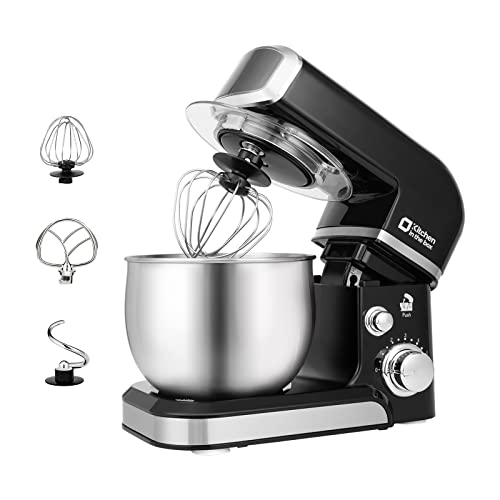
Kitchen in the box Stand Mixer,3.2Qt Small Electric Food Mixer,6 Speeds Portable Lightweight Kitchen Mixer for Daily Use with Egg Whisk,Dough Hook,Flat Beater (Black)
Included for 'Best Planetary Mixers for Home Baking' because the listing specifies 3.2Qt Small Electric Food Mixer and Dough Hook, details this guide uses to compare options.
View on Amazon
VIVOHOME Stand Mixer, 6-Quart Tilt-Head Kitchen Mixer with Bowl, Gray
Included for 'Best Planetary Mixers for Home Baking' because the listing specifies 6-Quart Tilt-Head Kitchen Mixer with Bowl and Gray, details this guide uses to compare options.
View on Amazon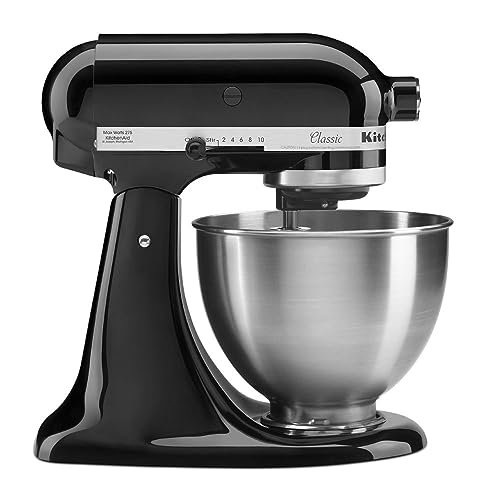
KitchenAid Classic Series 4.5 Quart Tilt-Head Stand Mixer K45SS, Onyx Black
Included for 'Best Planetary Mixers for Home Baking' because the listing specifies Onyx Black, details this guide uses to compare options.
View on Amazon
Waring Luna Planetary Stand Mixer with 7-Quart Capacity
Included for 'Best Planetary Mixers for Home Baking' as a relevant option in this category; details come from the product listing.
View on AmazonCapacity alone does not tell you how much food a machine can mix successfully. A bowl may hold 5 quarts, but a stiff dough can overload the motor long before the bowl is full. For practical planning, a 5-quart machine is generally most comfortable with one standard cake batter, two dozen cookies, or one moderate loaf recipe. Larger machines are better suited to multiple loaves or larger batches, provided the recipe is within the manufacturer’s dough limits.
Head-to-head comparison
| Model | Nominal bowl capacity | Mixing style | Speed control | Approximate footprint | Best use |
|---|---|---|---|---|---|
| KitchenAid Artisan 5-Quart | 4.8 L / 5 qt | Planetary, tilt-head | 10-speed lever | About 35.5 × 22.1 cm | Cakes, cookies, frosting, moderate dough |
| KitchenAid 7-Quart Bowl-Lift | 6.6 L / 7 qt | Planetary, bowl-lift | 11-speed control on current versions | About 41.9 × 28.7 cm | Large batches and heavier dough |
| Bosch Universal Plus | 6.2 L / 6.5 qt | Bottom-drive mixer with central column | Variable electronic control | About 35.6 × 33 cm | Frequent bread and high-volume dough |
| Ankarsrum Assistant Original | 7 L bowl | Rotating bowl with roller and scraper | Variable dial control | About 48 × 26.8 cm | Large bread batches and dense dough |
| Kenwood Titanium Chef Baker | 5 L and 3.5 L bowls, depending on package | Planetary, lift-head | Variable electronic control with pulse | About 39.5 × 22.5 cm | Mixed baking tasks and accessory use |
Footprint figures are approximate and exclude the clearance needed to open a head, lift a bowl, or attach accessories. Measure the depth as well as the width: a machine that fits between two cabinets may still be awkward if its head cannot open fully.
Best planetary mixers for different home bakers
Best all-rounder: KitchenAid Artisan 5-Quart
The KitchenAid Artisan is the safest choice for a typical home baker making cakes, buttercream, cookies, meringue, and occasional bread. Its 4.8-liter stainless-steel bowl is large enough for most family recipes without making the machine excessively wide. The 10-speed control gives useful separation between slow folding, medium creaming, and fast whipping.
Its greatest advantage is the power-takeoff attachment hub. Depending on the accessory, one mixer can support a pasta roller, grinder, slicer, spiralizer, or ice-cream attachment. This ecosystem is valuable if you will use those tools regularly, but buying several accessories can cost more than the mixer itself. The tilt-head design is convenient for adding ingredients, though it can make the machine less stable than a bowl-lift model when kneading stiff dough.
Best for large bread batches: Bosch Universal Plus
The Bosch Universal Plus is a practical choice for bakers who make bread several times a week. Its central mixing column and bottom-drive arrangement leave the dough hook room to work around a large bowl, and the machine is known for handling larger dough quantities than many conventional tilt-head mixers.
The unusual bowl shape is excellent for dough but can feel less natural for small amounts of butter or egg whites. Its accessory system is useful for tasks such as blending, shredding, and food processing, although it is not interchangeable with KitchenAid attachments. Choose it for dough capacity and efficiency rather than for a traditional stand-mixer appearance.
Best premium option for substantial dough: Ankarsrum Assistant Original
The Ankarsrum Assistant Original is not a conventional planetary mixer: the stainless-steel bowl rotates while a roller and scraper knead the dough. That arrangement can be gentler on the motor during large, dense batches and gives the bowl a generous 7-liter capacity.
It takes practice to learn ingredient order, roller position, and speed selection. The machine is a strong investment for someone who regularly makes several loaves, brioche, pizza dough, or other substantial mixtures. It is less compelling if your main tasks are small cakes and a few cookies, where its size and learning curve offer little benefit.
Best for accessory versatility: Kenwood Titanium Chef Baker
The Kenwood Titanium Chef Baker appeals to bakers who want more than mixing. Models in this family are available with different bowl combinations and attachments, and some versions include integrated weighing. The electronic speed control is useful when a recipe needs a gradual increase rather than an abrupt jump to high speed.
Check the exact package before buying because bowl sizes and included accessories vary by market. A weighing function can reduce measuring equipment and cleanup, but it should not be the deciding factor if you already own accurate kitchen scales.
How much capacity do you actually need?
Use your largest regular recipe, not the bowl’s advertised volume, as the sizing benchmark. A helpful rule is to leave at least 25 percent of the bowl empty for ingredients to circulate and to prevent flour from escaping. For example, if a recipe produces about 3.6 liters of batter, a 5-quart bowl holds it comfortably in theory because its nominal capacity is about 4.8 liters. However, a dry, elastic dough requires more caution because it places greater torque on the motor than liquid batter.
- Up to 2 people or occasional baking: a 4- to 5-quart mixer is usually sufficient.
- Family-sized cakes and regular cookies: choose a 5- to 6-quart mixer.
- Two or more loaves at a time: look at a 6.5-quart or larger dough-focused machine.
- Frequent dense dough: prioritize manufacturer dough limits and motor cooling over wattage printed on the box.
Motor performance and speed control
Wattage is an incomplete way to compare mixers. Manufacturers measure input and output differently, so a larger watt figure does not automatically mean better kneading performance. Look instead for a transmission designed for dough, a slow start that limits flour clouds, stable speed under load, and clear guidance about maximum flour or dough quantities.
Ten or more speed settings are useful only when the control is well spaced. Most baking uses a small range: low speed to combine, medium speed to cream or develop gluten, and high speed to whip. A pulse function helps with short bursts, while an electronic speed sensor can prevent the beater from slowing sharply when thick batter is added.
Countertop clearance and everyday ownership
Before choosing a mixer, measure the intended location with the bowl and beater installed. Allow roughly 10 to 15 centimeters above a tilt-head mixer for opening, and more if a tall accessory will be used. Bowl-lift mixers may be lower overall but need space to remove the bowl vertically. Heavy machines are best left in one place: repeatedly lifting a 10-kilogram appliance from a cabinet can make an otherwise excellent mixer inconvenient.
The parts that usually wear first are the beater coating, attachment gears, bowl handles, and drive components stressed by oversized dough batches. Do not wash a metal beater or dough hook in a dishwasher unless the manual explicitly permits it; repeated dishwasher exposure can damage finishes. Wipe the motor housing rather than immersing it, and remove flour from the attachment hub before it hardens.
Buying decision matrix
| Your priority | Look for | Avoid |
|---|---|---|
| Lowest total cost | Included whisk, beater, dough hook, and a 4- to 5-quart bowl | Paying for attachments you will rarely use |
| Small countertop | Narrow tilt-head body and a bowl that can be stored inside it | Large bowl-lift models that need permanent clearance |
| Weekly bread baking | Documented dough capacity, sturdy drive system, and overload protection | Choosing by wattage alone |
| Beginner-friendly operation | Simple speed control, slow-start function, and easy beater removal | Specialized machines with unfamiliar mixing methods unless you want to learn them |
| Maximum versatility | An established attachment hub and accessories available in your region | Assuming attachments transfer between brands |
Bottom line
For most home bakers, the KitchenAid Artisan 5-Quart offers the best balance of capacity, speed control, footprint, and attachment choice. Choose the Bosch Universal Plus when bread is a routine and large dough batches matter more than a traditional mixer layout. Choose the Ankarsrum Assistant Original for serious dough volume and long-term capacity. If counter space is the deciding factor, start with a compact 4- or 5-quart mixer and resist paying for a larger bowl that your recipes will rarely fill.



Write Your Review
No reviews yet. Be the first to share your experience!