
Key takeaways
- A “silent” or “ultra-quiet” claim with no explanation of how noise was measured.
- Peak wattage presented without sustained wattage or clear operating instructions.
- A cup that flexes, wobbles, or does not lock firmly into the base.
- No replacement cups, gaskets, or blade assemblies listed for sale.
- Instructions that encourage running thick mixtures without enough liquid.
- A warranty that excludes the motor, blades, or ordinary household use.
- Reviews repeatedly mentioning smoke, leaking seals, stripped threads, or rattling.
- An accessory bundle that costs more but includes lids or blades you cannot replace.
What's inside
A quiet personal blender can make a morning smoothie more pleasant, but “quiet” is often used loosely in product listings. Many shoppers focus on wattage or the number of accessories, then discover that a compact blender still produces a harsh, high-pitched sound, struggles with frozen fruit, or leaves a cup that is awkward to clean. Others buy the smallest model available without checking whether it fits beneath a cabinet or holds enough for a full breakfast.
The best approach is to treat noise as one part of the buying decision. Look at the motor’s power, the blade design, the cup material, the way the motor base is supported, and the retailer’s return policy. Manufacturers do not use a consistent standard for blender noise, and many do not publish decibel ratings under comparable conditions. The guidance below explains what to look for in a quiet personal blender in 2026, including realistic dimensions, useful power ranges, and the tradeoffs behind common prices.
As an Amazon Associate we earn from qualifying purchases at no extra cost to you. Product prices and availability are accurate as of the date shown and are subject to change.


Decide These 3 Things First
- How much will you blend? A 16- to 20-ounce cup suits one smoothie, while a 24- to 32-ounce cup is better for a large serving or a drink to take on the road. Do not fill a personal cup to its rim; leave roughly 1 to 2 inches of headspace.
- What ingredients will you use? Soft fruit, yogurt, protein powder, and liquid require less power than ice, frozen berries, nuts, or fibrous greens. For occasional smoothies, 500 to 700 watts may be sufficient. Frequent frozen blending is easier with roughly 800 to 1,000 watts, though wattage alone does not predict quietness or blending quality.
- When will you use it? If you blend before other people wake up, sound quality matters more than peak power. A lower-pitched motor, stable base, and short blending cycle may be less disruptive than a louder high-wattage machine.
Size and Capacity
Measure the space before buying. Most personal blender bases are approximately 4.5 to 6 inches wide and 5 to 8 inches deep, but the cup and lid can bring the total height to 12 to 16 inches. If you intend to store the blender beneath a cabinet, measure with the cup attached and allow at least 1 inch of extra clearance.
Capacity claims can be misleading. A 16-ounce cup may provide only 12 to 14 ounces of practical blending space once ingredients and headroom are accounted for. A 20- to 24-ounce cup is a versatile choice for one substantial smoothie. Models with 32-ounce cups offer more room, but they usually take longer to blend and may be less convenient to store.
Weight also affects perceived noise. A motor base weighing about 2.5 to 4 pounds is easier to lift, while a base closer to 4 to 6 pounds may stay more firmly planted during use. A heavier base is not automatically quieter, but it can reduce rattling when paired with rubber feet and a well-fitted cup.
Material and Cup Design
Look for BPA-free plastic or glass that matches your routine. Tritan-style plastic is lighter than glass and is less likely to break if dropped, making it practical for a travel cup. Glass resists lingering odors and scratches but adds weight and may be unsafe for some portable designs. A personal cup weighing 8 to 16 ounces empty is generally easier to carry than a thick glass vessel weighing 1.5 pounds or more.
Check the drinking lid, gasket, and thread pattern. A lid should close with a clear stop rather than relying on a loose friction fit. Silicone gaskets help prevent leaks, but they can retain smoothie residue if they cannot be removed for cleaning. A wide mouth of at least 2.5 to 3 inches makes it easier to add ingredients and wash the cup by hand.
For a quiet blender, cup fit matters as much as cup material. A cup that twists into place unevenly can vibrate against the base. Look for molded alignment marks, a substantial collar, and a lid that does not flex when pressed.
Construction and Noise Control
Personal blenders are generally loud because the motor and blades are close to the cup, so do not expect silent operation. Instead, assess the features that can reduce vibration and make the sound less abrupt. Rubber or silicone feet, a rigid motor housing, a secure blade assembly, and a cup that locks tightly are more meaningful than a vague “quiet motor” claim.
Noise listings deserve caution. Unless a manufacturer states the testing distance, ingredient load, speed, and room conditions, a decibel number is difficult to compare. A claimed reading at 1 meter may sound very different from a reading next to the cup. User reviews can help identify rattling or a high-pitched whine, but they are not controlled tests.
Place any blender on a hard, level surface, and avoid sliding it across the counter while running. A thin silicone mat can reduce countertop vibration, but do not cover ventilation openings or place the motor base on a soft towel that could restrict airflow. If a product emits a burning smell, produces a sudden metallic rattle, or changes pitch dramatically, stop using it.
Comfort and Performance
Power should match the ingredients, not simply the largest number on the box. Budget personal blenders commonly list 250 to 700 watts, while stronger models often advertise 800 to 1,000 watts or more. Some manufacturers use “peak watts,” which describes a momentary maximum rather than sustained operating power. Compare the wording carefully.
For soft fruit and liquid smoothies, a 250- to 500-watt machine can be adequate if the cup is not overloaded. For frozen fruit and ice, 700 to 900 watts is a more comfortable target, provided the blade geometry and recipe instructions support those ingredients. Add liquid first, cut large produce into pieces under about 1 inch, and use short pulses rather than forcing a thick mixture to run continuously.
Controls affect both comfort and sound exposure. A push-to-blend cup is quick, but it may require holding the cup down for the entire cycle. A model with a pulse button or a timed setting offers better control over texture. Look for nonslip feet, a power cord of at least 2.5 to 3 feet, and a cup that can be removed without twisting against a tight seal.
Price Tiers That Make Sense
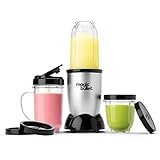
At roughly $25 to $40, expect a basic personal blender with one motor base, one or two cups, and limited control. Examples in this category include the $34.99 Ganiza Smoothie Blender, the $27.99 Consciot 11-Piece Blender, and the $29.98 magic bullet Personal Blender. Their accessory counts may be attractive, but inspect whether every lid and blade is genuinely useful. At this price, noise reduction is more likely to come from a stable fit and rubber feet than from specialized acoustic engineering.
The $45 to $80 range typically brings a better-known brand, more consistent controls, sturdier cups, or easier access to replacement parts. The $54.98 Ninja Fit Compact Personal Blender is an example of a compact model in this range. It may be a sensible choice for shoppers who value a simple design and established support over a large accessory bundle.
At $80 to $150 or more, you may find stronger construction, better warranties, more durable containers, and advanced sound-dampening features. Do not assume a premium price guarantees quiet operation. Confirm the return window and read the care instructions before paying extra for a feature that may not matter in your kitchen.
Warranty and Replacement Parts
A one-year limited warranty is common and provides basic protection against manufacturing defects. A two- to five-year motor warranty is more reassuring, but read what it excludes. Wear on blade bearings, cracked cups, misuse, commercial use, and damage from overheating may not be covered.
Replacement availability is particularly important for personal blenders because cups, seals, and blade assemblies experience regular wear. Before buying, verify that replacement cups and blade units are sold separately and identify their approximate cost. A $30 blender that requires replacing the entire appliance after a $12 gasket fails may be less economical than a $60 model with supported parts.
Delivery and Assembly
Personal blenders are usually ready to use after washing the cup, lid, and blade assembly, but accessory-heavy packages can require more inspection. Confirm that the box includes the correct cup sizes, travel lids, blade caps, and any required sealing rings. A missing gasket can cause leaks and may make a product appear defective.
Check the retailer’s return window before opening every accessory. A practical window is at least 30 days, with return shipping terms stated clearly. Keep the packaging until you have tested the blender with your usual smoothie recipe. If the cup arrives cracked, the base is damaged, or the unit rattles immediately, photograph the issue and contact the seller rather than continuing to run it.
Spec Checklist
| Spec | Budget | Mid | Premium |
|---|---|---|---|
| Typical price | $25–$40 | $45–$80 | $80–$150+ |
| Practical cup capacity | 12–16 oz | 14–20 oz | 16–28 oz |
| Advertised power | 250–700 watts | 600–900 watts | 800–1,200 watts |
| Base width | 4.5–6 in. | 4.5–6.5 in. | 5–7 in. |
| Empty base weight | 2.5–4 lb. | 3–5 lb. | 4–7 lb. |
| Warranty target | 1 year | 1–2 years | 2–5 years on motor |
Red Flags
- A “silent” or “ultra-quiet” claim with no explanation of how noise was measured.
- Peak wattage presented without sustained wattage or clear operating instructions.
- A cup that flexes, wobbles, or does not lock firmly into the base.
- No replacement cups, gaskets, or blade assemblies listed for sale.
- Instructions that encourage running thick mixtures without enough liquid.
- A warranty that excludes the motor, blades, or ordinary household use.
- Reviews repeatedly mentioning smoke, leaking seals, stripped threads, or rattling.
- An accessory bundle that costs more but includes lids or blades you cannot replace.
FAQ
Are personal blenders actually quiet?
Most are quieter than full-size countertop blenders only because they blend smaller amounts for shorter periods, not because they are silent. A stable base, secure cup, rubber feet, and a lower-pitched motor can make operation less irritating. Since decibel claims are not standardized, use the return policy as part of your noise strategy.
How many watts do I need for frozen fruit?
For occasional frozen fruit, look for roughly 700 watts or more and follow the manufacturer’s liquid and portion guidance. Frequent ice crushing or dense smoothie bowls may justify 800 to 1,000 watts, but a powerful motor cannot compensate for an overfilled cup or insufficient liquid.
Is a glass cup better than plastic?
Glass resists odors and scratches but is heavier and breakable. BPA-free plastic is lighter, safer for commuting, and usually more practical for a personal blender. Choose the material that suits your storage and travel habits, then prioritize a secure lid and removable gasket.
What is the best way to reduce blender noise?
Use a level counter, check that the cup is fully locked, and place a thin silicone mat beneath the base without blocking ventilation. Blend smaller loads, add liquid first, and use short pulses. If the blender rattles even when correctly assembled, stop using it and pursue a replacement or return rather than trying to muffle a possible mechanical problem.


Write Your Review
No reviews yet. Be the first to share your experience!