
Key takeaways
- Best overall for frequent repairs: Gerber Center-Drive. Its centered bit driver is easier to align with a screw than an offset driver, and the full-size pliers and replaceable bit system make it the most capable choice here.
- Best value for general household use: Gerber Suspension-NXT. It provides a broad tool selection, locking tools, and a pocket clip at a moderate market price, without the Center-Drive’s additional weight.
- Best for a backpack, keychain, or compact emergency kit: Gerber Dime. It is small enough to carry routinely, though its tiny pliers and short drivers are not substitutes for full-size tools.
- Best compact knife-and-driver tool: Gerber Armbar Drive. It is slim and easy to pocket, with a one-hand-opening blade and driver, but it lacks conventional pliers.
- Best for high-torque gripping: Gerber Dual-Force. Its sliding-jaw pliers give it a different mechanical advantage from ordinary multi-tools, making it appropriate for stubborn fasteners and heavier gripping work.
The best Gerber multi-tools for everyday carry are the Gerber Center-Drive for serious work, the Suspension-NXT for balanced value, the Dime for a truly small pocket tool, and the Armbar Drive when a compact knife-and-driver format matters more than pliers.
Choosing among them is less about counting tools and more about matching the tool combination, carry method, and maintenance burden to your routine. A kitchen, workshop, bicycle bag, emergency kit, and trouser pocket each reward a different design.

Gerber Suspension NXT 15-in-1 EDC Multitool, Pliers w/ Pocket Knife, Black
Included for 'Best Gerber Multi-Tools for Everyday Carry' because the listing specifies Pliers w/ Pocket Knife and Black, details this guide uses to compare options.
View on Amazon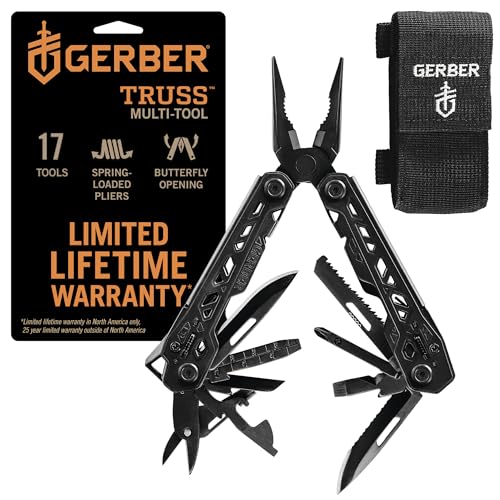
Gerber Truss 17-in-1 EDC Multitool Pliers, Pocket Knife, Molle Sheath,Black
Included for 'Best Gerber Multi-Tools for Everyday Carry' because the listing specifies Pocket Knife and Molle Sheath, details this guide uses to compare options.
View on Amazon
Gerber Dime 12-in-1 Mini Multitool Pliers, Pocket Knife,Bottle Opener,Green
Included for 'Best Gerber Multi-Tools for Everyday Carry' because the listing specifies Pocket Knife and Bottle Opener, details this guide uses to compare options.
View on Amazon
Gerber Gear Center-Drive Multitool - With Needle-Nose Pliers, 3.25" Blade & Center-Axis Bit Driver - Includes Magnetic Flathead & Phillips Bits - Comes with Coyote Brown Sheath - Made in USA - Black
Included for 'Best Gerber Multi-Tools for Everyday Carry' because the listing specifies With Needle-Nose Pliers and 3.25" Blade & Center-Axis Bit Driver, details this guide uses to compare options.
View on AmazonBest Gerber multi-tools by everyday situation
- Best overall for frequent repairs: Gerber Center-Drive. Its centered bit driver is easier to align with a screw than an offset driver, and the full-size pliers and replaceable bit system make it the most capable choice here.
- Best value for general household use: Gerber Suspension-NXT. It provides a broad tool selection, locking tools, and a pocket clip at a moderate market price, without the Center-Drive’s additional weight.
- Best for a backpack, keychain, or compact emergency kit: Gerber Dime. It is small enough to carry routinely, though its tiny pliers and short drivers are not substitutes for full-size tools.
- Best compact knife-and-driver tool: Gerber Armbar Drive. It is slim and easy to pocket, with a one-hand-opening blade and driver, but it lacks conventional pliers.
- Best for high-torque gripping: Gerber Dual-Force. Its sliding-jaw pliers give it a different mechanical advantage from ordinary multi-tools, making it appropriate for stubborn fasteners and heavier gripping work.
Head-to-head specifications
The figures below are useful for comparing the physical trade-offs. Gerber specifications can vary slightly by production run, finish, or regional package, so confirm the exact version before buying. “Open length” refers to the tool in its plier configuration where that measurement is published.
| Model | Closed length | Open length | Weight | Notable combination | Carry format |
|---|---|---|---|---|---|
| Center-Drive | 4.7 in | 6.6 in | 9.5 oz | Centered bit driver, pliers, knife, saw, file | Belt sheath; pocket carry is possible but substantial |
| Suspension-NXT | 4.25 in | 6.25 in | 6.7 oz | Spring-loaded pliers, knife, scissors, saw, file | Integrated pocket clip and sheath |
| Truss | 4.35 in | 6.25 in | 8.4 oz | Full tool selection with scissors and locking tools | Belt sheath; no especially slim pocket profile |
| Dual-Force | 4.75 in | 7.0 in | 10.2 oz | Sliding-jaw pliers, replaceable bit driver, file and knife | Belt sheath |
| Armbar Drive | 3.6 in | Not applicable as a conventional plier tool | 3.1 oz | Knife, bit driver, hammer surface, scissors and utility tools | Compact pocket or organizer carry |
| Dime | 2.75 in | About 4.25 in | 2.2 oz | Mini pliers, scissors, knife, tweezers and bottle opener | Keychain loop or small pocket |
Tool combinations: what the numbers do not tell you
Center-Drive versus Suspension-NXT
The Center-Drive earns its larger footprint through the driver. Its bit holder sits on the centerline of the opened handle, allowing a straighter wrist position and more direct pressure on a screw. That is valuable for cabinet hardware, appliance panels, bicycle adjustments, and repeated fastening. It also accepts standard 1/4-inch hex bits through its bit-driver system, although loose bits must be carried separately.
The Suspension-NXT is the easier recommendation for mixed household chores. Its spring-loaded pliers reduce hand fatigue during repeated gripping, and its scissors, saw, file, and knife cover more common light-duty tasks. Its pocket clip makes it more likely to be carried than a tool that requires a belt sheath. Choose it over the Center-Drive when most jobs involve cutting, opening packages, trimming wire, or occasional tightening rather than sustained screwdriving.
Truss versus Suspension-NXT
These two are closer in purpose. The Truss is more traditional and slightly heavier, while the Suspension-NXT emphasizes pocket convenience. Both are better generalists than specialist drivers. If you already carry a compact screwdriver, the Truss or Suspension-NXT can provide useful pliers, scissors, blades, and files without duplicating your main driver.
Dime versus Armbar Drive
The Dime wins on size and tool density, especially when a keychain loop matters. Its pliers can grab small items, but their short handles limit leverage. The Armbar Drive is longer and heavier, yet its full-length handle makes the driver and knife more usable. It is the better “one small tool in a pocket” choice when you do not need pliers.
Locking mechanisms and safe use
Full-size Gerber models commonly use liner-lock or frame-lock-style retention for individual implements, while some tools use slip-joint or friction retention. The exact locking arrangement differs by model and tool. A lock is not permission to apply unlimited force: blades, files, and narrow drivers can still break or slip if twisted sideways.
- Check each implement separately. Open it fully and confirm that the lock engages before applying pressure.
- Keep fingers outside the closing path. This matters especially when a blade or saw is folded manually.
- Use the correct driver size. A loose-fitting bit damages both the screw and the driver interface.
- Do not pry with a blade or bit. Use the pliers or a dedicated pry tool for levering.
- Inspect worn pivots. A tool that develops side-to-side play can be less predictable even if its lock still clicks into place.
Pocket carry, dimensions, and practical fit
A 9.5-ounce Center-Drive is manageable on a belt but can pull down lightweight trousers when clipped or carried loose. The 6.7-ounce Suspension-NXT is a more comfortable all-day pocket tool for many people, especially because the clip keeps it oriented. The Dime’s 2.2-ounce weight is unlikely to be noticed, but its compact handles make every operation slower and less forceful.
For a kitchen drawer or emergency pouch, closed length matters more than pocket comfort. For clothing, thickness and weight matter together. A tool that is 4.5 inches long but thick and nearly 10 ounces may be less convenient than a 3.6-inch, 3.1-ounce tool. If you carry a separate knife, the Armbar Drive’s blade may duplicate it; if you carry a separate screwdriver, the Dime may add more useful functions.
Corrosion resistance: stainless is not maintenance-free
Gerber multi-tools generally use stainless-steel components, but stainless steel is corrosion-resistant rather than corrosion-proof. Salt, acidic food residue, perspiration, and trapped moisture can produce staining or pitting, particularly around pivots, tool recesses, and textured surfaces. Black or coated finishes can also show wear where parts rub together.
For kitchen-adjacent use, do not treat any multi-tool as a food-preparation utensil. Keep it away from direct food contact, wash contamination off promptly, and dry it completely. Avoid leaving it in a damp sink, dishwasher, or closed pouch after outdoor use.
Real-world maintenance in five minutes
- Remove grit first. Open every implement and brush out sand, lint, and metal filings with a soft brush or compressed air. Do this before adding oil, or the lubricant can turn debris into abrasive paste.
- Clean residue. Wipe the tool with a damp cloth and mild detergent when it has encountered food residue, salt, or sweat. Do not soak a tool with removable bits, springs, or complex pivots unless the manufacturer specifically permits it.
- Dry all pivots. Folded handles can retain water. Leave the tool open until dry, then wipe it thoroughly.
- Lubricate sparingly. Apply a small drop of light machine oil to each pivot and work the implement repeatedly. Wipe away excess so it does not attract dust or migrate onto a blade handle.
- Check edges and fasteners. Tighten loose pivot screws only with the correct driver and without overtightening. Sharpen a blade with a consistent angle; replace damaged bits rather than forcing them.
A useful maintenance schedule is to wipe the tool after every wet or salty outing, lubricate every few months under ordinary use, and inspect it before demanding work. The first parts likely to show wear are pivot joints, bit tips, wire cutters, and blade edges—not the stainless handles themselves.
Which Gerber multi-tool should you buy?
| Your situation | Recommended choice | Why |
|---|---|---|
| Daily pocket carry, occasional repairs | Suspension-NXT | Good balance of weight, pliers, scissors, knife, and pocket clip |
| Frequent screwdriving or mechanical work | Center-Drive | Centered driver and replaceable 1/4-inch bit compatibility |
| Very limited pocket or keychain space | Dime | Smallest and lightest option, with useful opening and cutting tools |
| Compact carry without needing pliers | Armbar Drive | More usable knife and driver handles in a slim format |
| High-force gripping and stubborn fasteners | Dual-Force | Sliding-jaw plier design and heavier construction |
| Drawer or belt-kit general-purpose backup | Truss | Broad tool selection and conventional full-size layout |
Market pricing typically places the Dime and Armbar Drive in the lower range, the Suspension-NXT and Truss in the midrange, and the Center-Drive and Dual-Force higher because of their larger construction and specialized mechanisms. The best Gerber multi tools are therefore not one universal model: select the smallest tool that still gives you the pliers, driver, blade, or scissors you will actually use, then preserve its reliability with dry storage, light lubrication, and sensible load limits.






Write Your Review
No reviews yet. Be the first to share your experience!