
Key takeaways
- Stabilization: Electronic stabilization can make walking and vehicle footage look smoother, but it does not remove every jolt or correct poor mounting. Use a rigid mount and secure its joints; an arm that vibrates can spoil footage even when the camera is stabilizing.
- Battery life: Treat advertised runtime as a best-case reference, not a guaranteed day’s use. High-resolution recording and repeated starts, previews, and transfers use power. A spare battery is more dependable than planning around a single quoted runtime.
- Water resistance: A depth rating applies to the camera under specified conditions, not every accessory or damaged seal. Salt water, sand, and repeated impacts raise the risk. Rinse the camera with fresh water after saltwater use, dry it fully, and inspect doors and seals before submersion.
- App editing: Phone apps are convenient for reframing, subject tracking, and quick exports. Desktop software gives more room for careful edits, but demands storage and time. Check phone compatibility and available free space before a trip; high-resolution clips can fill a device quickly.
- Mounting: A short invisible selfie stick works well for travel perspectives, while a chest or helmet mount suits hands-free action. For cycling, use a secure clamp and tether where appropriate. Keep the pole or mount clear of both lenses if you want the stitched view to hide it cleanly.
The best 360 cameras for travel and everyday use
The best 360 cameras for most travelers are the Insta360 X5 for its blend of image quality, replaceable lenses, stabilization, and waterproofing, and the DJI Osmo 360 for strong low-light video and a large battery. Choose the smaller Insta360 X4 if price matters more than the newest image features, or the GoPro MAX if you want an established system and find it at a worthwhile discount.
A 360 camera records in every direction, letting you choose the framing later. That flexibility is useful on a bike ride, hike, or family outing—but it brings trade-offs: footage takes more storage and editing than ordinary action-camera video, and sharp lenses need protection. The right choice depends less on the biggest headline resolution than on how you’ll carry, mount, edit, and maintain it.

Insta360 X5 - Waterproof 8K 360° Action Camera, Leading Low Light, Invisible Selfie Stick Effect, Rugged and Replaceable Lens, 3-Hour Battery, Built-in Wind Guard, Stabilization, Triple AI Chip Design
Included for 'Best 360 Cameras for Travel and Everyday Use' because the listing specifies Waterproof 8K 360° Action Camera and Leading Low Light, details this guide uses to compare options.
View on Amazon
Insta360 X4 Air Starter Bundle - Lightweight 165g 8K 360 Camera, Invisible Selfie Stick, Replaceable Lenses, Shoot First & Frame Later, Built-in Wind Guard, FlowState Stabilization, AI-Powered App
Included for 'Best 360 Cameras for Travel and Everyday Use' because the listing specifies Lightweight 165g 8K 360 Camera and Invisible Selfie Stick, details this guide uses to compare options.
View on Amazon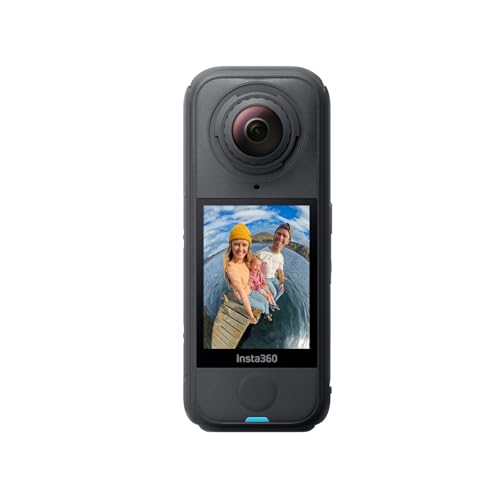
Insta360 X4 Air - Lightweight 165g 8K 360 Camera, Invisible Selfie Stick Effect, Replaceable Lenses, Shoot First & Frame Later, Built-in Wind Guard, FlowState Stabilization, AI-Powered App
Included for 'Best 360 Cameras for Travel and Everyday Use' because the listing specifies Lightweight 165g 8K 360 Camera and Invisible Selfie Stick Effect, details this guide uses to compare options.
View on Amazon
Insta360 X5 Starter Bundle - Waterproof 8K 360° Action Camera, Leading Low Light, Invisible Selfie Stick Effect, Rugged & Replaceable Lens, 3-Hour Battery, Clear Audio, Stabilization
Included for 'Best 360 Cameras for Travel and Everyday Use' because the listing specifies Waterproof 8K 360° Action Camera and Leading Low Light, details this guide uses to compare options.
View on AmazonQuick comparison
Figures below are manufacturer-stated specifications; recording time varies with resolution, temperature, stabilization, and settings. Battery capacities are not directly comparable across brands.
| Camera | 360 video | Weight | Battery capacity | Waterproofing | Best fit |
|---|---|---|---|---|---|
| Insta360 X5 | Up to 8K/30 fps | About 200 g | 2,400 mAh | Up to 15 m without a case | All-round travel and rougher use |
| DJI Osmo 360 | Up to 8K/30 fps | About 183 g | 1,950 mAh | Up to 10 m without a case | Low-light scenes and longer outings |
| Insta360 X4 | Up to 8K/30 fps | About 203 g | 2,290 mAh | Up to 10 m without a case | Lower-cost entry to high-resolution 360 |
| GoPro MAX | Up to 5.6K/30 fps | About 154 g | 1,600 mAh | Up to 5 m without a case | Discount buyers and GoPro users |
These cameras use different sensors, lenses, and processing, so resolution alone doesn’t determine detail. High-resolution 360 footage spreads pixels across the full sphere; a cropped view has fewer pixels than the original recording. For a conventional wide-angle video that fills the screen, a dedicated action camera may produce a cleaner result with less editing.
Pick by the way you’ll use it
For one camera to take on a trip: Insta360 X5
The X5 is the strongest all-around choice if your trip mixes walking, cycling, water, and quick handheld clips. Its 8K capture gives room to reframe, and its in-camera stabilization helps smooth movement without requiring a gimbal. Replaceable lens elements are a practical advantage: a scratched front lens can be more fixable than damage that means replacing the whole camera. Confirm that replacement parts and the repair process are available where you live.
Its app-led editing is convenient for selecting a subject or exporting a conventional flat video. Still, a phone workflow can involve transferring large files, waiting for processing, and spending time choosing a view. If you only want to press record and share, that extra step may outweigh the 360 flexibility.
For evening walks and longer days: DJI Osmo 360
The Osmo 360 is worth considering if dusk, indoor scenes, or a long day out feature often in your plans. Its larger battery capacity on paper and low-light-oriented imaging are appealing for those situations. Capacity alone doesn’t guarantee longer recording, though: heat, resolution, wireless connections, and cold weather all affect runtime. Carry a charged spare or power bank for a full day of frequent recording.
DJI’s app and editing tools make it possible to reframe and export without a desktop workflow. Before choosing it, check that the mounts and accessories you need—such as a handlebar clamp or extension pole—are available and fit your existing gear.
For a tighter budget: Insta360 X4 or GoPro MAX
The X4 offers high-resolution 360 recording at a lower general market price than newer flagships, making it a sensible pick if you can accept older hardware. The GoPro MAX records at a lower maximum resolution, but can still suit casual reframing, especially when heavily discounted or when you already use compatible GoPro mounts. Compare current local prices with the cost of a spare battery, lens protection, and a pole; accessories can narrow the apparent savings.
What matters more than the headline specs
- Stabilization: Electronic stabilization can make walking and vehicle footage look smoother, but it does not remove every jolt or correct poor mounting. Use a rigid mount and secure its joints; an arm that vibrates can spoil footage even when the camera is stabilizing.
- Battery life: Treat advertised runtime as a best-case reference, not a guaranteed day’s use. High-resolution recording and repeated starts, previews, and transfers use power. A spare battery is more dependable than planning around a single quoted runtime.
- Water resistance: A depth rating applies to the camera under specified conditions, not every accessory or damaged seal. Salt water, sand, and repeated impacts raise the risk. Rinse the camera with fresh water after saltwater use, dry it fully, and inspect doors and seals before submersion.
- App editing: Phone apps are convenient for reframing, subject tracking, and quick exports. Desktop software gives more room for careful edits, but demands storage and time. Check phone compatibility and available free space before a trip; high-resolution clips can fill a device quickly.
- Mounting: A short invisible selfie stick works well for travel perspectives, while a chest or helmet mount suits hands-free action. For cycling, use a secure clamp and tether where appropriate. Keep the pole or mount clear of both lenses if you want the stitched view to hide it cleanly.
A realistic travel setup and ownership costs
For a weekend trip with occasional clips, start with the camera, a short extension pole, a protective pouch, and a fast, compatible microSD card. Add a spare battery if you expect repeated filming, cold weather, or long days away from charging. There’s little benefit in buying a large accessory bundle before you know whether you’ll mostly walk, ride, swim, or shoot family scenes.
Lens care is the most important ownership habit. The exposed, curved lenses are vulnerable to scratches from keys, grit, and careless cleaning. Put the camera in its pouch between shots; brush away loose dust before wiping, and use a clean microfiber cloth rather than rubbing sand across the glass. Lens guards can reduce scratch risk, but may affect reflections or image quality, so check the manufacturer’s guidance and test them before relying on them for an important shoot.
Plan storage, too. A 360 camera records more of a scene than you may use, so keeping every clip quickly becomes expensive in device space and editing time. After each outing, review footage, export the reframed clips you want, and back up the original files if you may want to choose a different angle later. This simple routine prevents a full memory card from becoming the surprise limit on the next day’s filming.
Bottom line
Choose the Insta360 X5 for the broadest mix of travel durability, flexible reframing, and replaceable lens elements. Pick the DJI Osmo 360 if low-light shooting and battery capacity matter more to you. The Insta360 X4 is a practical value option, while the GoPro MAX makes most sense at a substantial discount or as part of an existing GoPro setup. Whichever you choose, budget for a secure mount, lens protection, and a manageable way to store and edit the footage.







Write Your Review
No reviews yet. Be the first to share your experience!