
Key takeaways
- Adjustable shelves: Shelf pins spaced about 1 to 2 inches apart let you fit tall bottles and short cans without wasting vertical space.
- Full-extension runners: These allow a pull-out shelf to come forward far enough to see the rear items. Soft-close action is useful but less important than a suitable load rating.
- Door storage: Door racks add capacity for small packets and spices, but they should not be overloaded because leverage stresses the hinges.
- Durable surface finishes: Melamine, laminate, sealed wood, and powder-coated metal are easier to wipe than unfinished fiberboard.
- Leveling and anti-tip hardware: These improve safety and prevent doors from drifting out of alignment.
- Removable or washable liners: Liners protect shelves from flour, leaks, and sticky residue, especially around oils and syrups.
Pantry Cabinets for Kitchens: Types, Sizes, and Planning Tips
The best pantry cabinets for kitchen storage depend first on the space you have: choose a freestanding unit for flexibility, a pull-out cabinet for a narrow gap, a wall pantry for limited floor space, or a tall pantry for maximum capacity.
Choose by Kitchen Situation
| Your situation | Best cabinet type | Why it fits | Main compromise |
|---|---|---|---|
| Renter or limited budget | Freestanding pantry | No cabinet demolition; easy to move | Uses visible floor space and may need wall anchoring |
| Unused gap between cabinets | Pull-out pantry | Turns a narrow opening into organized storage | Less capacity and more expensive hardware |
| Small kitchen with available wall space | Wall pantry | Keeps food off the floor and can fit above a counter | Limited load capacity and harder-to-reach shelves |
| Family kitchen or frequent bulk shopping | Tall pantry cabinet | High capacity with full-height shelves and door storage | Requires careful measuring and secure installation |
| Older home with uneven floors | Freestanding cabinet with adjustable feet | Levels more easily than a fixed cabinet | May not have the seamless built-in appearance |
Four Main Types of Pantry Cabinets
Freestanding Pantry Cabinets
Freestanding pantry cabinets are enclosed storage units that sit on the floor without becoming part of the kitchen cabinet run. Common widths range from about 24 to 36 inches, with depths of 12 to 18 inches and heights between 60 and 84 inches.

AQY Kitchen Pantry Cabinet,61" White Pantry Storage Cabinet with 4 Tier Adjustable Shelves and 2 Doors,Freestanding Cupboard,Metal Pantry Cabinets with Handle for Living Room Kitchen Assembly Required
Included for 'Pantry Cabinets for Kitchens: Types, Sizes, and Planning Tips' because the listing specifies Freestanding Cupboard, details this guide uses to compare options.
View on Amazon
GRUSIGN 71" Pantry Cabinet with Charging Station, Large Capacity Kitchen Hutch Storage Cabinet, Kitchen Cabinet with Microwave Stand, Storage Drawers & Adjustable Shelves for Dining Room, White
Included for 'Pantry Cabinets for Kitchens: Types, Sizes, and Planning Tips' because the listing specifies Large Capacity Kitchen Hutch Storage Cabinet and Kitchen Cabinet with Microwave Stand, details this guide uses to compare options.
View on Amazon
Sauder Select Storage Cabinet/ Pantry cabinets, White finish
Included for 'Pantry Cabinets for Kitchens: Types, Sizes, and Planning Tips' because the listing specifies White finish, details this guide uses to compare options.
View on Amazon
VASAGLE Pantry Cabinet, Freestanding Tall Cupboard with a Drawer
Included for 'Pantry Cabinets for Kitchens: Types, Sizes, and Planning Tips' because the listing specifies Freestanding Tall Cupboard with a Drawer, details this guide uses to compare options.
View on AmazonThey are the simplest choice when you want extra storage without remodeling. Look for a solid back panel, adjustable shelves, a leveler or adjustable feet, and an included anti-tip strap. Particleboard construction can be adequate for dry goods, but thicker engineered wood, plywood, or solid wood generally handles repeated assembly and heavier loads better.
Freestanding units work well for snacks, boxed foods, canned goods, and small appliances. Their main weakness is access: a deep shelf can become a second row of forgotten food. Prefer shelves no deeper than about 16 inches unless they pull forward or are divided with bins.
Pull-Out Pantry Cabinets
Pull-out pantries are narrow cabinet units mounted on runners. Typical cabinet widths are 6, 9, 12, or 15 inches, although the usable opening is smaller after accounting for the frame and hardware. They are useful beside a refrigerator, range, or cabinet end where a full-size pantry will not fit.
The critical specification is not the outside width but the minimum opening required for installation. A nominal 9-inch model may need an opening close to 9 inches, while the shelves may be only 4 to 7 inches wide. Measure the opening at the top, middle, and bottom; walls and cabinets are not always perfectly parallel.
Pull-outs are excellent for oils, sauces, spice containers, cans, and narrow packages. They are less suitable for large cereal boxes, countertop appliances, or heavy bulk bags. Check the runner’s stated load rating and divide heavy items across shelves rather than placing everything at the bottom.
Wall-Mounted Pantry Cabinets
Wall pantry cabinets mount above a counter or on an otherwise unused wall. Standard kitchen wall-cabinet depths are often around 12 to 15 inches, while heights commonly range from 30 to 42 inches. A wall-mounted unit can store tea, coffee, baking ingredients, and everyday snacks without occupying floor area.
Because the cabinet hangs from the wall, installation quality matters more than with a freestanding unit. Fasten it through a secure wall stud or use an appropriate structural mounting system for the wall type. Do not rely on drywall anchors alone for a heavily loaded food cabinet unless the anchor and cabinet are specifically designed for that load.
Wall storage is most convenient when frequently used items are between shoulder and eye level. Reserve the highest shelves for lightweight, occasional-use items, and leave clearance for cabinet doors, lighting, and nearby appliances.
Tall Pantry Cabinets
Tall pantry cabinets are usually 84 to 96 inches high, with widths around 18 to 36 inches and depths of 12 to 24 inches. They offer the greatest storage capacity and can be coordinated with full-height kitchen cabinetry.
A 24-inch-deep tall pantry holds more, but deep fixed shelves make it easy to lose small packages behind larger ones. A 12- to 16-inch depth is usually easier for food organization. If you need greater depth for countertop appliances or bulk containers, choose adjustable shelves, interior drawers, or door racks.
Before buying a tall unit, measure ceiling height in several places. Allow room to stand the cabinet upright if it arrives assembled. A cabinet that is 84 inches tall may need more than 84 inches of clearance to tilt into position, depending on its depth.
Pantry Cabinet Size and Capacity Guide
| Cabinet type | Typical width | Typical depth | Typical height | Practical storage use |
|---|---|---|---|---|
| Freestanding | 24–36 in | 12–18 in | 60–84 in | General dry goods for a small to medium household |
| Pull-out | 6–15 in | 20–24 in overall | 72–84 in | Spices, bottles, cans, packets, and condiments |
| Wall-mounted | 18–36 in | 12–15 in | 30–42 in | Light, frequently used foods and baking supplies |
| Tall cabinet | 18–36 in | 12–24 in | 84–96 in | Highest capacity, bulk foods, appliances, and reserve stock |
These are planning ranges rather than universal standards. The interior capacity will be smaller than the outside dimensions because shelves, side panels, doors, and hardware take up space. A 30-inch-wide cabinet with ¾-inch side panels may have roughly 28½ inches of interior width before shelf supports and dividers are considered.
How to Measure Before You Buy
- Measure the opening width in three places. Use the smallest measurement, then subtract the manufacturer’s required installation clearance.
- Measure depth past obstacles. Include baseboards, handles, outlets, plumbing, radiator covers, and refrigerator doors.
- Check ceiling and door clearance. A tall assembled cabinet may not be able to tilt upright in a low-ceiling room.
- Map door and drawer swings. Leave enough clearance for the pantry door to open fully without striking an appliance or wall.
- Locate studs and floor irregularities. Fixed cabinets need a secure attachment point, while freestanding units benefit from adjustable feet or shims.
A useful capacity calculation is shelf area multiplied by usable shelf count. For example, a cabinet with six shelves that are 28 inches wide and 14 inches deep provides approximately 2,352 square inches of shelf surface: 28 × 14 × 6. That is theoretical area, not a guarantee of usable storage, because tall containers and access space reduce the practical total.
Features Worth Paying For
- Adjustable shelves: Shelf pins spaced about 1 to 2 inches apart let you fit tall bottles and short cans without wasting vertical space.
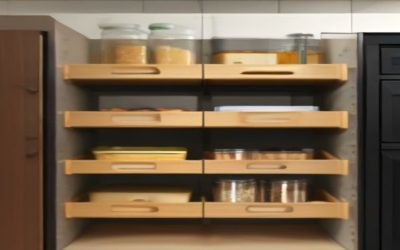
- Full-extension runners: These allow a pull-out shelf to come forward far enough to see the rear items. Soft-close action is useful but less important than a suitable load rating.
- Door storage: Door racks add capacity for small packets and spices, but they should not be overloaded because leverage stresses the hinges.
- Durable surface finishes: Melamine, laminate, sealed wood, and powder-coated metal are easier to wipe than unfinished fiberboard.
- Leveling and anti-tip hardware: These improve safety and prevent doors from drifting out of alignment.
- Removable or washable liners: Liners protect shelves from flour, leaks, and sticky residue, especially around oils and syrups.
Assembly, Maintenance, and Common Mistakes
Assembly quality affects how long a pantry lasts. Tighten fasteners only after panels are square, avoid forcing misaligned cam locks, and check that every shelf support is fully seated. For tall or narrow cabinets, attach the unit to the wall even if it feels stable when empty. Loading the top shelves can shift the center of gravity.
The parts most likely to wear first are drawer or pull-out runners, door hinges, shelf-pin holes, and thin cabinet backs. Keep runners free of crumbs and dust, wipe spills promptly, and follow the hardware manufacturer’s lubrication instructions rather than applying a random oil that may attract grit. Do not exceed the stated shelf or cabinet load rating.
A common planning mistake is choosing maximum depth instead of maximum accessibility. If you cannot see the back third of a shelf, use shallow bins, risers, or pull-out shelves. Group food by use rather than only by package type: breakfast items, baking supplies, cooking staples, snacks, and reserve stock are easier to maintain than a mixed deep shelf.
Final Buying Recommendation
Choose a freestanding pantry when flexibility and simple installation matter most. Choose a pull-out model for a narrow gap, but verify its actual shelf width and load rating. Choose a wall cabinet when floor space is scarce and the stored items are relatively light. Choose a tall pantry cabinet when you have sufficient ceiling, anchoring, and installation clearance and need the most storage in one location.
Whichever type you select, prioritize the smallest depth that meets your needs, adjustable shelving, secure anchoring, and dimensions measured from the real installation space. Those details usually make a bigger difference to daily convenience than an extra shelf or a decorative door style.


Write Your Review
No reviews yet. Be the first to share your experience!