
Key takeaways
- Push-to-connect: Push the tubing into a collet until it stops. These are convenient, but the tube must be cut squarely and inserted completely.
- Compression: A nut and ferrule grip the tubing. This can be secure, but overtightening may deform plastic tubing or damage the fitting.
- Threaded adapters: These can connect different systems, but each extra joint adds another possible leak point.
The best inline refrigerator water filter for most kitchens is a 1/4-inch quick-connect or compression filter rated for at least 1,500 gallons, with NSF/ANSI 42 certification when taste and odor are the main concerns; choose a 3/8-inch model only when your existing refrigerator line uses that larger connection.
Quick picks by situation
| Kitchen situation | Practical choice | Why it fits | What to verify |
|---|---|---|---|
| Standard refrigerator line and limited budget | 1/4-inch inline carbon block filter | Usually inexpensive, compact, and easy to replace | Connection style, flow direction, NSF/ANSI 42 claim |
| Frequent ice and water use | High-capacity carbon filter rated around 2,000–2,500 gallons | Fewer annual replacements and less chance of an exhausted cartridge | Capacity is based on rated water quality and flow, not unlimited service |
| Existing 3/8-inch tubing | 3/8-inch inline filter or correctly sized adapter assembly | Avoids unnecessary reducers and extra leak points | Both inlet and outlet sizes; many filters are not the same size at each end |
| Renter or first-time installer | Push-to-connect filter with shutoff valve | Fast installation without cutting tubing | Tubing must be fully inserted and supported |
| Concern about a specific contaminant | A filter with a certification or performance claim for that contaminant | Generic “purification” wording may only mean taste improvement | Look for the exact NSF/ANSI standard and contaminant claim |
What an inline refrigerator filter does
An inline filter sits in the water tube between the cold-water supply and the refrigerator or ice maker. Most use activated carbon, commonly carbon block or granular activated carbon, to reduce chlorine taste and odor. Some models also reduce sediment, but an inline carbon filter is not automatically a solution for lead, bacteria, nitrates, PFAS, or hard-water scale.

AQUA CREST INL 5 Years Inline Water Filter for Ice Maker and Refrigerator
Included for 'Best Inline Refrigerator Water Filters' as a relevant option in this category; details come from the product listing.
View on Amazon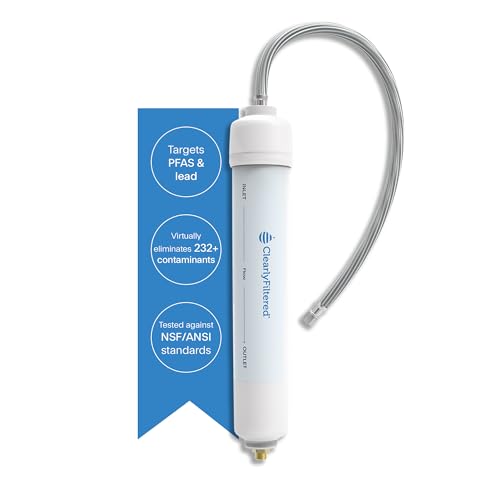
Clearly Filtered Inline Water Filter for Refrigerator, Ice Maker Water Line
Included for 'Best Inline Refrigerator Water Filters' because the listing specifies Ice Maker Water Line, details this guide uses to compare options.
View on Amazon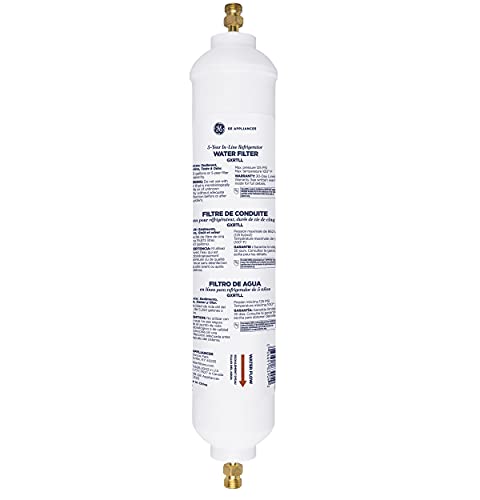
GE Appliances GXRTLL 5-Year in-LINE Filtration System Water Filter
Included for 'Best Inline Refrigerator Water Filters' as a relevant option in this category; details come from the product listing.
View on AmazonUnlike a filter built into the refrigerator door, an inline cartridge normally has no filter-life display. Replacement is based on time, gallons, taste, flow rate, or a combination of those factors. It is also separate from the refrigerator itself, so compatibility depends mainly on tubing size, connection type, water pressure, and available space.
Head-to-head: the specifications that matter
| Filter type | Typical connection | Typical rated capacity | Typical replacement interval | Best use |
|---|---|---|---|---|
| Compact carbon inline cartridge | 1/4-inch quick-connect or compression | 500–1,000 gallons | 6 months | Occasional ice and water use |
| Standard high-capacity carbon cartridge | 1/4-inch, sometimes 3/8-inch | 1,500–2,500 gallons | 6–12 months | Most family refrigerators |
| Refrigerator-specific inline replacement | Usually 1/4-inch | About 1,500–2,500 gallons | 6 months or stated gallon limit | Replacing a similar factory-style filter |
| Specialty reduction cartridge | 1/4-inch or 3/8-inch, model-dependent | Often 500–1,500 gallons | 6–12 months | A documented contaminant-reduction requirement |
These are useful comparison ranges rather than universal specifications. Always use the capacity printed on the exact cartridge. A filter rated for 2,500 gallons in laboratory conditions can clog sooner in a home with sediment, old galvanized plumbing, or unusually cloudy water.
Compatibility: measure before buying
1. Identify the tubing size
Most refrigerator water lines are 1/4 inch outside diameter, while some installations use 3/8-inch tubing. Measure the tube’s outside diameter, not the opening inside the filter fitting. A 1/4-inch tube is common for refrigerator connections; a 3/8-inch line is more common in higher-flow or newer plumbing installations.
2. Identify the connection style
- Push-to-connect: Push the tubing into a collet until it stops. These are convenient, but the tube must be cut squarely and inserted completely.
- Compression: A nut and ferrule grip the tubing. This can be secure, but overtightening may deform plastic tubing or damage the fitting.
- Threaded adapters: These can connect different systems, but each extra joint adds another possible leak point.
Do not assume that a filter advertised as “1/4 inch” accepts every 1/4-inch connection. Some use push-fit ports, some use compression fittings, and some include one fitting type while requiring separate adapters for another.
3. Check flow direction and space
Many cartridges have an arrow showing inlet-to-outlet direction. Installing one backward may reduce performance or cause an unexpected flow restriction. Measure the space behind the refrigerator: a typical inline cartridge is approximately 8–12 inches long and 2–3 inches in diameter, although compact models are smaller. Leave enough room to remove the filter and pull the refrigerator out without sharply bending the tube.
Certifications: what the label really tells you
For ordinary refrigerator water improvement, NSF/ANSI 42 is the most relevant certification to look for. It generally addresses aesthetic effects such as chlorine taste, odor, and particulate reduction. It does not mean the filter removes every health-related contaminant.
NSF/ANSI 53 concerns specific health-effect contaminants, but a filter must identify the particular contaminant and rated performance. “Tested to NSF standards” is less useful than a clear certification statement for the exact model. NSF/ANSI 401 relates to certain emerging contaminants and is also contaminant-specific.
Check the manufacturer’s performance sheet or the certification directory when a reduction claim matters. If your water report shows lead, nitrate, arsenic, microbial contamination, or another significant issue, use advice from your water supplier or a qualified water-treatment professional rather than relying on a generic refrigerator filter.
Capacity and replacement interval: a useful calculation
Suppose two people dispense 1.5 gallons per day through the refrigerator, including drinking water and ice. A 1,500-gallon filter would theoretically last:
1,500 gallons ÷ 1.5 gallons per day = 1,000 days
That calculation is not a safe replacement schedule. Manufacturers commonly specify six months even when the gallon capacity has not been reached because carbon can lose effectiveness over time, and the cartridge can accumulate sediment or develop odor. In this example, replace at six months unless the manufacturer gives a different interval. A busy household using 5 gallons per day would reach 1,500 gallons in about 300 days, making the gallon limit more important.
Use the shorter of the stated time interval or gallon capacity. Replace earlier if water flow slows noticeably, the water develops an unusual taste, or the cartridge has been exposed to contamination or a plumbing repair.
Installation without common leaks
- Turn off the refrigerator supply valve and dispense water until pressure drops.
- Cut tubing with a sharp utility knife or tubing cutter so the end is flat, not angled or crushed.
- Observe the arrow on the filter and connect the supply side to the inlet.
- For push fittings, insert the tube fully and tug lightly to confirm it is locked. For compression fittings, tighten firmly but do not force them.
- Turn the water on slowly and inspect every connection for several minutes.
- Flush the amount specified by the filter maker, often several quarts, before drinking the water or making ice.
- Check again after a few hours and the next day. A slow leak may not appear immediately.
Discard the first batch of ice after replacement because carbon fines and trapped installation debris can affect its taste. Keep the filter away from sharp cabinet edges and avoid bending the tubing tightly behind the refrigerator.
Ownership realities and value
The filter cartridge is usually the first part to wear out, but tubing, ferrules, and push-fit collets can also become trouble spots when repeatedly disturbed. If a connection leaks after replacement, inspect the tube end for scratches or an uneven cut before applying more tightening force. Cutting off a short damaged section and reconnecting clean tubing often works better than overtightening.
For value, compare annual cost rather than cartridge price alone. A $12 filter replaced twice per year costs about $24 annually. A $25 high-capacity filter replaced once per year costs roughly the same, provided its performance and connection fit your installation. Paying more for capacity is worthwhile when the filter is difficult to access or your household uses substantial ice and water; it is less compelling when the refrigerator is used only occasionally.
Bottom line
Choose a 1/4-inch inline carbon filter with a clearly stated NSF/ANSI 42 certification for general taste and odor improvement, a capacity suited to your household, and fittings that match your existing tubing without adapters. Prioritize a certified contaminant claim over a large gallon number when water quality is the main concern, and replace the cartridge on the manufacturer’s schedule even if the water still tastes acceptable.




Write Your Review
No reviews yet. Be the first to share your experience!