
Key takeaways
- 1/3 to 1/2 HP: Suitable for one or two people who mainly dispose of soft vegetable scraps, small fruit pieces, and limited leftovers. These units are more likely to stall when overloaded.
- 3/4 HP: The best all-purpose range for many homes. It handles routine food preparation and moderate leftovers without the cost and size of the largest models.
- 1 HP: Appropriate for frequent cooking, large families, and users who regularly process tougher scraps. More horsepower does not make every item safe to grind, but it provides greater torque and reduces nuisance stalls.
- 1-1/4 HP and above: Usually unnecessary for a typical household unless the manufacturer’s design, chamber size, warranty, or noise control justifies the added cost and cabinet space.
The best garbage disposals are continuous-feed models for most busy kitchens, while batch-feed models are the safer fit for homes that prioritize child safety, have limited electrical access, or want quieter, more deliberate operation.
Quick picks by kitchen situation
| Kitchen situation | Best match | Recommended specification | Why it fits |
|---|---|---|---|
| Small household, occasional use | Compact continuous-feed disposal | 1/3 to 1/2 HP; about 6–8 in. tall | Lower cost, modest cabinet footprint, enough for vegetable trimmings and routine scraps |
| Two- to four-person household | Midrange continuous-feed model | 3/4 HP; roughly 7–9 in. tall; sound insulation preferred | A practical balance of grinding capacity, speed, and price |
| Frequent cooking or large family | Premium continuous-feed disposal | 3/4 to 1 HP; stainless grinding components; 40–50 oz. chamber | Handles repeated loads with less stalling and better corrosion resistance |
| Children in the home or safety concerns | Batch-feed disposal | 3/4 to 1 HP; magnetic or keyed activation | Runs only when the cover is correctly positioned, reducing accidental activation risk |
| Very tight cabinet | Compact 1/2 or 3/4 HP model | Maximum height and width verified before purchase | May leave room for a drain trap, water filter, or pull-out bin |
| Noise-sensitive open-plan kitchen | Insulated premium model | Multi-layer sound reduction; 3/4 to 1 HP | Less disruptive during conversation, though no disposal is silent |
Continuous-feed versus batch-feed
Continuous-feed: convenient for everyday cooking
A continuous-feed disposal starts with a wall switch or air switch and continues running while scraps and water enter the opening. This is the easiest format for scraping plates, trimming vegetables, and processing several small additions during meal preparation.

InSinkErator EVOLUTION 0.75HP 3/4 HP, Advanced Series EZ Connect Continuous Feed Food Waste Garbage Disposal, Gray
Included for 'Best Garbage Disposals for Different Kitchens' because the listing specifies Gray, details this guide uses to compare options.
View on Amazon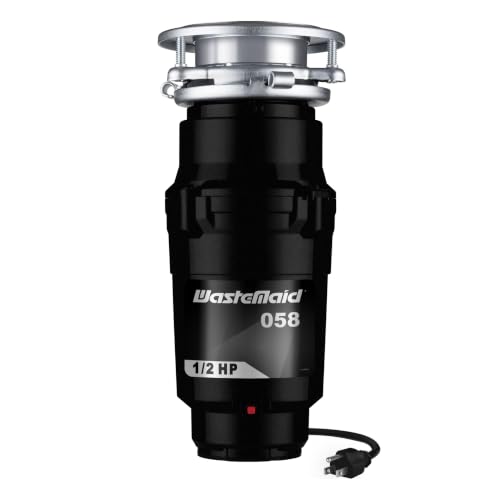
Waste Maid Garbage Disposal, Anti-Jam, Continuous Feed, 1/2 HP Economy
Included for 'Best Garbage Disposals for Different Kitchens' because the listing specifies Anti-Jam and Continuous Feed, details this guide uses to compare options.
View on Amazon
Waste King Garbage Disposal for Kitchen Sink with Power Cord, Compact Food Waste Disposer, L-111
Included for 'Best Garbage Disposals for Different Kitchens' because the listing specifies Compact Food Waste Disposer and L-111, details this guide uses to compare options.
View on Amazon
InSinkErator Power .75HP, 3/4 HP Garbage Disposal, Power Series EZ Connect Continuous Feed Food Waste Disposer, Black
Included for 'Best Garbage Disposals for Different Kitchens' because the listing specifies 3/4 HP Garbage Disposal and Power Series EZ Connect Continuous Feed Food Waste Disposer, details this guide uses to compare options.
View on AmazonIts main advantages are speed and convenience. Its disadvantages are that the opening remains accessible while the motor is running, and careless loading can increase jams. A continuous-feed unit also needs a properly wired switch or air-switch system, plus enough clearance for its larger motor housing.
Batch-feed: controlled and often easier to live with
A batch-feed disposal operates only after a stopper or cover is inserted and turned into its operating position. That interlock is useful in households with young children and in kitchens where accidental switch activation is a concern. It also eliminates the need for a conventional wall switch in some installations, although the electrical connection still needs to be correctly installed.
Batch-feed models process one load at a time, so they are slower when cleaning up after a large meal. The cover and activation mechanism are additional parts to keep clean, and the unit may be wider or taller than a comparable continuous-feed model. For deliberate, occasional use, however, those trade-offs are usually reasonable.
How much horsepower do you need?
- 1/3 to 1/2 HP: Suitable for one or two people who mainly dispose of soft vegetable scraps, small fruit pieces, and limited leftovers. These units are more likely to stall when overloaded.
- 3/4 HP: The best all-purpose range for many homes. It handles routine food preparation and moderate leftovers without the cost and size of the largest models.
- 1 HP: Appropriate for frequent cooking, large families, and users who regularly process tougher scraps. More horsepower does not make every item safe to grind, but it provides greater torque and reduces nuisance stalls.
- 1-1/4 HP and above: Usually unnecessary for a typical household unless the manufacturer’s design, chamber size, warranty, or noise control justifies the added cost and cabinet space.
Horsepower is only one part of performance. A disposal with a well-designed grinding system, stainless steel components, overload protection, and a larger chamber can outperform a cheaper unit with a higher advertised motor rating. Treat horsepower as a starting point, not a complete performance score.
Notable disposal types and established models
For a budget replacement: InSinkErator Badger 5
The InSinkErator Badger 5 is a familiar 1/2 HP continuous-feed choice for basic food-scrap duty. It is most suitable for smaller households and straightforward replacements where low initial cost matters more than premium sound insulation. Its compactness and common mounting ecosystem can simplify replacement, but verify the exact height, outlet position, and mounting assembly before assuming it will be a drop-in fit.
For a compact upgrade: InSinkErator Evolution Compact
The Evolution Compact is a 3/4 HP continuous-feed model designed for users who want more grinding capacity and quieter operation without moving to the largest housing. Its multi-stage grinding design is useful for frequent cooking, while insulation helps reduce—but does not eliminate—motor and vibration noise. Check the cabinet height carefully: premium insulation and grinding stages can make a disposal taller than an entry-level replacement.
For a premium, quiet continuous-feed setup: InSinkErator Evolution Excel
The Evolution Excel is aimed at large or frequently used kitchens that value sound reduction and high-capacity operation. Its 1 HP motor and premium construction make it a better fit for repeated loads than a basic 1/3 or 1/2 HP unit. It also tends to be heavier and more expensive, so the sink flange, mounting hardware, cabinet floor, and electrical circuit should all be checked before purchase.
For value-focused power: Waste King Legend models
Waste King’s Legend line includes compact continuous-feed disposals in several motor sizes, including commonly available 1/2, 3/4, and 1 HP versions. These models can be appealing when cabinet height and purchase price are important. Compare the actual housing dimensions, electrical connection, grinding components, and warranty terms rather than choosing solely by horsepower.
For a safety-first installation: batch-feed model
Choose a batch-feed disposal from a manufacturer such as InSinkErator when controlled activation is more important than rapid cleanup. A 3/4 HP batch-feed unit is a sensible middle ground for many homes; a 1 HP version is preferable when the household cooks heavily. Confirm that the model’s cover, stopper, and activation mechanism are comfortable for every person who will use it.
Fit the disposal to the sink and cabinet
Measure before ordering. Record the distance from the underside of the sink flange to the cabinet floor, the available width between cabinet walls, and the location of the drain outlet. Also measure the space needed for the P-trap, dishwasher drain hose, electrical box, and any water-filtration or recycling equipment.
As a rough planning guide, compact disposals are often about 6–8 inches tall and 6–7 inches wide, while larger insulated models can approach 10–13 inches in height and 8–9 inches in width. These are useful screening numbers, not substitutes for the manufacturer’s dimensional drawing.
Sink material matters too. A standard stainless-steel sink usually supports a disposal mounting flange without difficulty. Heavy composite, fireclay, or unusually thick sinks may require compatible mounting hardware. A disposal should hang squarely from the flange; forcing a misaligned unit can cause leaks or place stress on the sink.
What each type can and cannot handle
Most household disposals are designed for small amounts of ordinary food waste with a strong flow of cold water. Soft vegetable trimmings, cooked leftovers in modest quantities, citrus peel in small amounts, and small bits of meat are generally reasonable when the manufacturer permits them.
- Avoid grease, oil, and fats: They can cool inside the drain and combine with other debris.
- Avoid fibrous waste: Celery strings, corn husks, artichoke leaves, onion skins, and banana peels can wrap around grinding parts or clog plumbing.
- Avoid hard objects: Bones, shells, glass, metal, and large fruit pits can damage components or jam the turntable.
- Use caution with coffee grounds: Small amounts may pass through some systems, but repeated quantities can settle in plumbing rather than disappear.
- Never put hands inside: Turn off power at the switch and circuit breaker, then use tongs or the manufacturer’s tool for a visible obstruction.
Noise, maintenance, and ownership costs
Premium insulation reduces airborne noise, but vibration can still travel through the sink and drain piping. A properly seated mounting ring, a stable sink, and flexible dishwasher and drain connections often matter as much as insulation. Run cold water before starting, keep it running during grinding, and continue for several seconds afterward to move ground material through the trap.
The parts most likely to cause trouble are the splash baffle, mounting gasket, drain connections, reset button, and motor bearings or seals after years of service. A splash baffle can become brittle or stained and is usually replaceable. Leaks at the sink flange often indicate an installation or gasket problem rather than a failed motor.
A simple ownership calculation illustrates why the cheapest unit is not always the least expensive choice. Suppose a $110 disposal lasts six years and a $300 insulated model lasts ten years. Ignoring installation and repairs, the purchase cost is about $18 per year for the first and $30 per year for the second. If the premium model prevents one replacement installation or is substantially quieter in an open kitchen, its higher annual purchase cost may be worthwhile.
Installation requirements to confirm
- Check whether the sink flange and mounting ring are compatible with the new disposal.
- Confirm the electrical setup: a properly grounded receptacle or hardwired connection, a reachable switch or air switch, and circuit protection appropriate to the unit.
- Remove the dishwasher knockout plug if a dishwasher drain hose will connect to the disposal.
- Support the disposal while attaching it to the flange; do not let the drainpipe carry its weight.
- Use the manufacturer’s specified drain fittings and test for leaks with water running before restoring the cabinet contents.
Electrical work, sink modifications, and difficult drain alterations are best handled by a qualified professional. A disposal that fits physically can still be unsuitable if the circuit, drain layout, or sink mounting system is incorrect.
Bottom line
Choose a 3/4 HP continuous-feed disposal for the most balanced everyday solution. Choose a 1/2 HP compact model for light use and limited cabinet space, a 1 HP insulated model for frequent cooking and noise-sensitive kitchens, and a batch-feed model when controlled activation is the priority. The best garbage disposals are not necessarily the most powerful: the right choice matches the motor to your scraps, the housing to your cabinet, and the operating style to the way your household actually cooks.





Write Your Review
No reviews yet. Be the first to share your experience!