
Key takeaways
- Bowl capacity: 3.2 quarts, suitable for one-batch recipes up to roughly a single boxed cake mix or a dozen cookies at a time
- Speeds: six, with a tilt-head design that lifts the head for bowl access
- Format: compact electric stand mixer with a lightweight body, marketed as portable and easy to store
- Attachments: mixer attachments as supplied for mixing and whipping; check the listing for whether a dough hook is included
- Footprint: the smallest base in this roundup, meaning it fits under upper cabinets on most kitchens and stores upright
- Price tier: budget
Top 3 Picks
The best stand mixer for most home bakers is the KitchenAid Classic Series 4.5 Quart Tilt-Head Stand Mixer K45SS. Its 4.5-quart bowl handles a double batch of cookie dough or two standard cake layers, the tilt-head design gives clear access to the bowl, and the rear-mounted motor on a die-cast base keeps the unit planted during stiff doughs. It suits anyone who bakes at least weekly and wants a machine with a long parts and attachment ecosystem.
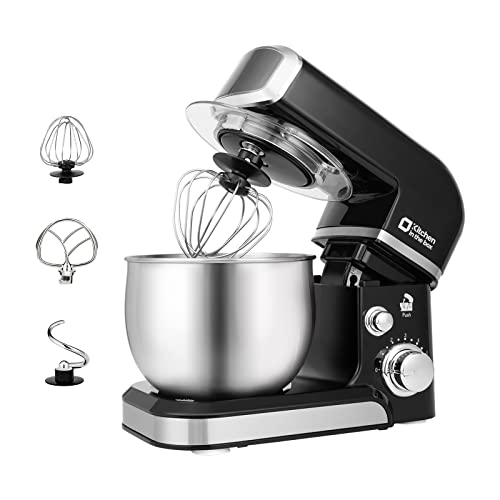
The best budget pick is the Kitchen in the box 3.2Qt Small Electric Food Mixer. At roughly 3.2 quarts, it is aimed at small batches, single cake layers, whipped cream, and egg whites, with six speeds and a lightweight body that stores in a cabinet. It makes sense for renters, dorm kitchens, and bakers who make one recipe at a time.
The best premium pick for heavy or frequent mixing is the Camic 7.45 QT Tilt-Head Stand Mixer, the largest bowl capacity in this roundup. A bowl that size means fewer batches when you are scaling up, and the tilt-head layout with a stainless-steel bowl keeps cleanup straightforward. It is the pick for households that bake in volume and have permanent counter space.
Quick Comparison
| Product | Best For | Bowl Capacity | Speed / Power Class | Format | Price Tier |
|---|---|---|---|---|---|
| Kitchen in the box Stand Mixer | Small kitchens, tiny batches | 3.2 qt | 6 speeds, light-duty motor | Tilt-head, compact | Budget |
| KitchenAid Classic Series K45SS | Everyday all-round baking | 4.5 qt | 10 speeds, medium-duty motor | Tilt-head, die-cast | Premium |
| Cuisinart Stand Mixer | Precise speed control, cakes and creams | 5.5 qt | 12 speeds, 500-watt class | Tilt-head, stainless bowl | Mid-range |
| Kourice 6.5QT Tilt-Head Mixer | Bread dough and larger batches | 6.5 qt | 10 speeds, heavy-duty pro class | Tilt-head, stainless cladding | Mid-range |
| Camic 7.45 QT Tilt-Head Mixer | Volume baking, big household batches | 7.45 qt | 10-speed class, high-torque motor | Tilt-head, silver finish | Premium |
| OLIXIS 4.2 Qt Stand Mixer | Beginner setups, light weekly use | 4.2 qt | 10 speeds, light-duty motor | Tilt-head | Budget |
| VIVOHOME 6-Quart Stand Mixer | Mid-size batches, colorful kitchens | 6 qt | 6-speed class, medium-duty | Tilt-head, red finish | Mid-range |
| KitchenAid Artisan KSM150PS | Attachment ecosystem and longevity | 5 qt | 10 speeds, medium-duty motor | Tilt-head, die-cast | Premium |
| OLIXIS 6.3 Qt Stand Mixer | Wider bowls on a tight budget | 6.3 qt | 10 speeds, light-to-medium duty | Tilt-head | Budget |
| Martha Stewart 5.3QT Tilt-Head Mixer | Quiet-feeling control, clean design | 5.3 qt | 12 speeds, medium-duty | Tilt-head, stainless bowl | Premium |
| Hamilton Beach Classic Stand and Hand Mixer | Two tools in one, starter kitchens | 4 qt | 6 speeds + QuickBurst, 290 W peak | Convertible stand/hand | Budget |
| Aucma Stand Mixer | Cake and cookie batches, mid-range value | 6.5 qt | 6 speeds, 660 W | Tilt-head | Mid-range |
How We Chose
This roundup compares published product information rather than lab results. Every mixer here was evaluated against four criteria that a spec sheet does not explain on its own. First, bowl capacity in relation to realistic batch math: how much buttercream, cookie dough, or bread dough a bowl actually holds once you account for ingredients climbing the sides, since a bowl filled to the brim cannot be mixed. Second, motor power class: whether the machine is built for light-duty work like whipped cream and pancake batter, medium-duty work like butter and cookie dough, or sustained dough kneading, which is the single most demanding task a stand mixer performs.
Third, attachment and ecosystem: what comes in the box (whisk, paddle, dough hook, splash guard, or bowl cover) and whether the machine uses a proprietary hub that can accept add-on slicers, grinders, or pasta rollers later. Fourth, countertop footprint and storage: base depth, height under a standard upper cabinet, and whether the machine is storable without rearranging a shelf.
The picks are organized by the situation each one fits: small kitchens, budget ceilings, bread-heavy baking, and volume baking. No products were tested or handled; the analysis is based on category-standard specifications, brand reputation, and the documented realities of owning each design.
1. Kitchen in the box Stand Mixer – Best for Small Kitchens
This is the smallest mixer in the group, and that is the entire point. With a 3.2-quart bowl and six speeds, it is sized for single-layer cakes, muffin batter, whipped cream, frosting for one dozen cupcakes, and meringues made with two or three egg whites. It suits apartment dwellers, students, people who bake a few times a month, and anyone who wants a stand mixer that lives in a cabinet and comes out on demand. It is also a reasonable first stand mixer for someone moving up from a hand mixer who is not ready to commit to a heavier, pricier machine.
Key specs, described by class:
- Bowl capacity: 3.2 quarts, suitable for one-batch recipes up to roughly a single boxed cake mix or a dozen cookies at a time
- Speeds: six, with a tilt-head design that lifts the head for bowl access
- Format: compact electric stand mixer with a lightweight body, marketed as portable and easy to store
- Attachments: mixer attachments as supplied for mixing and whipping; check the listing for whether a dough hook is included
- Footprint: the smallest base in this roundup, meaning it fits under upper cabinets on most kitchens and stores upright
- Price tier: budget
Strengths
The value proposition is clear: a stand mixer form factor at a budget price. Standing hands-free while the mixer whips cream or combines batter is the main upgrade over a hand mixer, and the small bowl means less leftover capacity to scrape. The compact footprint is the standout strength. Many stand mixers are tall enough that they cannot sit on the counter under a cabinet, which pushes people to store them in a closet; a 3.2-quart machine avoids that problem entirely. Combined with the lightweight build, it moves easily between counter and cabinet.
Pros
- Smallest footprint in this roundup, easiest to store
- Budget price tier with genuine stand-mixer convenience
- Ideal bowl size for single-batch recipes and small households
- Tilt-head access makes adding ingredients and scraping simple
- Lightweight, so lifting it in and out of a cabinet is not a chore
Cons
- 3.2 quarts runs out of room quickly if you double a recipe or bake for a crowd
- Light-duty motor class is not intended for stiff bread dough or long kneading sessions
- Fewer speeds than the mid-range and premium machines here
- Smallest attachment ecosystem, so upgrading later usually means replacing the mixer
- Small bowls mix smaller quantities less evenly at the bottom, so scraping is still part of the routine
How It Compares
Against the OLIXIS 4.2 Qt, this machine trades about a quart of capacity for a smaller, lighter body and usually a lower price. The practical split: choose the Kitchen in the box if counter space and storage are your binding constraint, and the OLIXIS 4.2 Qt if you routinely make full recipes and want a little more headroom in the bowl without jumping to mid-range pricing. Against the Hamilton Beach Classic, the Kitchen in the box is a pure stand mixer, while the Hamilton Beach converts between stand and hand use; if you value having a hand mixer for quick jobs, the convertible design is more flexible, but it is a different ownership experience and a different bowl size.
2. KitchenAid Classic Series K45SS – Best Overall
The K45SS is the reference point for home stand mixers, and it earns the best-overall label because it balances capacity, durability, and ecosystem better than anything else in this group. The 4.5-quart bowl is the sweet spot for most households: it comfortably handles a two-layer cake, a batch of drop cookies, a standard loaf of bread dough, and frosting for a sheet cake. The tilt-head design in Onyx Black with a die-cast body gives the machine a planted, stable feel, and the rear-mounted motor design is what makes the whole family of mixers compatible with add-on attachments. It suits the regular baker who wants one machine to do everything for the next several years.
Key specs, described by class:
| Bowl capacity | 4.5 quarts |
| Speeds | 10, with a slow-start setting for folding in flour and chips without a cloud of dust |
| Design | Tilt-head, die-cast body, Onyx Black finish |
| Attachments | Coated flat beater, dough hook, wire whip; rear power hub accepts a wide range of optional add-ons sold separately |
| Motor class | Medium-duty, positioned for cakes, cookies, and moderate bread work |
| Price tier | Premium |
Strengths
Three things explain the K45SS’s reputation. First, parts and accessory availability: replacement bowls, beaters, and a long list of hub attachments are widely sold, so the machine does not become disposable when a part wears out. Second, the 10-speed control with a gentle starting ramp is genuinely useful in a home kitchen, letting you blend dry ingredients into wet without throwing flour over the counter. Third, stability: the die-cast base and heavy frame keep the bowl from walking across the counter when you knead a stiff dough at speed 2. The 4.5-quart bowl also fits recipes that a 5- or 6-quart bowl leaves too empty, which matters because mixers with oversized bowls beat smaller quantities inefficiently, leaving ingredients below the reach of the beater.
Pros
- 4.5-quart bowl is right-sized for the majority of home recipes
- Die-cast construction gives a stable, low-vibration mix on doughs
- Deep pool of replacement parts and optional attachments
- 10 speeds with a slow start, useful for folding and dust-prone dry ingredients
- Compact for its class; the tilt-head format lowers the overall height versus bowl-lift designs
Cons
- Premium price tier sits well above the budget machines here
- 4.5 quarts is limiting for double batches, big-batch bread, or large parties
- Medium-duty motor class means long, heavy kneading sessions are best kept to normal recipe sizes
- Beater-to-bowl clearance means you still need to scrape the bowl at least once per mix
- Add-ons are sold separately, so the full ecosystem costs more than the mixer alone
How It Compares
Against the KitchenAid Artisan KSM150PS, the trade-off is capacity versus price. The Artisan adds about half a quart of bowl (5 quarts), more color options, and the same tilt-head layout; if you regularly make larger batches, the extra room matters, and the Artisan is the natural step up. If your recipes are standard-size, the K45SS gets you the same build feel and ecosystem for less. Against the Cuisinart 5.5 Quart, the K45SS gives up bowl size and about two speeds but gains attachment compatibility and a longer track record of parts availability. Against the budget machines, the K45SS costs more but is the pick least likely to leave you shopping again in two years.
3. Cuisinart Stand Mixer – Best for Speed Control
The Cuisinart Stand Mixer is the precision pick of the mid-range. Its 12 speeds and 5.5-quart stainless steel bowl make it especially good for tasks where control matters more than raw torque: whipping egg whites to a specific stage, bringing buttercream to the right consistency, and folding delicate batters. It ships with a chef’s whisk, mixing paddle, dough hook, and splash guard, which is a more complete starter kit than most machines at its price tier. The 5.5-quart bowl handles a two-layer cake with frosting, a batch of brownies, and most bread recipes, making it a genuine all-rounder.
Key specs, described by class:
- Bowl capacity: 5.5 quarts, stainless steel
- Speeds: 12, giving fine steps between slow stirring and high-speed whipping
- Motor class: 500-watt class, mid-range torque for cookies, butter, and moderate bread dough
- Included attachments: chef’s whisk, mixing paddle, dough hook, splash guard
- Format: tilt-head with a stable base; the splash guard is the practical feature that reduces counter cleanup
- Price tier: mid-range
Strengths
The splash guard is an underrated feature in real kitchens. Adding a cup of flour at speed 3 without a guard usually means wiping the backsplash afterward; a guard changes that. The 12-speed dial gives better resolution than a 6-speed machine to do the same tasks, because the jumps between settings are gentler. The stainless-steel bowl resists staining and odors in a way that uncoated or thinly finished bowls sometimes do not, and it stays cold longer, which helps when you whip cream or make pastry where heat is the enemy. Finally, the bowl size hits a practical middle: bigger than the entry machines, not so big that a single cake layer gets lost in it.
Pros
- 12 speeds offer the finest control in this roundup’s mid-range tier
- 5.5-quart stainless bowl balances batch size and everyday recipes
- Four included attachments, including a splash guard, reduce add-on spending
- Stainless bowl resists staining and holds temperature well for cream and pastry
- Mid-range price tier with features usually found a step higher
Cons
- Uses a proprietary attachment hub, so the add-on range is narrower than the KitchenAid ecosystem
- Heavy for its size; it is not a machine you casually move between cabinet and counter
- 5.5 quarts is generous for a single cake layer, so very small batches mix less efficiently
- Premium KitchenAid models still outperform it on sustained, stiff dough kneading
- 12 speeds can be more granularity than a casual baker needs
How It Compares
Against the KitchenAid Classic K45SS, the Cuisinart wins on bowl size (5.5 vs 4.5 quarts), speed count (12 vs 10), and included accessories, while the KitchenAid wins on attachment ecosystem and long-term parts availability. Choose Cuisinart if you want more capacity and precise speed control out of the box; choose KitchenAid if you plan to add a grinder, spiralizer, or pasta roller later. Against the Aucma 6.5-Qt, the Cuisinart gives up about a quart of bowl and some wattage but offers finer speed control, a splash guard, and a stronger brand support footprint. For cake, cream, and pastry work specifically, the Cuisinart’s control set is the better fit.
4. Kourice 6.5QT Tilt-Head Stand Mixer – Best for Bread Dough
Bread is the hardest thing a home stand mixer does, and the Kourice 6.5-quart machine is built for it. A heavy-duty pro 10-speed motor, stainless-steel cladding, and a stainless steel bowl signal a machine intended for sustained resistance work rather than occasional whipping. The 6.5-quart bowl is the practical threshold where dough stops fighting the bowl: a two-loaf batch of lean dough, an enriched brioche, or a large pizza dough have space to move. It suits the baker who has moved past cakes and cookies and now makes bread weekly, or who wants one mixer that can also handle generous batches of cookie dough and frosting.
Key specs, described by class:
- Bowl capacity: 6.5 quarts, stainless steel, enough for double batches of many recipes
- Speeds: 10, with low settings intended for kneading
- Motor class: heavy-duty pro, positioned for dough and sustained mixing rather than light whipping only
- Build: stainless-steel cladding on the body for durability and easier cleaning
- Format: tilt-head, with a heavier base to resist movement during kneading
- Price tier: mid-range
Strengths
The two features that matter for bread are bowl size and motor class, and this machine delivers on both. Dough needs room to be folded and stretched against the bowl wall; undersized bowls force you to stop, scrape, and restart, which interrupts gluten development. A 6.5-quart bowl lets the dough hook actually work. The heavy-duty motor class means the machine is less likely to stall or heat up when kneading a stiff dough for eight to ten minutes, the standard window for developing gluten in many bread recipes. Stainless cladding also means the body wipes clean rather than absorbing flour dust into a textured finish, and it holds up to years of use better than painted plastic housings.
Pros
- 6.5-quart bowl gives dough room to develop properly
- Heavy-duty motor class suited to sustained kneading
- Stainless steel cladding and bowl for durability and easy cleanup
- 10 speeds cover slow kneading through fast whipping
- Mid-range price tier for a heavy-duty class motor
Cons
- Large bowl mixes small batches inefficiently; a single cake layer may sit below the beater
- Heavier and taller than 4- to 5-quart machines, so storage is more demanding
- Larger footprint needs real counter space if it stays out
- Heavy-duty capacity is more than a cookies-and-cakes baker needs
- Attachment ecosystem is smaller than the established KitchenAid network
How It Compares
Against the Aucma 6.5-Qt, these two are direct capacity rivals: same bowl size, both mid-range, both aimed at bread-capable mixing. The Kourice leans into a heavier-duty pro motor and stainless cladding, while the Aucma leans on a 660-watt motor and six speeds. If you knead bread often, the Kourice’s build and speed range are the safer bet; if you mainly make cakes and cookies with occasional dough, the Aucma is the more economical route to the same bowl size. Against the Camic 7.45 QT, the Kourice gives up about a quart of capacity but stays easier to house on a counter and usually easier to move; the Camic is the choice only if volume is the priority.
5. Camic 7.45 QT Tilt-Head Stand Mixer – Best for Volume Baking
The Camic is the largest machine in this roundup, and that is its reason to exist. At 7.45 quarts, it is aimed at households that bake in volume: multiple batches of cookies for a bake sale, double or triple cake recipes, big batches of bread, and frosting for large tiered cakes. The 10-speed tilt-head format with a silver finish keeps the layout familiar, and the high-torque motor class is intended to carry the load that a bowl this large implies. It suits the holiday baker, the family that cooks for a crowd, and the home baker who has outgrown a 5-quart machine and does not want to run it twice.
Key specs, described by class:
- Bowl capacity: 7.45 quarts, the largest in this roundup
- Speeds: 10-speed class with low settings for dough
- Motor class: high-torque, paired with the large bowl
- Finish: silver, tilt-head format for bowl access
- Footprint: the biggest and most counter-hungry machine here; measure your space before buying
- Price tier: premium
Strengths
Volume is the entire argument. Where a 4.5-quart mixer means two rounds to make a large batch of chocolate chip cookies, a 7.45-quart bowl gets there in one. That saves time and, more importantly, prevents the inconsistency that comes from splitting a batch, since a divided dough or batter often mixes differently in batch two. The large bowl also handles stiff dough volumes that smaller machines simply cannot, and the tilt-head design means you are not wrestling a giant bowl off a locking mechanism just to scrape it. For anyone who regularly bakes for groups, the capacity pays for itself in avoided frustration.
Pros
- Largest bowl in this roundup at 7.45 quarts
- Fewer batches when scaling recipes for events and holidays
- High-torque motor class matched to the bowl size
- Tilt-head access keeps loading and scraping manageable
- Handles heavy dough volumes that 4- to 5-quart machines cannot
Cons
- Big footprint; it needs permanent counter space or a deep cabinet
- Small batches mix poorly in a bowl this large
- Heaviest machine in the group, difficult to move
- Premium price tier for capacity many households will not use weekly
- Overkill for a two-person kitchen that bakes standard-size recipes
How It Compares
Against the Kourice 6.5QT, the Camic buys roughly an extra quart of capacity and a premium finish at the cost of counter space and a higher price. The decision is simple: if you regularly double or triple recipes, the Camic; if a 6.5-quart bowl already holds your biggest batch, the Kourice is the more sensible, easier-to-house machine. Against the KitchenAid Artisan KSM150PS, the comparison is capacity versus ecosystem: the Camic gives you far more bowl for volume work, while the Artisan gives you the attachment hub, parts network, and resale value of the leading brand. Volume bakers should take the bowl; everyone else should take the ecosystem.
6. OLIXIS 4.2 Qt Stand Mixer – Best for Beginner Setups
This is the step up from a hand mixer without the price of a mid-range machine. With a 4.2-quart bowl and 10 speeds in a tilt-head format, the OLIXIS 4.2 Qt covers the standard beginner repertoire: boxed cake mix, from-scratch brownies, chocolate chip cookies, whipped cream, and frosting. It suits someone furnishing a first kitchen, a household that bakes a few times a month, and anyone who wants to confirm they actually enjoy stand-mixer baking before spending more. The 10-speed control is notable at this tier because it offers more usable steps than the typical 6-speed budget machine.
Key specs, described by class:
- Bowl capacity: 4.2 quarts, sized for single batches of most recipes
- Speeds: 10, tilt-head design
- Motor class: light-duty, intended for batters, creams, and light doughs
- Attachments: standard mixing attachments as supplied; check the listing for dough hook inclusion
- Format: compact tilt-head, lighter than mid-range and premium machines
- Price tier: budget
Strengths
The value here is the speed count at the price. Ten speeds on a budget machine means you can actually use the middle settings, which is where most mixing happens, instead of choosing between too slow and too fast. The 4.2-quart bowl is closer to a full-size recipe than the 3.2-quart entry machine, so you are less likely to hit the ceiling when a recipe says “makes 24 cookies.” The tilt-head design is the user-friendly layout for beginners because the head lifts up and out of the way, making it easy to see what is happening at the bottom of the bowl. Its lighter weight also means it stores easily in a small kitchen.
Pros
- 10 speeds at a budget price tier
- 4.2-quart bowl handles standard single recipes
- Tilt-head layout is easy to learn and to scrape
- Lighter and more compact than mid-range machines
- Low entry price makes it easy to start stand-mixer baking
Cons
- Light-duty motor class is not meant for bread dough or long kneading
- 4.2 quarts still limits double batches
- Fewer included or optional attachments than premium brands
- Less stable at high speeds with heavy dough than die-cast machines
- Not the machine to buy if you already know you want to bake bread weekly
How It Compares
Against the Kitchen in the box 3.2Qt, this is the capacity upgrade: roughly a quart more bowl for full-size recipes, still at budget pricing. If you consistently make standard batches, the OLIXIS 4.2 Qt is the better value; if storage and weight are the deciding factors, the 3.2-quart machine wins. Against the OLIXIS 6.3 Qt, the two products share the same brand and speed count, so the choice is pure capacity versus footprint: the 6.3-quart version handles bigger batches but takes more counter space and is heavier to store. Beginners with small kitchens should start at 4.2 quarts; anyone baking for a family of four or more should pay the small premium for the larger bowl.
7. VIVOHOME 6-Quart Stand Mixer – Best for Mid-Size Batches
The VIVOHOME 6-quart machine sits in a useful middle: big enough for a double batch of cookies or a two-loaf bread recipe, smaller than the 6.5- and 7.45-quart giants, and finished in a bright red that reads as a deliberate kitchen appliance rather than a hidden one. It suits a household of three or four that bakes regularly, wants one mixer for both cakes and bread, and is prepared to leave it on the counter. The 6-quart bowl is the practical threshold at which you stop worrying about overflow when you add the last cup of flour.
Key specs, described by class:
- Bowl capacity: 6 quarts, with a bowl-included tilt-head design
- Speeds: 6-speed class, covering stir through fast whip
- Motor class: medium-duty, suited to cookie dough, butter, and moderate bread
- Finish: red, an intentional countertop color
- Format: tilt-head with a standard base footprint for its size
- Price tier: mid-range
Strengths
The main strength is the capacity-to-price ratio. Six quarts is a lot of bowl for a mid-range machine, and it means a double batch of muffins or a large bowl of frosting without stopping halfway. The medium-duty motor class is appropriate for the tasks a 6-quart bowl implies: the bowl is big enough to invite bread dough, and the motor is specified to cope with it at normal home recipe sizes. The red finish deserves a mention because appliances you enjoy looking at get used more; if the mixer stays out, aesthetics are part of the value. It is also simpler to operate than 10- and 12-speed machines, which some bakers prefer.
Pros
- 6-quart bowl at a mid-range price tier
- Medium-duty motor class suited to cookies, butter, and moderate bread
- Large capacity for double batches without jumping to premium pricing
- Distinctive red finish that works as a displayed appliance
- Simple 6-speed control with fewer decisions
Cons
- 6 speeds offers coarse control for delicate whipping
- Heavy-duty bread work is better served by the Kourice or Camic
- Small batches mix inefficiently in a 6-quart bowl
- Narrower attachment ecosystem than KitchenAid or Cuisinart
- Requires counter space to get the most out of it
How It Compares
Against the Aucma 6.5-Qt, both are mid-range machines with nearly the same bowl size. The Aucma offers 660 watts and six speeds; the VIVOHOME offers six speeds in a more compact, colorful package. If you knead dough often, the Aucma’s higher wattage is the more appropriate spec; if you mainly make cakes and cookies and want a machine that looks good on the counter, the VIVOHOME is easier to live with. Against the Cuisinart 5.5 Quart, the VIVOHOME gives up fine speed control and a splash guard in exchange for slightly more bowl. Crumb control matters more to you than a half-quart of capacity, and the Cuisinart is the upgrade.
8. KitchenAid Artisan 5-Qt Tilt-Head Stand Mixer – Best for Long-Term Ownership
The Artisan is the upgrade most K45SS owners eventually consider, and for good reason. The 5-quart bowl adds meaningful capacity over 4.5 quarts; the tilt-head, die-cast format is the same proven layout; and the KSM150PS model in Almond Cream is part of the most extensively supported mixer ecosystem in home baking. It suits bakers who intend to keep one machine for a decade or more, add attachments over time, and want a finish that stays looking intentional in a kitchen. If your question is “which mixer will still have parts and accessories in ten years,” this is the answer.
Key specs, described by class:
| Bowl capacity | 5 quarts |
| Speeds | 10, with slow-start mixing |
| Design | Tilt-head, die-cast body, Almond Cream finish, KSM150PS model |
| Attachments | Flat beater, dough hook, wire whip included; rear hub accepts the broad KitchenAid attachment range sold separately |
| Motor class | Medium-duty, positioned for cakes, cookies, and standard bread recipes |
| Price tier | Premium |
Strengths
The strongest argument for the Artisan is not the bowl or the motor; it is the ecosystem and the ownership experience. The wide attachment range, from pasta rollers to food grinders to spiralizers, means the mixer can take on new jobs instead of being replaced when your cooking changes. Combine that with the broad availability of replacement bowls, beaters, and hooks, plus the die-cast build quality, and you get a machine with an unusually shallow depreciation curve. The 5-quart bowl is also well-calibrated: it accommodates most home recipes without being so large that single batches suffer, and the slow-start feature keeps dry ingredients in the bowl where they belong.
Pros
- Largest attachment ecosystem of any machine in this roundup
- Widely available replacement parts and add-ons
- 5-quart bowl handles standard and slightly scaled-up recipes
- Die-cast tilt-head build with a stable, low-vibration mix
- Wide color range, including the Almond Cream KSM150PS
Cons
- Premium price tier, the highest in this roundup alongside the Camic
- Medium-duty motor class does not match heavy-duty bread machines
- 5 quarts is smaller than the 6.5- and 7.45-quart options here
- Add-ons are sold separately and add up quickly
- Heavier than budget machines, so storing it in a cabinet is a two-hand job
How It Compares
Against the KitchenAid Classic K45SS, the Artisan is a straightforward upgrade: half a quart more bowl, the same tilt-head layout, more finish options, and the same attachment hub. If you already own a K45SS and are at capacity, the Artisan is the natural next machine. If you are choosing between them new, pick the Artisan when you make larger batches and want the color choice; pick the K45SS when standard recipes are the norm and you would rather spend the difference on ingredients. Against the Cuisinart 5.5 Quart, the Artisan gives up half a quart and two speeds but wins decisively on attachment range and parts longevity. Buy the Cuisinart for out-of-the-box features; buy the Artisan for a ten-year plan.
9. OLIXIS 6.3 Qt Stand Mixer – Best for Budget Batch Baking
This is the large-bowl budget option, and it occupies a specific niche: bakers who need capacity more than they need wattage or brand support. A 6.3-quart bowl and 10 speeds in a tilt-head format, at a budget price tier, means you can make a double batch of cookie dough or a big bowl of frosting without spending mid-range money. It suits families on a tight budget, people who bake in bursts for birthdays and holidays rather than weekly, and anyone who has learned that bowl size is the spec they actually run out of first.
Key specs, described by class:
- Bowl capacity: 6.3 quarts, the second-largest in the budget tier here
- Speeds: 10, tilt-head design
- Motor class: light-to-medium duty, appropriate for batters, cookie dough, and frostings
- Attachments: standard mixing attachments as supplied; confirm dough hook inclusion in the listing
- Format: tilt-head with a full-size base for a 6.3-quart bowl
- Price tier: budget
Strengths
The core strength is straightforward: nowhere else in this roundup do you get this much bowl for a budget price. If your recipe failures have been about overflow, not motor power, a 6.3-quart bowl solves the actual problem. The 10-speed control gives finer resolution than a 6-speed machine, which is genuinely useful for folding and for slowly streaming in oil for mayonnaise or emulsified frostings. It is also a sensible choice for a second mixer, a rental kitchen, or a vacation home, where the priority is capability per dollar rather than long-term brand support.
Pros
- 6.3-quart bowl at a budget price tier
- 10 speeds for finer control than typical budget machines
- Tilt-head design for easy loading and scraping
- Good fit for burst baking and holiday batches
- Low cost of entry for a large-bowl machine
Cons
- Light-to-medium motor class limits sustained bread kneading
- Budget build is less stable at high speed with heavy dough than die-cast machines
- Smaller attachment ecosystem and less certain long-term parts availability
- Large bowl underperforms on very small batches
- Not the machine to choose if bread is your main goal
How It Compares
Against the OLIXIS 4.2 Qt, the decision is capacity versus footprint and weight: the 6.3-quart version handles double batches, the 4.2-quart version stores more easily. If you have the counter space and bake for more than two people, the larger bowl is the better buy. Against the Aucma 6.5-Qt, the bowl sizes are nearly identical, but the Aucma’s 660-watt motor and mid-range build make it the stronger choice for dough; the OLIXIS 6.3 Qt wins on price. If your budget is fixed and capacity is the priority, take the OLIXIS; if you can stretch to mid-range, the Aucma is the more durable machine for the same bowl size.
10. Martha Stewart 5.3QT Tilt-Head Stand Mixer – Best for Neighborhood-Scale Baking
The Martha Stewart 5.3-quart machine is a premium-tier mixer with a practical mid-size bowl and 12 speeds, aimed at bakers who want refined control and a clean, understated look. The stainless steel bowl is finished to resist staining, and the 12-speed control gives the finest resolution of any machine here outside the Cuisinart. It suits bakers who make a consistent rotation of cakes, cookies, breads, and frostings, want the control to handle each properly, and prefer a machine that reads as a working appliance rather than a showpiece. The 5.3-quart capacity comfortably covers a two-layer cake with frosting, a full batch of cookie dough, and standard bread recipes.
Key specs, described by class:
- Bowl capacity: 5.3 quarts, stainless steel
- Speeds: 12, the highest speed count in this roundup alongside the Cuisinart
- Motor class: medium-duty, positioned for cakes, cookies, butter, and standard bread
- Formula: tilt-head with a stainless steel bowl included
- Format: mid-size tilt-head; footprint similar to other 5-quart machines
- Price tier: premium
Strengths
Twelve speeds on a 5.3-quart bowl is a combination tailored to bakers who work across categories. Whipping egg whites benefits from the top of the range; creaming butter needs a steady middle setting; folding in flour wants the slowest speed with no jumps. Having that resolution means fewer workarounds like pulsing the machine on and off. The stainless bowl is another practical plus: it cleans easily, resists lingering odors from garlicky savory doughs or strong extracts, and holds temperature, which helps with pastry and whipped cream. The 5.3-quart size is the middle ground between everyday and large-batch, and for many households it is the capacity that actually matches how they bake.
Pros
- 12 speeds for precise control across whipping, creaming, and folding
- 5.3-quart stainless steel bowl balances everyday and scaled-up recipes
- Mid-size footprint is easier to house than 6.5- and 7.45-quart machines
- Stainless bowl resists staining and holds temperature
- Clean, neutral design that fits most kitchen styles
Cons
- Premium price tier for a mid-size bowl
- Medium-duty motor class, not a heavy bread-kneading specialist
- Smaller capacity than the 6-quart-and-up machines here
- Attachment ecosystem is narrower than KitchenAid’s
- 12 speeds is more control than casual bakers will use
How It Compares
Against the Cuisinart 5.5 Quart, these two are closely matched: both offer 12 speeds, both have stainless bowls, and both sit within a fraction of a quart of each other. The Cuisinart includes a splash guard and sits at a mid-range price tier; the Martha Stewart machine is a premium-tier unit with a slightly smaller bowl and a cleaner design language. If budget and included accessories matter most, the Cuisinart is the better value. If you want the highest speed resolution with a more restrained look, the Martha Stewart is the alternative. Against the KitchenAid Artisan, the trade-off is control versus ecosystem: choose the Martha Stewart for the 12-speed dial, and the Artisan for attachments and parts.
11. Hamilton Beach Classic Stand and Hand Mixer – Best for Two Tools in One
This is the most unusual product in the roundup, and it solves a specific problem. The Hamilton Beach Classic converts between a stand mixer and a hand mixer: it can run hands-free in the 4-quart bowl, or the head can be detached and used by hand for quick jobs. Six speeds with QuickBurst add a temporary boost, Bowl Rest lets the hand mixer rest on the bowl edge between additions, and 290 watts peak power covers light mixing tasks. It suits small kitchens, people who want one appliance instead of two, and bakers who mostly whip, beat, and blend rather than knead.
Key specs, described by class:
- Bowl capacity: 4 quarts
- Speeds: 6 with QuickBurst for a momentary speed increase
- Power class: 290 watts peak, light-duty
- Format: convertible stand and hand mixer, with Bowl Rest for resting the hand unit on the bowl
- Attachments: beaters and dough hooks as supplied, depending on the package
- Price tier: budget
Strengths
The conversion feature is the reason to buy it. Anyone who has made a single mug cake or whipped half a cup of cream knows a hand mixer is faster to grab than a stand mixer, but anyone who has held a hand mixer for five minutes knows the arm gets tired. This machine gives you both behaviors from one box: hands-free for longer jobs, handheld for short ones. Bowl Rest is a small design detail with real value, keeping the running beater over the bowl instead of dripping onto the counter. At a budget price tier for effectively two appliances, the value is hard to argue with.
Pros
- Converts between stand and hand use, replacing two appliances
- QuickBurst adds momentary extra power for stiff mixtures
- Bowl Rest keeps the hand unit tidy between additions
- Budget price tier with low cost of entry
- Compact and easy to store compared with full stand mixers
Cons
- Light-duty power class is not intended for bread dough
- 4-quart bowl limits batch size
- Hand-mixer mode still requires holding the unit for extended periods
- Less stable at speed than full-size stand mixers
- Narrower attachment ecosystem than any dedicated stand mixer here
How It Compares
Against the Kitchen in the box 3.2Qt, the comparison is dedicated versus convertible. The Kitchen in the box is a purpose-built small stand mixer; the Hamilton Beach is a hand mixer that can also stand up. If you never want to hold a mixer, take the Kitchen in the box. If flexibility matters more than hands-free operation, the Hamilton Beach covers more situations. Against the OLIXIS 4.2 Qt, the bowl sizes are similar and both are budget machines, but the OLIXIS is a stronger stand mixer while the Hamilton Beach is a stronger hand mixer. Buy based on which mode you will use more.
12. Aucma Stand Mixer – Best for Cake and Cookie Batches
The Aucma 6.5-quart mixer is the value all-rounder in the mid-range tier. A 660-watt motor and six speeds with a tilt-head design, plus a dough hook and wire whip included, make it capable of the full home-baking range: cake batter, cookie dough, buttercream, and standard bread recipes. It suits a household that bakes weekly, wants one machine for every category, and prioritizes capacity and power per dollar over brand-name attachment systems. The 6.5-quart bowl handles double batches of many recipes and gives dough room to work.
Key specs, described by class:
- Bowl capacity: 6.5 quarts
- Power: 660 watts
- Speeds: 6, tilt-head design
- Included attachments: dough hook, wire whip, and standard mixing attachments
- Motor class: medium-to-heavy duty, suited to cookies, cake, and moderate bread
- Price tier: mid-range
Strengths
660 watts in a 6.5-quart machine at a mid-range price is the headline. That power figure puts it above the budget machines and in range of machines that cost more, and it means the mixer is less likely to bog down in thick cookie dough or a firm bread dough. The included dough hook and wire whip cover the two most important jobs beyond basic mixing, so you are not immediately shopping for accessories. Six speeds is fewer than the Cuisinart or Martha Stewart machines, but the settings are well spread for the tasks a 6.5-quart bowl implies, and the tilt-head layout keeps bowl access easy.
Pros
- 660 watts for its price tier
- 6.5-quart bowl for double batches and bread
- Dough hook and wire whip included
- Mid-range price with a large bowl and strong power figure
- Good single-machine solution for cakes, cookies, and moderate bread
Cons
- Six speeds offers coarse control for delicate tasks
- Large bowl mixes small batches inefficiently
- Narrower attachment ecosystem than KitchenAid or Cuisinart
- Heavier and bulkier than 4- to 5-quart machines, so storage needs thought
- Sustained heavy kneading is better handled by a heavy-duty pro-class machine
How It Compares
Against the Kourice 6.5QT, these two share bowl size and price tier, so the split is build philosophy: the Kourice offers a heavy-duty pro motor class and stainless cladding, while the Aucma offers a 660-watt motor and a simpler six-speed layout. For frequent bread, the Kourice’s heavy-duty specification is the better match; for cakes and cookies with occasional dough, the Aucma is more than sufficient and often the less expensive route to 6.5 quarts. Against the VIVOHOME 6-Quart, the Aucma wins on wattage and gives up half a quart of bowl; if dough is part of your routine, the Aucma’s power advantage matters more than the bowl difference.
How to Choose
Choosing a stand mixer comes down to four numbers you can check before you buy: bowl capacity in quarts, motor power class, the height and depth of the base, and the number of speeds. Everything else is a preference. Here is how to weigh each one against the way you actually bake.
Bowl capacity: match it to your largest regular batch
Bowl capacity should be set by the biggest thing you make in a normal month, not the biggest thing you might make once at the holidays. As a working rule, a stand mixer bowl should never be filled past about two-thirds with batter or dough, because ingredients need room to move and the beater needs to reach them. That means a quart rating overstates usable capacity by roughly a third.
Practical capacity thresholds:
- 3 to 3.5 quarts: one cake layer, one boxed mix, up to a dozen cookies, two to three egg whites whipped. Right for one or two people who bake occasionally.
- 4 to 4.5 quarts: a two-layer cake, a standard batch of drop cookies, frosting for a sheet cake, one loaf of bread. Right for most households, most of the time.
- 5 to 5.5 quarts: the same as above with room to scale up slightly, plus a double batch of brownies or muffins. Right for regular bakers who sometimes cook for guests.
- 6 to 6.5 quarts: double batches of cookies, two loaves of bread, large bowls of frosting, big pizza dough. Right for families of four or more and frequent bakers.
- 7 quarts and up: triple batches, tiered cakes, bake-sale volumes. Right for holiday bakers and anyone feeding a crowd.
The reverse mistake is buying too much bowl. A 7.45-quart mixer trying to whip two egg whites will leave most of the whites below the whisk; you will whip longer and get less volume. If your typical batch is small, a large bowl costs you time and results.
Motor power: rated by what it can do, not by wattage alone
Wattage numbers are useful but not comparable across brands, because peak wattage, continuous wattage, and marketing wattage are all different figures. A more reliable approach is to read the machine by class:
- Light-duty: batters, whipped cream, egg whites, frosting. These machines handle cookie dough with care but are not built for repeated kneading.
- Medium-duty: the standard home class. Cakes, cookies, butter, frosting, and standard bread recipes at normal batch sizes.
- Heavy-duty pro: sustained kneading, stiff doughs, large batches, and frequent bread baking.
Bread is the dividing line. Kneading develops gluten through several minutes of continuous resistance, which is the hardest load a mixer sees. If you plan to make bread weekly, spend up to the heavy-duty class or accept that you will knead in shorter bursts and finish by hand. If bread is occasional, a medium-duty machine is fine and you should put the money into bowl size instead.
Speeds: fewer settings, more discipline
Speed count matters less than the spread. Six speeds can cover every home task if the gaps are sensible; 10 to 12 speeds are more useful for bakers who whip egg whites and make pastry, where small increments change the result. The one feature worth paying attention to is a slow start or a genuinely slow first setting, because folding flour into batter at speed 2 sends a dust cloud across the kitchen. If your machine lacks a slow start, always begin at the lowest setting and increase after the dry ingredients are incorporated.
Footprint: measure before you commit
Countertop footprint is the spec people forget and then regret. A few numbers to check with a tape measure before buying:
- Clearance under upper cabinets: many kitchens have about 18 inches between counter and cabinet. Full-size tilt-head mixers typically stand taller than 13 inches, and bowl-lift designs can exceed 16 inches, so a tall mixer under a low cabinet means it lives on the counter only where the cabinet ends.
- Base depth: 6-quart-and-up machines commonly have bases deeper than 9 inches, plus bowl overhang, so plan for roughly 12 to 14 inches of depth from the wall.
- Weight: budget 4-quart machines often weigh under 10 pounds and store on a shelf; die-cast 5-quart and heavier machines can run 20 to 25 pounds, which is a two-hand lift. If you plan to store rather than display, weight is a daily cost.
A simple decision: if the mixer will live on the counter, choose capacity and power freely. If it must go in a cabinet, favor lighter, compact machines or accept a permanent spot on the counter.
Attachments and the upgrade path
The attachment hub is the difference between a mixer and a system. Machines with a powered rear or front hub accept add-ons like pasta rollers, meat grinders, spiralizers, and slicers, which extend what the mixer can do. Machines without one rely only on the tools in the box. If you think you may want a pasta roller in two years, buy into a system now rather than replacing the mixer later. Also check what is included: a dough hook and splash guard in the box can save meaningful money compared with buying them separately, and a missing dough hook on a machine you bought for bread is an immediate extra purchase.
Durability and the realities of ownership
Stand mixers wear in predictable places, and knowing what fails first helps you buy well. Common wear points and what to expect:
- The beater, whisk, and dough hook: coated tools can chip or flake after a few years of heavy use, especially if they are washed in a dishwasher. Hand-washing extends their life significantly, and replacements are the cheapest part of the system.
- The bowl: stainless bowls hold up well; coated or painted bowls can scratch and stain. Avoid metal utensils in any bowl and soak dough off rather than scrubbing.
- The motor and gearbox: this is the expensive failure. Kneading at the wrong speed, such as using a high setting for stiff dough, is the most common cause of premature wear. Follow the manufacturer’s recommended kneading speed, which is almost always the lowest or second-lowest setting.
- Beater-to-bowl clearance: over time, the head adjustment can shift, leaving the beater either scraping the bowl or leaving a ring of unmixed ingredients. Some machines have an adjustable screw for this; it is worth checking once a year.
- Power cords and switches: bench mixers with cords routed around a hot motor are more likely to show cord wear. Coil the cord loosely, not tightly around the base.
Cleaning mistakes worth avoiding: never submerge the head or base, wipe them with a damp cloth only; wash the bowl and tools promptly after dough so gluten does not cement onto the surface; dry stainless bowls immediately to avoid water spots; and store beaters separately rather than nested in the bowl, where they can bend.
A decision matrix by situation
| Your Situation | Priority Spec | Best Fit |
|---|---|---|
| Tiny kitchen, bakes a few times a month, stores the mixer in a cabinet | Smallest footprint and lightest weight | Kitchen in the box 3.2Qt |
| First stand mixer, standard recipes, budget under mid-range | 4-quart bowl, 10 speeds, low price | OLIXIS 4.2 Qt or Hamilton Beach Classic |
| One machine for everything, standard batches, long-term keeper | Ecosystem, parts, 10 speeds, mid-size bowl | KitchenAid Classic K45SS |
| Cakes, cream, and pastry where control matters most | 12 speeds, splash guard, stainless bowl | Cuisinart 5.5 Quart |
| Scaling up recipes, wants attachment support | 5-quart bowl plus full attachment hub | KitchenAid Artisan KSM150PS |
| Bakes bread weekly alongside everything else | Heavy-duty motor class, 6.5-quart bowl | Kourice 6.5QT |
| Cake and cookie batches on a strict budget | 660 W, 6.5-quart bowl, mid-range price | Aucma 6.5-Qt |
| Family of four or more, double batches regularly | 6-quart bowl, medium-duty motor | VIVOHOME 6-Quart |
| Large batches, no budget pressure, permanent counter spot | Largest bowl, high torque | Camic 7.45 QT |
| Burst baking and holidays, lowest cost per quart | Large bowl at budget price | OLIXIS 6.3 Qt |
| Wants refined control without the biggest machine | 12 speeds, 5.3-quart stainless bowl | Martha Stewart 5.3QT |
A worked cost-per-use example
Cost per use is a fair way to compare machines at very different prices, because the budget machine you replace in two years can cost more overall than the premium machine you keep for ten. Run the math with your own numbers: divide the price of the mixer by the number of baking sessions per year times the years you expect to keep it. A budget machine used twice a month for two years sees about 48 sessions; a premium machine used twice a month for ten years sees about 240. Even if the premium machine costs several times more up front, its cost per session is often lower, and it avoids a second purchase. The counterpoint is honest: if you are not sure you will keep baking, a budget machine is the low-risk way to find out, and its low cost per use only if it survives that long.
Frequently Asked Questions
What size stand mixer do I need for bread?
For bread, prioritize bowl capacity and motor class together. A 6-quart bowl or larger gives a standard two-loaf batch room to knead without climbing the sides, and a medium-duty or heavy-duty motor class handles several minutes of continuous resistance. Machines in the 3- to 4.5-quart range with light-duty motors are best kept to batters and cookie dough; if you want to knead bread regularly, step up to 6 quarts and a heavier motor specification.
Is a tilt-head or bowl-lift stand mixer better?
Tilt-head mixers, which are the majority of the models here, lift the head back so you can access the bowl from the front, and they tend to be lighter and shorter. Bowl-lift designs raise and lower the bowl on a lever and are usually built for larger, heavier batches. For home baking at 4- to 7-quart sizes, tilt-head is easier to live with, especially in kitchens with low upper cabinets.
How many watts should a stand mixer have?
Wattage is a rough guide at best, because brands measure it differently. As a frame of reference, light-duty machines often list around 250 to 300 watts, mid-range machines commonly list in the 500 to 660 watt range, and heavy-duty machines go higher. What matters more is what the machine is rated to do; a 660-watt machine specified for cookies and moderate bread is a better guide than the number alone.
Can a stand mixer knead bread dough?
Yes, provided the machine is rated for it and you use the right speed. Kneading should happen on the lowest or second-lowest speed with a dough hook, typically for 8 to 10 minutes for many recipes. Using a high speed with stiff dough is the most common cause of motor strain and premature wear, so follow the manufacturer’s recommended setting rather than trying to speed the process up.
How do I stop flour from flying out of the bowl?
Start on the lowest setting and add dry ingredients gradually, or use a machine with a genuine slow-start feature. A splash guard, included with some models such as the Cuisinart, is the most direct solution. If your mixer has no slow start and no guard, drape a clean kitchen towel loosely over the top during the first few seconds of incorporation.
What wears out first on a stand mixer?
The coated beater, whisk, and dough hook usually show wear first, especially if they are washed in a dishwasher; replacements are inexpensive. After that, the bowl finish and the head alignment are common issues. The motor and gearbox are the expensive failures and are usually caused by kneading stiff dough at too high a speed for too long.
Is a more expensive stand mixer worth it for occasional baking?
For occasional baking, a budget machine in the 4-quart range is usually the better value, because you are unlikely to use the capacity or attachment ecosystem that premium machines charge for. The exception is if you know you want to add attachments later or you bake bread regularly; in that case, buying into a supported system once often costs less than replacing a cheaper machine.
How much counter space does a stand mixer need?
Plan for roughly 12 to 14 inches of depth from the wall for 6-quart-and-up machines, allowing for the base plus bowl overhang, and check the height against your upper cabinets. If you have about 18 inches of clearance, most tilt-head mixers will fit under the cabinet; taller machines may need to sit where the cabinet ends or be stored instead.
The Short Version
If you bake standard recipes regularly and want one machine to keep for years, the KitchenAid Classic Series K45SS is the safest pick. If your kitchen is small and your batches are small, the Kitchen in the box 3.2Qt gives you stand-mixer convenience without the footprint. If bread is central to your baking, the Kourice 6.5QT is the machine built for dough. If you bake in volume, the Camic 7.45 QT ends the batch-splitting problem. If budget is the hard constraint, the OLIXIS 4.2 Qt and OLIXIS 6.3 Qt cover the small-batch and large-batch ends of that tier respectively. And if you want a machine that grows with your cooking through add-on attachments, the KitchenAid Artisan KSM150PS is the ten-year plan.



Write Your Review
No reviews yet. Be the first to share your experience!