
Key takeaways
- Measuring the basket instead of the appliance. Capacity in quarts describes cooking volume, not the outside footprint.
- Ignoring ventilation space. A fryer that physically fits beneath a cabinet may not have enough room to release heat and steam safely.
- Forgetting the door or basket travel. Add several inches in front for a pull-out drawer and more for an oven door.
- Assuming a larger capacity means a taller appliance. Some 9-quart models are wider, while 14-quart oven models are taller and deeper.
- Using a crowded outlet. High-wattage countertop appliances should not share an overloaded circuit with another heating appliance.
- Leaving the fryer permanently on a weak shelf. Confirm that the shelf or cart can support the appliance’s weight plus food and accessories.
What's inside
Air fryers range from compact countertop baskets to full-size toaster-oven-style appliances. The right choice depends on more than basket capacity: you also need room for the power cord, ventilation, basket movement, door opening, and hot air released during cooking. Use the measurements below as planning figures, then confirm the exact product manual before placing an appliance beneath cabinets.
The Short Answer
A typical 4-quart air fryer measures about 10.5 to 12.5 inches wide, 12 to 14 inches deep, and 11 to 13 inches high (26.7 to 31.8 cm wide, 30.5 to 35.6 cm deep, and 27.9 to 33 cm high). Larger 8- to 9-quart models commonly need 12 to 15 inches of width, 15 to 17 inches of depth, and 13 to 15 inches of height.
As an Amazon Associate we earn from qualifying purchases at no extra cost to you. Product prices and availability are accurate as of the date shown and are subject to change.


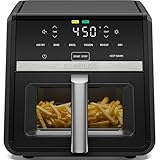
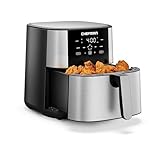
For safe countertop operation, allow at least 5 inches of open space on both sides and behind the air fryer. Leave approximately 12 inches above the top, or the clearance specified by the manufacturer. Oven-style models with a front door may need 6 inches on the sides and back, plus enough space in front for the door to open fully.
Many manufacturers advise against operating an air fryer directly beneath upper cabinets. If the manual permits countertop use in that location, pull the appliance forward so hot air and steam can escape into the open room. Never block vents, place the fryer against a wall, or store items directly above it while it is running.
Standard Sizes
The following are practical external-size ranges for common air-fryer formats. Dimensions are listed as width × depth × height and include the appliance body, not the extra ventilation space. Handles, open doors, protruding controls, and removable baskets can increase the required working area.
| Air-fryer type | Capacity | Typical external dimensions | Centimeters | Typical weight | Typical wattage |
|---|---|---|---|---|---|
| Personal compact basket | 2 to 3 qt | 10.0 × 12.0 × 10.5 in | 25.4 × 30.5 × 26.7 cm | 7 to 9 lb | 1,000 to 1,300 W |
| Compact family basket | 4 qt | 10.5 × 12.5 × 11.5 in | 26.7 × 31.8 × 29.2 cm | 8 to 11 lb | 1,200 to 1,500 W |
| Medium basket | 5 to 6 qt | 11.5 × 14.0 × 12.5 in | 29.2 × 35.6 × 31.8 cm | 11 to 15 lb | 1,400 to 1,700 W |
| Large basket | 8 qt | 12.5 × 15.0 × 13.0 in | 31.8 × 38.1 × 33.0 cm | 13 to 17 lb | 1,700 to 1,800 W |
| Extra-large or dual-basket | 9 to 10 qt | 14.0 × 16.0 × 13.5 in | 35.6 × 40.6 × 34.3 cm | 16 to 22 lb | 1,700 to 2,000 W |
| Air-fryer oven | 12 to 14 qt | 13.5 × 16.5 × 15.5 in | 34.3 × 41.9 × 39.4 cm | 18 to 25 lb | 1,700 to 1,800 W |
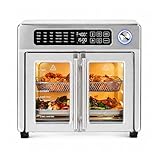
A compact 4-quart Chefman-style basket fryer is generally suited to one or two people and often falls near the compact-family range. A 6-in-1, 14-quart oven-style unit usually takes up substantially more vertical and front-to-back space than a basket fryer, even when its listed capacity seems only moderately larger. The 8- and 9-quart TurboFry-style models are typically wide, deep countertop appliances that require a dedicated landing area.
Prices also vary by size and features. Compact basket models commonly sell for about $50 to $70, standard 8- to 9-quart models for approximately $75 to $100, and multifunction 12- to 14-quart oven models for roughly $90 to $140. The example products in this category range from about $57.92 to $99.96. Promotions, finishes, and included accessories can change the final price.
How to Measure Your Space
- Measure the countertop width. Measure the uninterrupted section where the fryer will sit. Add at least 10 inches to the appliance width for 5 inches of side clearance on each side. For example, a 12-inch-wide fryer needs a countertop section about 22 inches wide for comfortable ventilation.
- Measure the usable depth. Measure from the front edge of the counter to the backsplash or wall. Add the fryer’s full depth, including the rear vent area and power-cord bend. A 16-inch-deep model may need at least 21 inches of usable depth.
- Measure vertical clearance. Measure from the countertop to the underside of the cabinet, not to the bottom of a raised shelf. Compare that number with the fryer’s height plus the recommended open space above it. If the cabinet is 18 inches above the counter and the fryer is 13 inches tall, only 5 inches remain, which is less than the preferred clearance.
- Check the operating position. Pull-out baskets need room to extend forward, while oven-style doors need clearance below and in front. Leave a safe area where a hot basket or door will not strike a wall, appliance, or person.
- Locate the outlet. Most air fryers use approximately 1,200 to 1,800 watts. Plug the fryer directly into a properly grounded wall outlet whenever possible. Avoid an overloaded power strip or extension cord, and make sure the cord does not cross a hot surface.
- Plan for storage. If the fryer must be stored in a cabinet, let it cool completely first. Measure the cabinet opening, not just the interior, and allow space to lift the appliance without catching the cord or accessories.
By Room or Use Case
Small apartment kitchen
Choose a 2- to 4-quart basket model with a footprint near 10.5 by 12.5 inches. It can work on a narrow counter, but the appliance should still be moved away from cabinets during operation if the manual requires it. A compact model is easier to lift into a pantry after cooling; expect roughly 7 to 11 pounds.
Everyday family cooking
A 5- to 8-quart basket offers more usable cooking area without the depth of a large oven model. Plan on at least 22 to 25 inches of counter width and 20 to 25 inches of depth once ventilation is included. This size is a practical compromise for side dishes, vegetables, snacks, and several servings of protein.
Large households and entertaining
An 8- to 10-quart model, including some dual-basket designs, may be 14 inches wide or more. It needs a sturdy, permanent location because moving a 16- to 22-pound appliance each time is inconvenient. Check that both baskets can open fully without hitting a backsplash or nearby cabinet handle.
Air-fryer oven or multifunction cooking
A 12- to 14-quart oven-style fryer is useful for toast, roasting, dehydrating, and rotisserie accessories, but it needs the most clearance. Reserve at least 24 inches of countertop width, 23 inches of depth, and enough front space for the door. The top and rear vents may become especially hot, so an open cart or island is often better than a tight cabinet run.
Common Sizing Mistakes
- Measuring the basket instead of the appliance. Capacity in quarts describes cooking volume, not the outside footprint.
- Ignoring ventilation space. A fryer that physically fits beneath a cabinet may not have enough room to release heat and steam safely.
- Forgetting the door or basket travel. Add several inches in front for a pull-out drawer and more for an oven door.
- Assuming a larger capacity means a taller appliance. Some 9-quart models are wider, while 14-quart oven models are taller and deeper.
- Using a crowded outlet. High-wattage countertop appliances should not share an overloaded circuit with another heating appliance.
- Leaving the fryer permanently on a weak shelf. Confirm that the shelf or cart can support the appliance’s weight plus food and accessories.
FAQ
How much clearance does an air fryer need from cabinets?
Use 5 inches on each side and behind the fryer as a baseline, with about 12 inches above it. Some manuals specify different distances or prohibit operation beneath cabinets altogether. The product manual takes priority, especially for models with top-facing vents.
Can an air fryer sit under a kitchen cabinet?
It can be stored there, but operation depends on the manufacturer’s instructions. If permitted, pull it forward into an open area before cooking. Do not let steam, hot air, or the top of the appliance contact cabinet doors, laminate, or an over-the-range hood surface.
What size air fryer fits a small counter?
A 2- to 4-quart model is usually the easiest fit. Look for an appliance no more than 11 inches wide and 13 inches deep, then add at least 5 inches of clearance around it. Confirm that the counter still has room for the basket or door to open.
Is an 8-quart air fryer too large for two people?
Not necessarily. An 8-quart model is useful if you want leftovers, cook larger foods, or replace a small oven. However, it may occupy roughly 12.5 by 15 inches before clearance is added. For occasional single- or two-serving meals, a 4- to 6-quart fryer is usually easier to store.





Write Your Review
No reviews yet. Be the first to share your experience!