
Key takeaways
- Measuring only the motor base: The pitcher, lid, and cup often determine the true height.
- Ignoring lid removal: A blender may fit beneath a cabinet but leave no room to add ingredients or lift the container.
- Forgetting depth at the controls: Touch buttons and dials are difficult to use when the base is pushed against a backsplash.
- Buying capacity instead of usable space: A 64-ounce pitcher can be excessive for one person and harder to store than a 20-ounce cup.
- Underestimating accessories: Extra cups, blades, seals, and tamper tools can fill an entire drawer.
- Choosing by wattage alone: Power ratings do not tell you whether the appliance will fit, lift easily, or store conveniently.
- Skipping weight checks: A heavy base may be stable, but it is less practical to move every day in a compact kitchen.
What's inside
Choosing the right blender for a small kitchen is less about the advertised capacity and more about the appliance’s footprint, height, storage position, and cord clearance. A blender that fits on a counter may still be too tall to slide beneath an upper cabinet, while a compact personal model may require enough room to remove a travel cup without hitting a shelf.
The Short Answer
For most small apartment kitchens, look for a blender measuring approximately 5 to 8 inches wide, 5 to 9 inches deep, and 11 to 16 inches tall (about 13 to 20 cm wide, 13 to 23 cm deep, and 28 to 41 cm tall). Personal blenders with 18- to 24-ounce cups usually have the smallest footprint. Traditional countertop models with 40- to 60-ounce pitchers need more depth and overhead clearance.
As an Amazon Associate we earn from qualifying purchases at no extra cost to you. Product prices and availability are accurate as of the date shown and are subject to change.


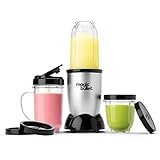

The best all-around target is a blender no wider than 7 inches (18 cm), no deeper than 8 inches (20 cm), and no taller than 15 inches (38 cm) when assembled. Allow at least 2 inches (5 cm) of extra space on each side for ventilation and handling. If the blender will remain under a cabinet, measure it with the pitcher and lid attached, not just the motor base.
Standard Sizes
The table below shows common blender categories and practical dimensions to use when planning a small-kitchen setup. Dimensions are listed as width × depth × height. Actual measurements vary by brand, blade design, lid, and cup configuration, so confirm the manufacturer’s specification before buying.
| Blender type | Typical capacity | Typical dimensions (inches) | Typical dimensions (cm) | Typical weight | Best for |
|---|---|---|---|---|---|
| Mini personal blender | 12–18 oz | 4.5–6 W × 4.5–6 D × 10–14 H | 11–15 W × 11–15 D × 25–36 H | 2–4 lb (0.9–1.8 kg) | Single smoothies and shakes |
| Standard personal blender | 18–24 oz | 5–7 W × 5–8 D × 12–16 H | 13–18 W × 13–20 D × 30–41 H | 3–6 lb (1.4–2.7 kg) | Daily smoothies and portable cups |
| Compact countertop blender | 32–48 oz | 6–8 W × 7–10 D × 13–17 H | 15–20 W × 18–25 D × 33–43 H | 5–9 lb (2.3–4.1 kg) | Soups, sauces, and multiple servings |
| Full-size countertop blender | 48–72 oz | 7–9 W × 8–12 D × 15–20 H | 18–23 W × 20–30 D × 38–51 H | 7–14 lb (3.2–6.4 kg) | Family-size batches and frequent cooking |
For comparison, small personal models such as the 250-watt Magic Bullet-style blender generally occupy less counter space than a full pitcher blender, but their cups can add several inches to the total height. A 900-watt personal system, such as the Ninja Nutri-Plus type, may still have a compact motor base while requiring storage space for multiple 20-ounce cups and lids.
A 40- to 48-ounce blender, including models similar in format to the bella Fits-anywhere Flip & Store, can be more useful for two servings or food preparation. Its folding or storage-oriented design may reduce cabinet problems, but measure the blender in both operating and stored positions. Multi-piece kits such as an 11-piece personal-and-kitchen blender set can offer flexibility at a low price, often around $25 to $80, but accessories may take more cabinet space than the motor base.
How to Measure Your Space
- Measure the counter width. Identify the exact area where the base will sit. Record the clear width between a wall, backsplash, cabinet edge, coffee maker, toaster, or sink. Leave at least 2 inches (5 cm) of side clearance when possible.
- Measure front-to-back depth. Include the backsplash and the counter’s usable front edge. A blender that is 8 inches deep may need 9 to 11 inches (23 to 28 cm) once you allow room to reach the controls and remove the pitcher.
- Measure overhead height. Measure from the counter surface to the bottom of the cabinet above it. Compare this number with the blender’s fully assembled height. Do not assume the lid can be removed easily if the appliance is directly beneath a cabinet.
- Check the removal path. Measure the vertical space needed to lift the pitcher or cup off the motor base. Some personal cups must be lifted straight up, while others twist off and need less overhead room.
- Plan for the cord. Add 1 to 3 inches (2.5 to 7.5 cm) behind or beside the blender for the plug and cord bend. Avoid forcing the cord against a wall or letting it cross a wet area.
- Measure storage shelves. If the blender will be stored away, measure the shelf opening, not just the shelf surface. Count the base, pitcher, lid, tamper, cups, and blades as separate storage pieces.
- Test the working zone. Leave enough open counter space to load ingredients, set down a cutting board, and place a cup. A compact blender is inconvenient if every use requires moving several other appliances.
By Room or Use Case
Under-Cabinet Counter
Choose a model no taller than the measured clearance minus at least 1 inch (2.5 cm). For many apartments, this means a personal blender or a compact pitcher blender below 14 inches (36 cm). If the blender is used daily, a short, wide base may be easier to operate than a tall, narrow model.
Studio Apartment Kitchen
Prioritize a footprint of about 6 × 7 inches (15 × 18 cm) or smaller. Personal blenders with one or two cups are usually the easiest to store. Expect to pay approximately $25 to $75 for basic to midrange models; wattage commonly ranges from 250 to 900 watts. Higher wattage does not automatically mean a better fit, so check cup height and accessory storage.
Shared Kitchen or Roommate Setup
A removable-cup personal blender can reduce cleanup and make individual portions simple. Look for a base under 6 pounds (2.7 kg), cups between 18 and 24 ounces, and lids that stack. A model with three cups may be useful, but confirm that the set can fit in one cabinet or drawer rather than spreading across the kitchen.
Cooking in a Small Apartment
If you make sauces, soups, dips, or two-person batches, choose a compact countertop blender with a 32- to 48-ounce container. A price range of $35 to $120 is common, with power often between 500 and 1,000 watts. These models need more vertical clearance and may weigh 5 to 9 pounds (2.3 to 4.1 kg), so keep them on a stable counter instead of a high shelf.
Small Home Office or Guest Suite
For occasional breakfast smoothies, a mini blender measuring roughly 5 inches (13 cm) wide and 11 to 13 inches (28 to 33 cm) tall is usually sufficient. Store it with the cup inverted only if the manufacturer allows that position and the blade assembly is protected.
Common Sizing Mistakes
- Measuring only the motor base: The pitcher, lid, and cup often determine the true height.
- Ignoring lid removal: A blender may fit beneath a cabinet but leave no room to add ingredients or lift the container.
- Forgetting depth at the controls: Touch buttons and dials are difficult to use when the base is pushed against a backsplash.
- Buying capacity instead of usable space: A 64-ounce pitcher can be excessive for one person and harder to store than a 20-ounce cup.
- Underestimating accessories: Extra cups, blades, seals, and tamper tools can fill an entire drawer.
- Choosing by wattage alone: Power ratings do not tell you whether the appliance will fit, lift easily, or store conveniently.
- Skipping weight checks: A heavy base may be stable, but it is less practical to move every day in a compact kitchen.
FAQ
What blender size is best for a small apartment kitchen?
A personal blender measuring about 5 to 7 inches wide, 5 to 8 inches deep, and 12 to 16 inches tall is the easiest fit for most apartments. Choose a 32- to 48-ounce countertop model if you regularly prepare several servings or recipes.
How much clearance does a blender need under cabinets?
Leave at least 1 inch (2.5 cm) above the assembled blender, plus enough room to remove the cup or pitcher. If the container must be lifted vertically, the required clearance may be several inches greater than the blender’s listed height.
Is a 900-watt blender too large for a small kitchen?
Not necessarily. Wattage describes motor power, not physical size. A 900-watt personal blender can have a smaller footprint than a lower-powered full-size model, but check its base width, cup height, weight, and accessory count.
What is the smallest practical blender capacity?
A 12- to 18-ounce cup works well for one smoothie or shake. For a larger breakfast, two servings, or thicker mixtures, an 18- to 24-ounce personal cup is more practical. When comparing 2026 models, measure the complete assembled unit and storage pieces rather than relying on capacity alone.






Write Your Review
No reviews yet. Be the first to share your experience!