
Key takeaways
- Section collars: Dirt and grit can reduce grip or cause binding. Wipe the exterior after dusty or sandy locations.
- End connectors: Repeated twisting and accidental cable pulls can loosen miniature connectors. Support the cable rather than letting it hang from the microphone.
- Grip material: Foam and rubber can become sticky, compressed, or cracked with sweat and heat. Replaceable grips are a useful long-term feature.
- Thread adapters: The microphone mount may loosen before the pole itself fails. Check the thread and shock mount before every take.
- Carbon sections: Do not use abrasive tools or aggressive solvents. Clean with a soft, slightly damp cloth and let the pole dry fully before collapsing it.
The best boom poles for film audio recording are lightweight carbon-fiber models with enough reach for the shot, a collapsed length that fits your case, a comfortable handle, and cable routing that will not introduce handling noise; for most location sound operators, a 3–4 m carbon-fiber pole is the best balance.
Quick recommendations by recording situation
| Situation | Best pole type | Useful specification | Why it fits |
|---|---|---|---|
| One-person crew or student film | Carbon-fiber telescoping pole | 2.5–3 m maximum; about 0.5–0.7 kg | Light enough for long takes and compact in a small kit |
| General narrative and documentary work | Five- or six-section carbon-fiber pole | 3–4 m maximum; roughly 0.6–0.9 kg | Good reach without becoming difficult to control |
| Large interiors, wides, and overhead work | Long carbon-fiber pole | 4–5 m maximum; approximately 0.8–1.2 kg | Reaches talent from outside the frame, but requires better technique |
| Infrequent use or a strict budget | Aluminum telescoping pole | 2–3 m maximum; usually 0.7–1.1 kg | Lower purchase cost, with a weight penalty |
| Fast-moving two-person sound team | Carbon-fiber pole with internal cable | 3–4 m maximum; internal XLR or TA3 wiring | Faster deployment and fewer external cable snags |
Carbon fiber versus aluminum
Carbon fiber: the better long-day choice
Carbon fiber provides a high stiffness-to-weight ratio. That matters when the microphone must stay above a performer for several minutes at a time. A lighter pole reduces fatigue in the wrist, forearm, and shoulder, while a stiff shaft makes it easier to make small aiming corrections without excessive flex.

Movo Boom Mic Kit for Filmmaking – Supercardioid Shotgun Microphone, 9.8ft Boom Pole, Blimp Windscreen & Deadcat – Complete Location Sound Bundle
Included for 'Best Boom Poles for Film Audio Recording' because the listing specifies Supercardioid Shotgun Microphone and 9.8ft Boom Pole, details this guide uses to compare options.
View on Amazon
NEEWER Upgraded Microphone Boom Pole, 9.8ft/300cm, MS-300CB (Black)
Included for 'Best Boom Poles for Film Audio Recording' because the listing specifies 9.8ft/300cm and MS-300CB (Black), details this guide uses to compare options.
View on Amazon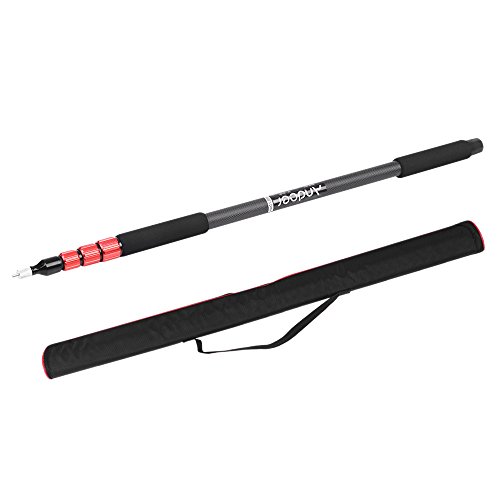
Andoer Telescoping Microphone Boom Pole Carbon Fiber, 4 Sections Stretchable Handheld Microphone Holder Pole Flash Light Boom Sound Recording Grip Support Rod (6.6lbs Load Capacity&9.8ft Max.Length)
Included for 'Best Boom Poles for Film Audio Recording' as a relevant option in this category; details come from the product listing.
View on Amazon
Andoer MK-3000 9.8ft Lightweight Carbon Fiber Mic Microphone Boom Holder Arm Pole Extension Mount Stand for Canon Nikon Sony DSLR Camera Camcorder Photography Sound Recording Interview Filming
Included for 'Best Boom Poles for Film Audio Recording' as a relevant option in this category; details come from the product listing.
View on AmazonCarbon-fiber poles also tend to feel more refined at the section locks. Higher-end models use smooth collars, replaceable wear parts, and carefully matched sections. The trade-off is cost: a dependable carbon-fiber pole commonly falls in the approximate $150–$600 range, while premium internally cabled or unusually long models can cost more.
Carbon fiber is not indestructible. Crushing a section, overtightening a collar, or dropping the pole onto a hard surface can damage fibers or make a section bind. Inspect the tube after impacts rather than assuming that a cosmetic mark is harmless.
Aluminum: practical and affordable
Aluminum poles are usually less expensive and can tolerate ordinary knocks well. They are a sensible choice for occasional recording, backup kits, classroom production, or situations where replacing a pole would be less painful than replacing a premium carbon model.
The disadvantage is weight. The difference between a 550 g carbon pole and a 950 g aluminum pole may appear small on paper, but the pole is held at arm’s length, so leverage magnifies the fatigue. Aluminum can also transmit more handling noise if the grip or cable is poorly isolated. For short takes, this may not matter; for a full shooting day, it often does.
Representative pole specifications
The figures below are useful benchmarks rather than a promise that every production run will be identical. Manufacturers may list weight without the connector, cable, or end attachment, so compare like with like.
| Model or type | Material | Maximum length | Collapsed length | Approximate weight | Best fit |
|---|---|---|---|---|---|
| RØDE Boompole | Aluminum | 3.0 m | 0.81 m | About 0.7 kg | Budget-conscious general use |
| RØDE Boompole Pro | Carbon fiber | 3.0 m | 0.81 m | About 0.5 kg | Lightweight single-operator kits |
| Ambient QP 4140 | Carbon fiber | 4.1 m | About 1.0 m | About 0.6 kg | Professional location sound and extra reach |
| K-Tek KE-110CC | Carbon fiber | About 2.7 m | About 0.74 m | About 0.7 kg | Compact professional setups with internal cable |
| Standard aluminum pole | Aluminum | 2.0–3.0 m | 0.7–0.9 m | 0.7–1.1 kg | Occasional use and backup equipment |
How much length do you actually need?
A longer pole is not automatically better. Every additional section adds potential flex, a larger collapsed package, and more leverage against your arms. Choose the shortest pole that keeps the microphone close enough to the subject while remaining outside the camera frame.
For a seated interview, 2–3 m is usually sufficient. A 3 m pole is the versatile choice for interiors, small crews, and documentary work. A 4 m pole gives useful extra clearance for wide shots, two-person scenes, and operators who must stand farther from the camera. Five-meter poles are valuable for large sets, but they are less convenient in small rooms and harder to control near ceilings or lighting fixtures.
Use this simple fit calculation: if the camera is 2.5 m from the talent and the boom operator must stand another 0.8 m behind the camera, a pole with at least 3.3 m of usable reach is desirable. Add a small margin for microphone angle and movement, so a 4 m pole is a more comfortable choice than a fully extended 3 m pole.
External cable or internal cable?
Internal cable
An internally cabled pole is cleaner and quicker. The cable runs through the shaft, so it cannot catch on clothing, door handles, or foliage. It also keeps the pole’s exterior smooth when the operator rotates or repositions it. This is especially useful for documentary work and crowded sets.
Internal wiring does introduce maintenance complexity. A damaged connector or cable may require partial disassembly, and a cable that is too tight can transmit bumps into the microphone. Check the connector type before buying: professional poles may use XLR, TA3, or another miniature connector, while the rest of your chain may require an adapter.
External cable
An external cable is easier to replace and usually cheaper. It can also be swapped for a different length or connector without servicing the pole. The key is securing it correctly: use short strips of purpose-made hook-and-loop cable wrap or soft tape at intervals, leaving enough slack near each section joint.
Do not wrap the cable tightly around the pole. Tight spirals can pull on the microphone connector, create rubbing noise, and make section adjustment awkward. A loose, regular attachment pattern is quieter than a cable that hangs freely and taps the shaft.
Handle comfort and section locks
The grip is more important than it appears. A narrow bare tube can become uncomfortable quickly, while a padded or textured handle gives better control with less squeezing. Look for a grip long enough to support multiple hand positions, especially if the pole will be held overhead.
Collars should open and close smoothly but hold firmly without excessive force. Twist locks are fast and compact; lever locks are easier to inspect visually and may be preferable when working quickly. Whichever style you choose, test every section before a shoot. A partially locked collar can allow the pole to collapse suddenly, risking the microphone and creating a loud handling event.
Ownership realities: what wears first
- Section collars: Dirt and grit can reduce grip or cause binding. Wipe the exterior after dusty or sandy locations.
- End connectors: Repeated twisting and accidental cable pulls can loosen miniature connectors. Support the cable rather than letting it hang from the microphone.
- Grip material: Foam and rubber can become sticky, compressed, or cracked with sweat and heat. Replaceable grips are a useful long-term feature.
- Thread adapters: The microphone mount may loosen before the pole itself fails. Check the thread and shock mount before every take.
- Carbon sections: Do not use abrasive tools or aggressive solvents. Clean with a soft, slightly damp cloth and let the pole dry fully before collapsing it.
Store the pole collapsed but not forced tightly into a case. If it has been used in rain or heavy humidity, extend every section and allow it to dry before storage. Moisture trapped inside an internally cabled pole can cause connector and cable problems over time.
Final buying advice
Choose a 3 m carbon-fiber pole if you want one dependable option for interviews, short films, documentary work, and general location recording. Choose a 4 m model when wide shots and operator distance are common. Select aluminum when purchase price matters more than long-session comfort, or when the pole will mainly serve as backup equipment.
Before paying, verify the maximum and collapsed lengths, complete weight with cable, connector compatibility, replacement-section availability, grip design, and warranty support. The best boom poles for film audio recording are not necessarily the longest or most expensive: they are the ones that give the required reach while staying quiet, comfortable, serviceable, and easy to transport.






Write Your Review
No reviews yet. Be the first to share your experience!