
Key takeaways
- Protect the ports first. Even when the solar surface tolerates splashes, exposed USB ports and charge controllers may not.
- Do not assume waterproof means submersible. Keep the panel out of puddles and dry it before folding.
- Wind is a major risk. An open 28W panel acts like a small sail. Use attachment points, rocks, or trekking-pole supports without placing sharp pressure on the cells.
- Clean gently. Dust, sunscreen, and salt can reduce output. Wipe the surface with a soft damp cloth and allow it to dry fully.
- Store it flat or in its intended folded position. Avoid tight rolls, crushed corners, and cables trapped in the hinge.
The best camping solar chargers are foldable 20–28W panels with a USB-C power-delivery output, because they provide a useful balance of charging speed, packability, and performance when sunlight is less than perfect.
Quick picks by camping situation
| Camping situation | Best fit | Why | What to compromise on |
|---|---|---|---|
| Day hikes and emergency use | 10–15W compact panel | Light, small, and adequate for topping up a phone | Slow charging and poor performance in shade |
| Regular backpacking | 20–21W folding panel | Good power-to-weight balance for phones, GPS units, and headlamps | Usually has limited or no weather sealing |
| Long trips or multiple devices | 28–40W panel with USB-C PD | More usable energy during short or partly cloudy days | Larger packed size and greater wind exposure |
| Car camping | Panel plus a 10,000–20,000mAh power bank | Lets the panel charge the battery while you use your phone | More weight and an additional item to protect |
| Wet, exposed campsites | Rugged panel with a protected controller and covered ports | Better resistance to splashes, dust, and handling | Weather resistance does not mean submersion resistance |
Best camping solar chargers compared
| Product or type | Rated output | Approx. folded size | Approx. deployed size | USB output | Weather and packability notes |
|---|---|---|---|---|---|
| BioLite SolarPanel 10+ | 10W | Approx. 8.3 × 9.5 × 1.0 in | Approx. 9.5 × 17.5 in | USB-A; integrated battery | Compact and easy to position; best for one phone or small electronics |
| Goal Zero Nomad 20 | 20W | Approx. 8.8 × 12.5 × 0.8 in | Approx. 17 × 12.5 in | USB-A; regulated output | Durable folding design with useful hanging points; check the port type before buying |
| Anker 625 Solar Panel | 21W | Approx. 11 × 6.3 × 1.1 in | Approx. 33 × 11 in | USB-A | Long, four-panel format packs flat; not a USB-C PD charger |
| BigBlue 28W Solar Charger | 28W nominal | Approx. 11 × 6.3 × 1.3 in | Approx. 33 × 11 in | Typically USB-A; model versions vary | High panel area for its price; keep ports and controller protected from rain |
| Modern 30–40W USB-C folding panel | 30–40W nominal | Approx. 10–14 × 7–10 × 1–2 in | Approx. 35–50 × 10–14 in | USB-C PD, often 18–30W | Fastest option for phones and some small battery packs; usually heavier |
Dimensions and output can differ between revisions and regional versions, so confirm the manufacturer’s specification sheet before purchase. Nominal wattage is also a best-case laboratory rating, not the continuous power you should expect at a campsite.
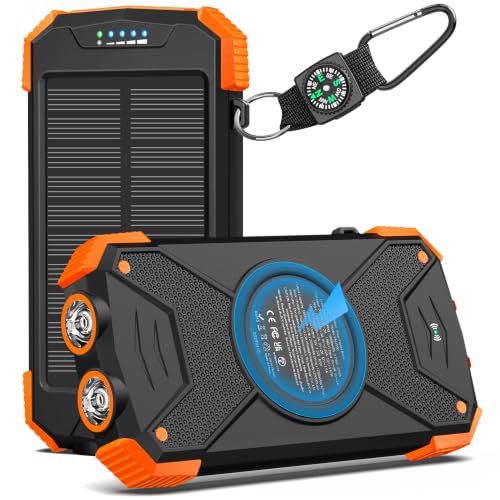
BLAVOR Solar Power Bank 10,000mAh Portable Wireless Charger for Cell Phones
Included for 'Best Camping Solar Chargers' because the listing specifies 000mAh Portable Wireless Charger for Cell Phones, details this guide uses to compare options.
View on Amazon
FlexSolar 40W Foldable Solar Panel Charger, USB-C USB-A & DC Outputs
Included for 'Best Camping Solar Chargers' because the listing specifies USB-C USB-A & DC Outputs, details this guide uses to compare options.
View on Amazon
Durecopow Solar Charger Power Bank 20,000mAh, Portable Charger, 4 Cables 3 Ports Fast Charging External Battery Pack with USB C for Cell Phones, Solar Panel Charger with Dual Flashlight for Camping
Included for 'Best Camping Solar Chargers' because the listing specifies 000mAh and Portable Charger, details this guide uses to compare options.
View on Amazon
Portable Solar Generator 300W Portable Power Station with 60W Solar Panel
Included for 'Best Camping Solar Chargers' as a relevant option in this category; details come from the product listing.
View on AmazonWhy USB-C output matters
A panel can have a USB-C-shaped socket without supporting USB-C Power Delivery. For a modern phone, tablet, or power bank, look for an explicitly stated USB-C PD output and its wattage. A 20W USB-C PD port can charge compatible phones much more effectively than a basic 5V USB-A port.
USB-C is especially valuable when charging a power bank. The power bank can negotiate an appropriate charging profile and store intermittent solar energy instead of repeatedly disconnecting when a cloud passes. If a panel only has USB-A, use a short, high-quality cable and expect slower charging unless the product clearly states a higher-current output.
Charging speed in partial sun
Solar-panel ratings are measured under strong, direct sunlight with the panel aimed correctly. In real camping conditions, a 20W panel may provide roughly 3–12W through much of the useful part of the day, while a 10W panel may provide only 1–6W. Shade, haze, heat, dirty cells, and a poor angle all reduce output.
Here is a practical calculation. Suppose a phone needs about 12Wh to go from nearly empty to full after accounting for charging losses. A 20W panel producing an average of 8W during four good solar hours generates approximately:
8W × 4 hours = 32Wh before conversion losses.
After cable, controller, and battery losses, perhaps 20–26Wh reaches the devices or power bank. That is enough for roughly one full phone charge with reserve. In partial sun averaging only 3W, the same panel produces about 12Wh before losses, so a complete recharge may take most of a day or require a power bank charged over multiple days.
Do not leave a phone baking directly on a dark panel. High temperatures can slow or pause charging. Instead, place the panel in full sun and keep the phone or power bank in shade, using a cable long enough to separate them.
Folded size versus deployed area
Packability is not just the folded measurement. A four-panel charger can fit neatly inside a backpack but occupy roughly 33 inches of length when opened. That is useful on a picnic table or tent vestibule, but difficult to orient on a narrow ledge.
For backpacking, compare the charger’s packed thickness and weight with its usable surface area. A small 10W unit is convenient but gives you little margin when clouds appear. A 20–21W unit is often the practical sweet spot: it can hang from a pack during a rest stop and still collect meaningful energy.
Flexible fabric-backed panels can conform to a pack, but repeated folding and bending can eventually stress the cells and wiring. Rigid folding panels are often heavier yet better protected when stored flat.
Weather resistance and durability
- Protect the ports first. Even when the solar surface tolerates splashes, exposed USB ports and charge controllers may not.
- Do not assume waterproof means submersible. Keep the panel out of puddles and dry it before folding.
- Wind is a major risk. An open 28W panel acts like a small sail. Use attachment points, rocks, or trekking-pole supports without placing sharp pressure on the cells.
- Clean gently. Dust, sunscreen, and salt can reduce output. Wipe the surface with a soft damp cloth and allow it to dry fully.
- Store it flat or in its intended folded position. Avoid tight rolls, crushed corners, and cables trapped in the hinge.
The parts most likely to wear first are cable ends, fabric hinges, elastic retainers, and USB sockets. A replaceable short cable and a small waterproof pouch can extend the useful life more than choosing a panel with a slightly higher headline wattage.
What to buy if you are unsure
Choose a 20–21W folding panel for ordinary phone, GPS, camera, and headlamp use. Choose a 28W or larger model if you camp for several days, share charging with another person, or expect frequent cloud cover. Choose a 30–40W USB-C PD model when fast charging and power-bank compatibility matter more than minimum weight.
Before ordering, verify five specifications: continuous USB-C wattage, folded dimensions, deployed dimensions, actual weight including cables, and the manufacturer’s water-resistance guidance. A panel with lower wattage but a genuine USB-C PD port may be more useful than a nominally larger panel limited to slow USB-A charging.
Frequently asked questions
Can a solar charger charge a phone directly?
Yes, but direct charging is vulnerable to clouds and changing sunlight. A power bank provides a buffer and usually gives more consistent results. For multi-day trips, charge the power bank during the brightest hours and charge the phone from the bank later.
Is a 10W panel enough for camping?
It is enough for occasional phone top-ups, a GPS unit, or small rechargeable lights. It is less suitable for two people, tablets, cameras, or cloudy conditions. A 20W panel offers substantially more useful margin without becoming excessively large.
Can a solar panel charge a power bank overnight?
No. The panel needs light, and most portable panels stop producing useful power after sunset. Charge the power bank during daylight, then use it overnight.






Write Your Review
No reviews yet. Be the first to share your experience!