
Key takeaways
- Capacity vs. Precision: For baking, look for 5kg to 11lb capacity with 1g increments. If you weigh yeast, gelatin, or espresso, choose 0.1g or 0.01g precision, but note that ultra-precise sensors often have lower max capacities.
- Units and Functions: Grams and ounces are essential; milliliters and fluid ounces help with water and milk. A responsive tare function, hold function for when the bowl covers the display, and a totalizer for adding ingredients are valuable for sourdough and batch recipes.
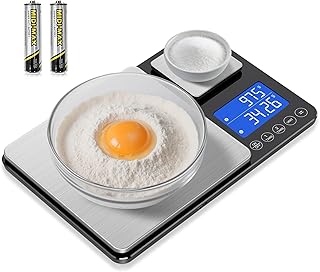
- Platform and Display: A stainless steel platform resists stains and is easy to clean. A backlit LCD with a wide viewing angle is critical when using large bowls, and compact footprints around 8.5 x 6 inches store easily in a drawer.
- Power Source: AAA batteries are convenient and long-lasting, while USB-rechargeable batteries reduce waste and avoid mid-recipe failures. Check for auto-off after 2-3 minutes to preserve power without interrupting your workflow.
- Ease of Cleaning and Storage: Flat, sealed buttons prevent flour from getting trapped, and a included storage bag or slim profile protects the scale. Avoid price-computing or counting scales over 20kg unless you regularly weigh bulk ingredients; they sacrifice counter space and fine precision.
What's inside
Accurate baking lives or dies on weight, not volume. A cup of flour can vary by 30 grams depending on how you scoop it, which is enough to turn a tender crumb into a dry brick. For 2026, we tested the most popular kitchen scales for precision, speed, and everyday usability to find the best options for baking, sourdough, and portion control.
Whether you need gram-level accuracy for macarons, an 11-pound capacity for batch baking, or simple portioning for meal prep and keto, these five scales deliver reliable results without cluttering your counter. Below are our top picks for accuracy, features, and value.
As an Amazon Associate we earn from qualifying purchases at no extra cost to you. Product prices and availability are accurate as of the date shown and are subject to change.




⚡ Save on Your Next PC — Amazon Prime
Prime members get fast free shipping on the systems above, plus early access to Prime Day & Black Friday PC deals. New members get a 30-day free trial.
Watch: Best Kitchen Scales for Accurate Baking and Portion Control — Video Review
How to Choose
- Capacity vs. Precision: For baking, look for 5kg to 11lb capacity with 1g increments. If you weigh yeast, gelatin, or espresso, choose 0.1g or 0.01g precision, but note that ultra-precise sensors often have lower max capacities.
- Units and Functions: Grams and ounces are essential; milliliters and fluid ounces help with water and milk. A responsive tare function, hold function for when the bowl covers the display, and a totalizer for adding ingredients are valuable for sourdough and batch recipes.
- Platform and Display: A stainless steel platform resists stains and is easy to clean. A backlit LCD with a wide viewing angle is critical when using large bowls, and compact footprints around 8.5 x 6 inches store easily in a drawer.
- Power Source: AAA batteries are convenient and long-lasting, while USB-rechargeable batteries reduce waste and avoid mid-recipe failures. Check for auto-off after 2-3 minutes to preserve power without interrupting your workflow.
- Ease of Cleaning and Storage: Flat, sealed buttons prevent flour from getting trapped, and a included storage bag or slim profile protects the scale. Avoid price-computing or counting scales over 20kg unless you regularly weigh bulk ingredients; they sacrifice counter space and fine precision.
The Best Picks Reviewed
Etekcity Food Kitchen Scale
Our go-to everyday scale for most bakers, the Etekcity balances simplicity, accuracy, and durability. It offers an 11lb / 5kg capacity with 1g increments and reads in grams, ounces, pounds:ounces, milliliters, and fluid ounces, so you can weigh everything from flour to liquids. The 304 stainless steel surface wipes clean and the tare function is instant, letting you zero out a mixing bowl in under a second. Its compact size and low-profile design make it ideal for meal prep, keto portions, and baking, and the clear LCD remains readable even under a large mixing bowl. If you want one reliable scale that does everything well without extra complexity, this is the pick.
Escali Primo Digital Food Scale
The Escali Primo is the minimalist’s favorite for precise portion control. With its iconic 8.5 x 6 x 1.5 inch chrome design, it fits anywhere and comes in multiple colors. It measures up to 11lb / 5kg in 1g / 0.05oz increments and features just two buttons: on/tare and unit. That simplicity is its strength — no modes to cycle through, no lag, and an automatic shut-off that preserves battery life. The sealed control panel prevents spills from seeping in, and the display is notably stable, without the flickering that plagues cheaper scales. Best for bakers and home cooks who value speed, consistency, and a scale that just works.
Greater Goods Digital Kitchen Scale
Designed specifically for bakers, the Greater Goods scale shines for sourdough and pastry work. It also handles 11lb with gram, ounce, milliliter, and fluid ounce units, but adds thoughtful baker-friendly extras: a tap-to-tare function, hold function to lock the weight when your bowl obscures the screen, and a bright display. The stainless steel top is paired with a soft-touch base and it includes a storage bag to keep it protected. In testing, it stabilizes quickly within 1-2 seconds and holds calibration well when moving the scale around the kitchen. An excellent middle ground between basic and high-precision models.
BOMATA Large Kitchen Scale
When you need more precision than standard 1g scales, the BOMATA delivers 0.1g / 0.001oz readability across an 11lb capacity, making it ideal for yeast, salt, baking powder, and specialty ingredients where a gram is too coarse. It adds a percentage function to scale recipes up or down accurately, a full-view angle LCD with backlight, and a USB-rechargeable battery that eliminates the hunt for coin cells. The larger stainless steel pan accommodates bulky bowls and sheet pans for dividing dough. For serious bakers who weigh small quantities regularly, the extra decimal place is a genuine advantage without sacrificing capacity.
Dual Platform Food Kitchen Scale
For bakers who do both micro and macro weighing, the Dual Platform scale solves the usual trade-off. It combines a small high-precision platform (0.01g / 0.001oz) with a larger 15kg / 33lb platform, so you can weigh 0.3 grams of instant yeast and then 10 pounds of bread dough on the same device. It offers seven units, a fast tare, and a totalizer function that sums ingredients as you add them — perfect for one-bowl baking and sourdough builds. Dual accuracy means the small platform stays precise at low weights while the large platform handles batch cooking. It takes up more counter space, but for high-volume bakers and meal preppers, it replaces two scales in one.
Frequently Asked Questions
Do I really need a scale for baking?
Yes, if you want consistent results. Weighing in grams removes the variability of cups and spoons. For example, 120 grams of all-purpose flour is always 120 grams, while a cup can weigh anywhere from 120 to 155 grams. That difference affects hydration, rise, and texture, especially in bread, cookies, and cakes.
What accuracy is best for baking and portion control?
For most baking and portioning, 1g increments are sufficient and provide stable readings up to 11lb. Choose 0.1g precision if you frequently weigh ingredients under 5 grams, such as yeast, salt, or gelatin. Reserve 0.01g precision for espresso, chocolate work, or formulating small batches where fractions matter.
Why does my scale give different readings?
Place the scale on a flat, stable, vibration-free surface and avoid drafts. Always tare with the bowl on the scale before adding ingredients, allow 1-2 seconds for the reading to stabilize, and avoid overloading beyond the stated capacity. Low batteries and uneven counters are the most common causes of drift.
How do I clean and maintain a kitchen scale?
Wipe the stainless steel platform with a damp cloth and mild soap, never submerge the scale. Keep the weighing surface free of crumbs under the platform, calibrate only if the manufacturer provides weights and instructions, and store it flat without stacking heavy items on top to protect the load cell.
Final Thoughts
For most home bakers, the Etekcity Food Kitchen Scale and Greater Goods Digital Kitchen Scale cover all the essentials with dependable 1g accuracy and easy tare functions. If you need finer resolution for yeast and precise formula work, step up to the BOMATA Large Kitchen Scale for 0.1g precision or the Dual Platform Food Kitchen Scale for true dual-range versatility in one device.



Write Your Review
No reviews yet. Be the first to share your experience!