
Key takeaways
- The paper test: Hold a sheet of printer paper vertically and try to slice down through it. A sharp knife cuts cleanly; a dull knife tears or catches.
- Sharpening frequency: For a home cook using knives 4-5 times per week, plan to sharpen every 2-3 months and hone weekly.
- Angle matters: Most Western chef knives are ground to 15-20 degrees per side. Japanese-style knives are often 10-15 degrees. Maintaining a consistent angle is more important than speed.
What's inside
- Watch: How to Sharpen Kitchen Knives at Home — Video Review
- 1. Understand Your Edge: Sharpening vs. Honing
- 2. Choose the Right Sharpener for Your Needs
- 3. How to Use a 3-Stage or 4-Stage Manual Sharpener Correctly
- 4. How to Maintain Serrated Knives and Scissors
- 5. Keep Your Knives Sharp Longer
- Tips
- Frequently Asked Questions
- Conclusion
- Related Articles
- Related Guides
A sharp knife is safer, faster, and more enjoyable to use than a dull one. In 2026, most home cooks don’t need to send knives out for professional service every few months — with the right technique and a few affordable tools, you can maintain a razor-sharp edge in under 10 minutes at home.
- Watch: How to Sharpen Kitchen Knives at Home — Video Review
- 1. Understand Your Edge: Sharpening vs. Honing
- 2. Choose the Right Sharpener for Your Needs
- 3. How to Use a 3-Stage or 4-Stage Manual Sharpener Correctly
- 4. How to Maintain Serrated Knives and Scissors
- 5. Keep Your Knives Sharp Longer
- Tips
- Frequently Asked Questions
- Conclusion
- Related Articles
- Related Guides
This guide covers the most effective methods for sharpening kitchen knives, how to choose the right sharpener for your knives and skill level, and the simple maintenance habits that keep your blades performing like new. Whether you own a single chef’s knife or a full block set, these steps will help you get consistent, reliable results.
As an Amazon Associate we earn from qualifying purchases at no extra cost to you. Product prices and availability are accurate as of the date shown and are subject to change.



⚡ Save on Your Next PC — Amazon Prime
Prime members get fast free shipping on the systems above, plus early access to Prime Day & Black Friday PC deals. New members get a 30-day free trial.
Watch: How to Sharpen Kitchen Knives at Home — Video Review
1. Understand Your Edge: Sharpening vs. Honing
Many people confuse sharpening and honing, but they do different jobs. Honing realigns the microscopic edge that bends with regular use — it doesn’t remove metal. Sharpening grinds metal away to create a new edge. For weekly maintenance, honing with a steel or ceramic rod is enough. For a truly dull knife that slides off a tomato skin or fails the paper test, you need to sharpen.
- The paper test: Hold a sheet of printer paper vertically and try to slice down through it. A sharp knife cuts cleanly; a dull knife tears or catches.
- Sharpening frequency: For a home cook using knives 4-5 times per week, plan to sharpen every 2-3 months and hone weekly.
- Angle matters: Most Western chef knives are ground to 15-20 degrees per side. Japanese-style knives are often 10-15 degrees. Maintaining a consistent angle is more important than speed.
2. Choose the Right Sharpener for Your Needs
Manual pull-through sharpeners are the easiest entry point for beginners, while whetstones offer the most control for enthusiasts. For most households in 2026, a quality staged sharpener delivers the best balance of ease and results.
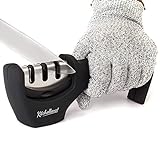
- 4-stage and 3-stage pull-through sharpeners: A model like the Longzon 5-in-1 Knife Sharpener 4 Stage is ideal for restoring very dull blades — it typically includes coarse carbide for repairing, medium diamond for sharpening, fine ceramic for polishing, and often a dedicated scissors slot. The 4-in-1 Kitchen Knife Accessories 3-Stage Sharpener is a simpler, more compact option that covers the three core stages: repair, restore, and polish, and both usually include a cut-resistant glove for added safety.
- Compact handheld sharpeners: The SHARPAL 191H Knife Scissors Sharpener is a good example of a small, preset-angle sharpener that works for both kitchen knives and household scissors. It requires no setup and is perfect for quick touch-ups.
- Versatile tungsten and ceramic models: The Professional 4-in-1 Sharpener with Tungsten Steel and Ceramic Slots uses tungsten steel for aggressive edge resetting and ceramic for fine honing, making it effective for straight-edge chef knives and utility blades without needing multiple tools.
- Built-in block sharpeners: If you prefer an all-in-one storage solution, sets like the Home Hero Kitchen Knife Set with Built-In Sharpener and the Astercook 15-Piece Knife Set with Sharpener Block integrate the sharpener into the block itself, so you can hone the edge with a few swipes each time you store the knife.
3. How to Use a 3-Stage or 4-Stage Manual Sharpener Correctly
You don’t need heavy pressure — let the abrasive do the work. Excess force can damage the edge and wear out the sharpener faster. Here is a reliable process for most staged sharpeners:
- Step 1 – Prepare: Place the sharpener on a flat, dry surface. If it has a non-slip base or handle, secure it firmly. Put on the cut-resistant glove if provided.
- Step 2 – Coarse (Repair): Only use the coarse slot if the knife is very dull, chipped, or has not been sharpened in 6+ months. Pull the blade through from heel to tip 3-5 times using light, even pressure. You should feel slight resistance.
- Step 3 – Medium (Sharpen): Pull through the medium/diamond slot 5-7 times. This refines the edge created in the coarse stage.
- Step 4 – Fine (Polish/Hone): Finish with 5-8 light strokes through the fine ceramic slot. This polishes the edge and removes any burr.
- Step 5 – Clean: Wipe the blade with a damp cloth to remove metal filings, then wash and dry immediately. Test sharpness on paper again.
4. How to Maintain Serrated Knives and Scissors
Straight-edge knives are straightforward, but serrated bread knives and kitchen shears need slightly different care. Never pull a serrated knife through a standard coarse slot — you will flatten the serrations.
- Serrated knives: Use only the fine ceramic rod or the dedicated serrated notch if your sharpener has one, or use a tapered diamond rod to sharpen each serration individually with 2-3 short strokes.
- Scissors: Open scissors fully and pull the blade through the scissors slot of a sharpener like the Longzon 5-in-1 or the SHARPAL 191H 4-5 times. Wipe clean and test on a piece of thin fabric or paper.
- Shears and poultry scissors: Tighten the pivot screw first — a loose pivot makes even a sharp pair feel dull.
5. Keep Your Knives Sharp Longer
Sharpening is only half the equation. How you use, clean, and store knives determines how long the edge lasts.
- Use the right cutting surface: Wood and soft plastic boards preserve edges. Glass, ceramic plates, and stone countertops dull them in just a few cuts.
- Wash by hand: Even sets labeled dishwasher safe, like the Astercook German Stainless Steel set, will keep their edge and anti-rust coating longer with hand washing. Wash with warm soapy water, rinse, and dry immediately.
- Store properly: A wooden block, magnetic strip, or blade guards prevent edges from banging against other utensils in a drawer. The block storage included with the Home Hero and Astercook sets is designed specifically for this.
- Hone regularly: A few light strokes on a honing rod or the fine ceramic slot before heavy prep keeps the edge aligned and delays the need for full sharpening.
Tips
- Always pull, never push — draw the knife toward you through the sharpener from the heel (closest to the handle) to the tip in one smooth motion.
- Use minimal pressure: about the weight of the knife itself plus gentle hand guidance is enough. If you have to press hard, the abrasive is worn or you need more passes on the coarse stage.
- Sharpen dry, clean wet: run the sharpener dry, then wash the knife after sharpening to remove microscopic steel particles before food prep.
- Label your slots: if your sharpener is not clearly marked coarse/medium/fine, mark them with a permanent marker so you always progress from most to least aggressive.
Frequently Asked Questions
How do I know which grit or stage to start on?
Start with the finest stage that still improves the edge. If 6-8 passes through the fine ceramic slot don’t pass the paper test, move to medium. Only use coarse if the knife is visibly dull, has small chips, or slides off an onion skin without biting. Starting too coarse when you don’t need it simply removes extra metal.
Can a pull-through sharpener damage good knives?
When used correctly with light pressure and the correct angle, a quality staged sharpener from brands like Longzon or SHARPAL will not damage Western-style stainless steel knives. Avoid electric grinders or aggressive carbide sharpeners on high-hardness Japanese knives (60+ HRC) or single-bevel blades — those are better served by whetstones.
How often should I sharpen if I cook daily?
Daily home cooks should hone weekly and sharpen every 6-8 weeks. If you use a built-in block sharpener like those in the Home Hero or Astercook sets, a few swipes each time you return the knife counts as honing. Professional-level sharpness for most families means sharpening 4-6 times per year.
Do I need to use oil or water with a manual sharpener?
No. Manual tungsten and ceramic pull-through sharpeners are designed to be used dry. Whetstones require water or oil, but staged handheld sharpeners do not. Just ensure the blade is clean and dry before sharpening, and wipe the sharpener’s slots with a dry brush occasionally to remove metal dust.
Conclusion
A consistently sharp knife makes every kitchen task safer and more precise. Start with a staged manual sharpener that matches your comfort level — whether that’s a complete Longzon 5-in-1 with glove for heavy restoration, a simple 3-stage or Professional 4-in-1 for everyday maintenance, or a compact SHARPAL 191H for quick touch-ups — and practice light, consistent strokes. Pair good sharpening habits with proper hand washing and safe storage, such as the integrated blocks in the Home Hero and Astercook sets, and your knives will hold a clean, paper-slicing edge for months at a time.




Write Your Review
No reviews yet. Be the first to share your experience!