
Key takeaways
What's inside
A dull knife is the one that cuts you. It slides off tomato skin, needs force to get through an onion, and the moment it slips your hand is behind it. Most home cooks do not own bad knives — they own decent knives that have not been sharpened since the day they were bought.
The good news is that fixing this is cheap. A pull-through sharpener under twenty dollars will restore a working edge on a chef’s knife in about a minute. What you spend more on is control: the ability to set a precise angle, sharpen a serrated blade, or put a mirror polish on a good Japanese knife without grinding away steel you cannot get back.
As an Amazon Associate we earn from qualifying purchases at no extra cost to you. Product prices and availability are accurate as of the date shown and are subject to change.



🛒 Best Price Today on Amazon
Prime members get fast, free shipping on everything above, plus member-only deals. New members get a 30-day free trial — cancel anytime.
How to choose a kitchen knife sharpener
Pull-through, fixed-angle, or electric. Pull-through sharpeners have preset carbide and ceramic slots — fast, cheap, foolproof, and slightly aggressive with the steel. Fixed-angle systems clamp the blade and let you dial in an exact bevel, which is what a good knife deserves but takes ten minutes per blade. Electric sharpeners split the difference: powered belts or wheels with angle guides, fast enough for a full block, forgiving enough for a beginner.
Know your bevel angle. German and most Western knives are ground around 20 degrees per side. Japanese knives are typically 15 degrees or less. Running a 15-degree Japanese blade through a 20-degree preset slot grinds off the very edge geometry you paid for. If your block mixes both, get a sharpener with adjustable angles.
Stages matter more than the count. A coarse stage repairs chips and resets a badly dulled edge; a fine stage hones and polishes. Anything beyond two or three genuine stages is mostly marketing. What you want is the coarse stage used rarely and the fine stage used often.
Serrated and specialty blades. Standard slots will not sharpen a bread knife. If you need serrations, scissors, or outdoor blades covered, that narrows the field to a handful of systems built for it.
Stability and safety. Non-slip feet and a full-hand grip matter more than the abrasive. A sharpener that slides on the counter is how people get hurt. Cut-resistant gloves included in the box are a genuine plus, not a gimmick.
The sharpeners worth buying
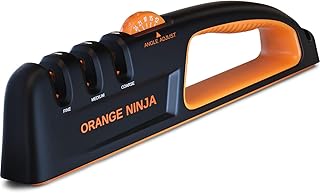
4-in-1 3-Stage Kitchen Knife Sharpener — best budget pick
With nearly 39,000 reviews at 4.5 stars, this is one of the most bought sharpeners in any kitchen drawer, and the reason is simple: under twenty dollars, three stages covering repair, restore and polish, and a result you can feel after a few passes. It will not respect a 15-degree Japanese bevel and it removes more steel than a whetstone would. For a workhorse knife block, none of that matters.
Longzon 5-in-1 Knife Sharpener with Cut-Resistant Glove — best value bundle
The Longzon covers four stages plus scissors, and it ships with a cut-resistant glove — the accessory most people skip and then wish they had. At 4.4 stars across more than 38,000 reviews it is as thoroughly tested as the pick above, at a slightly lower price. Choose between the two on which handle shape you prefer; both do the same job well.
Precision Adjust 3-Stage Manual Sharpener — best entry to angle control
This is the step up that actually changes results: a manual system with adjustable angle settings, so you can match 15 degrees for Japanese steel and 20 for German without compromise. Three premium stages, 4.5 stars over 4,000 reviews, and a price that sits between drawer-sharpener and serious-system territory. If you own one good knife you care about, start here.
Work Sharp Precision Adjust Elite — best fixed-angle system
Work Sharp’s Precision Adjust Elite is a proper fixed-angle sharpening system for kitchen and outdoor blades, rated 4.6 stars across more than 6,000 reviews. You clamp the blade, set the angle, and work through abrasives — the same process a professional uses, at a fraction of the learning curve of freehand stones. It is slow by design. That is the point: repeatable, precise edges with minimal steel removed.
Work Sharp MK2 Electric Knife Sharpener — best for a full knife block
The MK2 is the fastest way to bring an entire kitchen back from dull. It is an adjustable two-speed powered system, 4.7 stars over 8,000 reviews, and it handles the awkward blades — serrated edges, scissors, outdoor knives — that manual slots refuse. The low speed gives finer control on kitchen steel; the high speed reprofiles a badly abused blade quickly. If you are sharpening eight knives rather than one, this earns its price on time alone.
Work Sharp Ken Onion Edition — best for enthusiasts
The Ken Onion is the most capable tool here, with a fully adjustable sharpening system and flexible belts that follow a blade’s curve, covering knives, scissors and more at 4.7 stars. It is also the most expensive and the most likely to be overkill for a kitchen that owns three knives. For someone who sharpens as a hobby, or who maintains blades for other people, it is the one to own.
Frequently asked questions
How often should I sharpen my knives?
Sharpen when the blade stops biting into a tomato skin under its own weight — for most home cooks, two or three times a year. Honing is different and should happen far more often: a few passes on a steel or the fine stage before or after cooking keeps the edge aligned between real sharpenings.
Will a pull-through sharpener ruin my knives?
It will not ruin a standard Western kitchen knife. It does remove more metal than a whetstone, so over many years a heavily used blade gets visibly narrower. On expensive Japanese knives with thin bevels, use an adjustable-angle system instead.
Can these sharpen serrated knives?
Standard slots cannot. Powered systems with tapered abrasives, like the Work Sharp models above, can work each serration individually. For most people, a bread knife is a replace-every-few-years item rather than something to sharpen.
What angle should I use?
Twenty degrees per side for German and most Western knives, 15 degrees or less for Japanese. When in doubt, check the manufacturer’s specification — sharpening at the wrong angle wastes both steel and effort.
Electric or manual?
Manual if you own a few knives and want maximum control with no risk of overheating the steel. Electric if you have a full block, mixed blade types, or simply will not do the job unless it is fast. The best sharpener is the one you will actually use.
The verdict
If your knives are dull right now and you want them working tonight, the 4-in-1 three-stage sharpener costs less than a takeaway meal and has almost 39,000 reviews behind it. If you own knives worth protecting, the Precision Adjust system gets you real angle control for a modest step up. And for a full block plus scissors and serrations, the Work Sharp MK2 does in fifteen minutes what would otherwise be an afternoon.



Write Your Review
No reviews yet. Be the first to share your experience!