
Key takeaways
- No stated wattage or voltage: The listing should identify electrical requirements clearly.
- No automatic shutoff: This is a basic safety feature and should not be treated as optional.
- Boil-dry protection is not mentioned: Avoid models that provide no information about operation when empty.
- A vague “non-toxic” claim: Look for specific information about BPA-free materials and which parts contact water.
- A narrow, inaccessible opening: It can make descaling and removing residue unnecessarily difficult.
- A loose lid, wobbly base, or sharp seam: These are signs of poor fit and finish before the kettle has even been used.
- Unusually high wattage for your outlet: A kettle above 1,500 watts may place more demand on a circuit, especially if other appliances share it.
- Reviews focused on leaking or electrical faults: A few isolated complaints can happen, but repeated reports deserve attention.
What's inside
- Decide These 3 Things First
- 1. Choose the Right Size and Footprint
- 2. Compare Materials and Water Contact
- 3. Evaluate Construction and Cleaning
- 4. Match Comfort, Speed, and Controls to Your Routine
- 5. Understand the Price Tiers
- 6. Check the Warranty, Returns, and Delivery Details
- Spec Checklist
- Red Flags
- FAQ
Buying an electric kettle seems simple: choose a capacity, pick a color, and look for the lowest price. That approach often leads to a kettle that is too large for your daily needs, awkward to pour, difficult to clean, or made with materials you would rather not have in contact with hot water. Some buyers also focus on boil speed without checking wattage, outlet requirements, lid design, or whether the kettle can safely operate when empty.
- Decide These 3 Things First
- 1. Choose the Right Size and Footprint
- 2. Compare Materials and Water Contact
- 3. Evaluate Construction and Cleaning
- 4. Match Comfort, Speed, and Controls to Your Routine
- 5. Understand the Price Tiers
- 6. Check the Warranty, Returns, and Delivery Details
- Spec Checklist
- Red Flags
- FAQ
This guide explains what to look for when buying an electric kettle, including the specifications that affect everyday use. The best choice is rarely the kettle with the most features. It is the model with the right capacity, materials, controls, and safety protections for your routine. Prices and product availability can change, but the buying principles below remain useful in 2026.
As an Amazon Associate we earn from qualifying purchases at no extra cost to you. Product prices and availability are accurate as of the date shown and are subject to change.

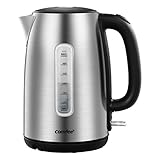


Decide These 3 Things First
- How much water do you normally boil? One or two cups do not require a 1.7- or 1.8-liter kettle. A compact model may be quicker and easier to store, while a larger kettle is more useful for families or cooking.
- Which materials and design features matter most? Stainless steel is durable, glass lets you see the water level, and plastic is often the least expensive and lightest. Also decide whether you want temperature controls or only a simple on/off switch.
- What is your realistic budget? Basic kettles commonly cost about $16 to $30. Better controls, quieter operation, stronger construction, and longer warranties can push the price to $40-$100 or more.
1. Choose the Right Size and Footprint
Capacity should match the amount of water you use, not the largest number on the package. A 0.8- to 1.0-liter kettle is suitable for one or two mugs of tea or coffee. A 1.5- to 1.7-liter kettle works well for a household, while a 1.8- to 2.0-liter model is useful when you regularly fill multiple cups, prepare oatmeal, or add boiling water to a pot.
Remember that advertised capacity is usually the maximum fill line. You should not fill above that mark, and some kettles need a minimum of roughly 0.5 liters to operate safely. Check the exterior dimensions as well. A typical 1.7-liter kettle may be about 8-10 inches tall, 8-9 inches deep, and 6-8 inches wide. Measure the space beneath your cabinets and around the base before ordering.
Weight matters when the kettle is full. Water weighs about 2.2 pounds per liter, so a 1.7-liter kettle contains approximately 3.7 pounds of water before the kettle itself is included. A lighter kettle is easier to pour, but a very light plastic body may feel less substantial.
2. Compare Materials and Water Contact
The main body may be stainless steel, borosilicate glass, plastic, or a combination. Stainless steel is tough, resists everyday knocks, and usually hides water spots. It can become hot to the touch, so look for an insulated or heat-resistant handle and a lid that does not require touching hot surfaces.
Glass provides a clear view of the water and often looks attractive on a countertop. Borosilicate glass is designed to handle temperature changes better than ordinary glass, but it is still more vulnerable to impact than steel. Check whether the water touches plastic components inside the lid, spout, or water-level window if that is important to you. A listing that says “BPA-free” does not necessarily mean the kettle has no plastic water-contact parts.
Plastic kettles are generally affordable, lightweight, and less likely to make the exterior dangerously hot. Look for food-contact materials, a strong hinge, and a clearly stated BPA-free construction. “Plastic-free” claims should be read carefully: the housing may be plastic-free while the lid seal, filter, or internal fitting is not.
3. Evaluate Construction and Cleaning
Good construction shows up in the parts you handle every day. The lid should open smoothly and stay out of the way while filling. A wide opening, ideally at least 3.5-4 inches across, makes it easier to reach inside for cleaning. If the lid opens only partially, mineral buildup can be difficult to remove.
A removable, washable scale filter at the spout helps catch loose mineral deposits. It does not replace descaling. In hard-water areas, you may need to descale every two to eight weeks, depending on use and water quality. A concealed heating element is easier to wipe clean than an exposed coil.
Inspect the base and cord design. A 360-degree swivel base works for right- and left-handed users, while cord storage underneath reduces counter clutter. The power cord is often about 24-30 inches long, so check that it can reach a grounded outlet without stretching across a sink or cooktop.
4. Match Comfort, Speed, and Controls to Your Routine
Most standard electric kettles draw 1,100-1,500 watts. At the same capacity, a 1,500-watt model will generally heat water faster than a 1,100-watt model, but actual timing depends on starting temperature, fill level, and the electrical supply. Do not treat a manufacturer’s boil-time claim as a universal result.
Temperature control is valuable if you prepare green tea, pour-over coffee, baby formula, or other drinks that benefit from water below a full boil. Basic kettles switch off near boiling. Adjustable models may offer settings from about 160°F to 212°F, often in 5°F or 10°F increments. A keep-warm function can hold water for 20-60 minutes, but it uses additional electricity and is unnecessary if you pour immediately.
Look for a balanced handle with enough clearance for your hand. A gooseneck spout offers more control for pour-over coffee, while a wider spout may fill a mug faster. The lid should open without forcing you to place your hand above steam. Helpful safety features include automatic shutoff, boil-dry protection, and a power indicator that is visible without being overly bright.
5. Understand the Price Tiers
A budget kettle typically costs about $16-$30. In this range, expect a 1.0- to 1.8-liter capacity, 1,100-1,500 watts, automatic shutoff, boil-dry protection, and either plastic, glass, or basic stainless steel. The Cosori, COMFEE’, Chefman, and OVENTE examples fall into the kind of price range where shoppers should compare construction and controls rather than assume one inexpensive brand is automatically better.
Midrange kettles generally cost $35-$70. They may add more precise temperature settings, better insulation, quieter operation, a stronger hinge, clearer controls, or a longer warranty. Premium models commonly cost $80-$180 or more and may include durable finishes, variable temperature presets, insulated walls, repair support, or specialized pouring designs.
Paying more does not guarantee faster boiling or better safety. A $25 kettle with the capacity and protections you need can be a better purchase than a $120 model whose temperature controls you never use.
6. Check the Warranty, Returns, and Delivery Details
Many basic kettles include a one-year limited warranty. Some midrange and premium models offer two years or longer, but warranty coverage may exclude mineral buildup, accidental damage, or normal wear to seals and filters. Save the receipt and register the product if required.
Read the return policy before buying, particularly for marketplace listings. You should be able to return a kettle for defects such as leaking, a loose lid, or a switch that will not stay engaged. Confirm whether the listing includes the removable filter, base, and any temperature-control accessories.
Electric kettles require no assembly beyond placing the kettle on its base and plugging it in. Delivery concerns are mainly practical: check the package dimensions, confirm that the voltage is appropriate for your outlet, and inspect glass models immediately for cracks. A standard U.S. household kettle is designed for 120 volts; do not use an incompatible imported model with a simple plug adapter.
Spec Checklist
| Spec | Budget | Mid | Premium |
|---|---|---|---|
| Typical price | $16-$30 | $35-$70 | $80-$180+ |
| Capacity | 1.0-1.8 L | 1.0-1.7 L | 0.8-1.7 L |
| Power | 1,100-1,500 W | 1,200-1,500 W | 1,200-1,800 W |
| Temperature control | Usually none | Often 3-6 settings | Precise settings, commonly 5°F-10°F increments |
| Body materials | Plastic, glass, or basic steel | Steel, glass, or insulated combinations | Insulated steel, glass, or reinforced specialty designs |
| Safety features | Auto shutoff and boil-dry protection | Auto shutoff, boil-dry protection, improved lid and handle | Multiple shutoff sensors and keep-warm controls |
| Warranty | About 1 year | 1-2 years | 2 years or more on some models |
Red Flags
- No stated wattage or voltage: The listing should identify electrical requirements clearly.
- No automatic shutoff: This is a basic safety feature and should not be treated as optional.
- Boil-dry protection is not mentioned: Avoid models that provide no information about operation when empty.
- A vague “non-toxic” claim: Look for specific information about BPA-free materials and which parts contact water.
- A narrow, inaccessible opening: It can make descaling and removing residue unnecessarily difficult.
- A loose lid, wobbly base, or sharp seam: These are signs of poor fit and finish before the kettle has even been used.
- Unusually high wattage for your outlet: A kettle above 1,500 watts may place more demand on a circuit, especially if other appliances share it.
- Reviews focused on leaking or electrical faults: A few isolated complaints can happen, but repeated reports deserve attention.
FAQ
What capacity electric kettle should I buy?
Choose 0.8-1.0 liters for one or two drinks, 1.5-1.7 liters for most households, and 1.8-2.0 liters if you regularly boil water for several people or cooking. Do not fill beyond the maximum line.
Is stainless steel or glass better for an electric kettle?
Stainless steel is usually more resistant to impact and hides mineral marks. Glass makes the water level easy to see and can be attractive, but it needs more careful handling. The better choice depends on whether durability or visibility is more important to you.
How many watts should an electric kettle have?
For typical U.S. use, 1,200-1,500 watts is a practical range. Higher wattage can support quicker heating, but it also draws more power. Check your outlet and avoid using a kettle on an overloaded circuit.
How often should I clean and descale an electric kettle?
Wipe the exterior and rinse the interior regularly. Descale when you see white deposits, notice reduced performance, or every two to eight weeks in hard-water areas. Follow the manufacturer’s instructions, especially for glass, coated, or temperature-controlled models.





Write Your Review
No reviews yet. Be the first to share your experience!