
Key takeaways
- Best for a small bakery, café, or catering kitchen: Globe SP20, with a 20-quart bowl and a relatively compact floor footprint.
- Best compact mixer for frequent but moderate batches: KitchenAid Commercial 8-Quart Bowl-Lift mixer, especially where counter space and electrical capacity are limited.
- Best for demanding daily production: Hobart H600, a 60-quart planetary mixer with a long-established commercial design and broad attachment support.
- Best for very high-volume kitchens: Hobart HL600, which adds programmable controls and production-oriented features to the 60-quart format.
- Best for dough-focused production: A dedicated spiral mixer may be a better investment than any planetary mixer if most of your output is bread or pizza dough.
The best commercial stand mixers for high-volume mixing depend on whether you need compact 5–20-quart production, continuous daily work, or the capacity to handle dense dough without overheating: KitchenAid Commercial 8-Quart and Globe SP20 suit smaller operations, while Hobart H600 and HL600 are better choices for demanding bakery and food-service workloads.
Quick picks by production situation
- Best for a small bakery, café, or catering kitchen: Globe SP20, with a 20-quart bowl and a relatively compact floor footprint.
- Best compact mixer for frequent but moderate batches: KitchenAid Commercial 8-Quart Bowl-Lift mixer, especially where counter space and electrical capacity are limited.
- Best for demanding daily production: Hobart H600, a 60-quart planetary mixer with a long-established commercial design and broad attachment support.
- Best for very high-volume kitchens: Hobart HL600, which adds programmable controls and production-oriented features to the 60-quart format.
- Best for dough-focused production: A dedicated spiral mixer may be a better investment than any planetary mixer if most of your output is bread or pizza dough.
Commercial stand mixer comparison
The figures below are useful planning values, but exact specifications vary by voltage, bowl package, model revision, and attachment configuration. Rated capacity is not the same as the maximum amount of every ingredient; stiff dough and low-hydration mixtures require more headroom than whipped products.

KitchenAid KSM8990CU 8-Quart Commercial Countertop Mixer, 10-Speed, Gear-Driven, Contour Silver
Included for 'Best Commercial Stand Mixers for High-Volume Mixing' because the listing specifies 10-Speed and Gear-Driven, details this guide uses to compare options.
View on Amazon
VEVOR Commercial Food Mixer 15Qt, Commercial Mixer with 3 Adjustable Speeds, 550W Dough Mixer,Commercial Stand Mixer with Stainless Steel Bowl
Included for 'Best Commercial Stand Mixers for High-Volume Mixing' because the listing specifies Commercial Mixer with 3 Adjustable Speeds and 550W Dough Mixer, details this guide uses to compare options.
View on Amazon
VEVOR 15Qt Commercial Food Mixer Timing Function 500W Commercial Mixer
Included for 'Best Commercial Stand Mixers for High-Volume Mixing' as a relevant option in this category; details come from the product listing.
View on Amazon
ZACME 8.4QT Commercial Stand Mixer 800W with Aluminum Die Casting Meets the Standard of NSF/ANSI 8-2023, Mixers Kitchen Electric Stand Mixer with Stainless Steel 8L Bowl, Dough Hook, Whisk and Beater
Included for 'Best Commercial Stand Mixers for High-Volume Mixing' because the listing specifies Dough Hook and Whisk and Beater, details this guide uses to compare options.
View on Amazon| Model or class | Nominal bowl | Motor and speeds | Approximate footprint | Approximate weight | Best fit |
|---|---|---|---|---|---|
| KitchenAid Commercial 8-Quart Bowl-Lift | 8 qt / 7.6 L | 1.3 hp; 10 speeds | 14.6 × 13.3 in | About 32 kg / 70 lb | Small batches, pastry, cakes, limited bread production |
| Globe SP20 | 20 qt / 19 L | Typically 1 hp; 3 speeds | About 22 × 24 in | About 110 kg / 240 lb | Cafés, restaurants, and small bakeries |
| Hobart H600 | 60 qt / 57 L | Typically 3 hp; 3 speeds | About 34 × 41 in | About 450 kg / 1,000 lb | Continuous bakery and institutional production |
| Hobart HL600 | 60 qt / 57 L | Typically 3 hp; 3 speeds with programmable controls | About 34 × 41 in | About 450 kg / 1,000 lb | High-volume kitchens needing repeatable cycles |
| 20–30 qt commercial planetary class | 20–30 qt / 19–28 L | Usually 1–2 hp; 2–3 speeds | Roughly 22–30 in wide | About 90–180 kg / 200–400 lb | Production between countertop and full-size floor equipment |
What separates a commercial mixer from a powerful home mixer?
Capacity that matches the recipe, not just the bowl
An 8-quart bowl does not provide eight quarts of usable dough. Flour expands as it hydrates, and a dough hook needs clearance to develop gluten without forcing the motor and transmission to work continuously at their limit. A practical planning rule is to calculate from the batch you actually make, then leave reserve capacity for mixing movement and ingredient additions.
For example, if one bread batch uses 3.5 kg of finished dough and your production schedule requires six batches per day, an 8-quart mixer may require multiple cycles. A 20-quart mixer could reduce the schedule to two or three larger cycles, but only if the manufacturer’s dough-capacity chart supports that formula. Capacity charts are more useful than bowl volume alone because they account for flour type, hydration, and mixing attachment.
Motor performance and duty rating
Horsepower is only one part of performance. Commercial mixers are designed around transmission strength, cooling, bearings, overload protection, and the ability to run repeated cycles. A home-style mixer may have a high advertised peak wattage but still be unsuitable for hours of stiff dough mixing.
For cakes, frostings, whipped cream, and soft cookie dough, a smaller commercial planetary mixer can be highly productive. Dense pizza dough is more demanding: it creates high torque at low speed and often exposes weak gears, slipping belts, or inadequate cooling. If bread dough makes up most of your workload, compare a planetary mixer with a spiral mixer before buying. Spiral machines generally use the bowl and hook more efficiently for dough, although they are less versatile for whipping and scraping.
Controls and repeatability
Basic two- or three-speed controls are adequate when an experienced operator supervises every batch. Programmable controls, such as those available on the Hobart HL600, become more valuable when different employees must produce the same result. Timed speed changes can reduce missed steps, but they do not replace proper scaling, temperature control, or visual checks.
Attachments: versatility versus production speed
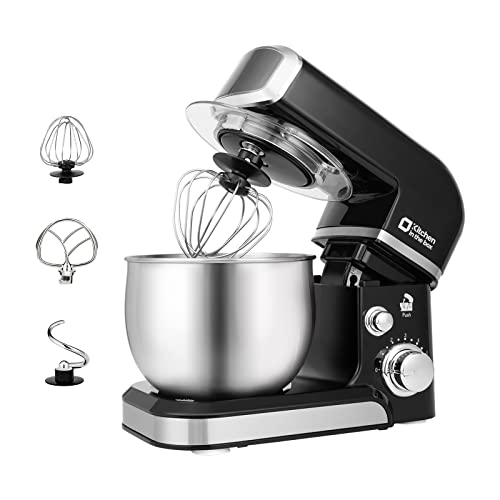
Most planetary commercial mixers can use a wire whip, flat beater, and dough hook. Some also accept a bowl scraper, which can improve batch consistency and reduce the need to stop the machine. Optional vegetable slicers, grinders, and other power-takeoff attachments can be useful in a restaurant, but they should not determine your purchase if the mixer will spend most of its time making dough.
- Wire whip: Best for aerating cream, egg whites, and light foams. It needs adequate bowl clearance and should not be used for heavy mixtures.
- Flat beater: Suited to cake batter, buttercream, mashed vegetables, and many cookie doughs.
- Dough hook: Designed for yeast dough, but the permitted batch size can be much lower than the bowl’s nominal capacity.
- Bowl scraper: Helpful for sticky batters and reducing manual scraping, provided it is approved for the specific bowl and speed.
Check whether bowls and attachments are included or priced separately. A 20-quart mixer that arrives without the attachment set you need may cost less initially but more after outfitting. Also verify whether replacement beaters and bowls remain available through the manufacturer or authorized service network.
Footprint, installation, and electrical requirements
Measure more than the machine’s width. Leave space to lift or remove the bowl, load ingredients, open a guard, clean behind the mixer, and move a heavy bowl safely. A 60-quart floor mixer can require a dedicated reinforced location, while an 8-quart model may fit on a sturdy work surface but still weigh around 70 pounds.
Electrical requirements vary significantly. Some smaller mixers can operate on common single-phase circuits, whereas large 60-quart units may require higher-voltage service and professional installation. Confirm the voltage, phase, amperage, plug, and local code requirements before ordering. A mixer that cannot receive the correct power reliably will not deliver its rated performance.
Decision matrix: which size makes sense?
| Your situation | Most suitable class | Why | Main compromise |
|---|---|---|---|
| One to three small batches per day; limited budget | 8-quart commercial bowl-lift | Lower purchase and installation burden; good attachment flexibility | More cycles and less reserve for stiff dough |
| Daily café or catering production; mixed recipes | 20-quart planetary | Meaningful capacity increase without a full 60-quart installation | Heavy and still limited for very large dough schedules |
| Several operators and repeat recipes | 20–30 quart unit with timer or programmable controls | More consistent speed and cycle management | More electronics and higher service cost |
| Many dough, batter, and frosting batches every day | 60-quart Hobart H600 or HL600 | Commercial transmission, large bowl, and established service support | High weight, space, power, and purchase cost |
| Mostly bread or pizza dough | Commercial spiral mixer | Better suited to repeated dough mixing and torque demands | Less capable for whipping and general pastry work |
Ownership realities: what wears first
In regular production, attachments, bowl-lift mechanisms, seals, belts, gears, and safety interlocks tend to need attention before the main motor. Scraping attachments can wear against the bowl, especially if incorrectly adjusted. Dough hooks and beaters can bend or develop damaged coatings if they strike an improperly positioned bowl or are used at excessive speed.
Clean the bowl, tools, guard, and contact surfaces after each production period. Do not flood the drive head or spray liquid into ventilation openings. Remove dried dough before it hardens, lubricate only where the service instructions specify, and arrange periodic inspection for unusual noise, heat, vibration, or slipping. A mixer that repeatedly trips its overload protection should not simply be reset and pushed harder; the batch may be too large, too stiff, or outside the machine’s duty rating.
Final buying advice
Choose the smallest machine that can complete your largest routine batch with meaningful reserve, not the largest bowl your budget permits. For occasional production, the KitchenAid Commercial 8-Quart can offer a sensible compact starting point. For a restaurant or small bakery, the Globe SP20 and similar 20-quart planetary mixers provide a more useful middle ground. For demanding daily output across doughs, batters, and whipped mixtures, Hobart’s H600 or HL600 is the stronger long-term direction. If your work is overwhelmingly bread dough, direct the budget toward a spiral mixer instead of paying for planetary attachments you will rarely use.




Write Your Review
No reviews yet. Be the first to share your experience!