
Choosing between glass and stainless steel is less about boiling water and more about how you live with an appliance every day. Both types can heat water quickly, shut off automatically, and serve a household well. The real decision is whether you value visual cleanliness and water-level visibility or favor toughness, heat retention, and a more forgiving exterior. Price, counter space, cleaning habits, and the chance of drops or bumps matter just as much.
For a typical 1.7-liter kettle, expect roughly 1,200 to 1,500 watts, a footprint of about 8 by 6 inches, and a weight between 2 and 3 pounds before adding water. The differences become more noticeable after months of daily tea, coffee, oatmeal, or baby-bottle preparation. Here is how glass and stainless steel compare for a 2026 kitchen.
Our top picks
 JoyJolt Faye 13oz Highball Glasses
- On the surface it may look like an…
- With its slimline 2.5” grip, 1.7oz heft and…
- Notice how thick, robust and slender your skinny…
 Gaoye Blue Light Blocking Glasses
- Our blue light glasses for women boast UV400…
- Our blue light glasses are engineered to reduce…
- Crafted from durable material, our trendy blue light…
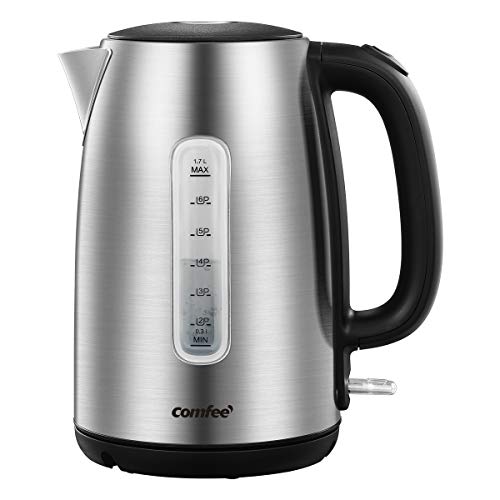 COMFEE' Stainless Steel Electric Kettle
- Premium Stainless Steel - 304 food-grade stainless steel…
- Fast Boil - This 1500W electric kettle has…
- Precise & Safe - With the professional thermostat…
| Product | Key specs | |
|---|---|---|
| JoyJolt Faye 13oz Highball Glasses | On the surface it may look like an… With its slimline 2.5” grip, 1.7oz heft and… Notice how thick, robust and slender your skinny… | Check price |
| Gaoye Blue Light Blocking Glasses | Our blue light glasses for women boast UV400… Our blue light glasses are engineered to reduce… Crafted from durable material, our trendy blue light… | Check price |
| COMFEE' Stainless Steel Electric Kettle | Premium Stainless Steel - 304 food-grade stainless steel… Fast Boil - This 1500W electric kettle has… Precise & Safe - With the professional thermostat… | Check price |
 Cosori Stainless Steel Electric Kettle | 𝟯𝟬𝟰 𝗙𝗼𝗼𝗱-𝗚𝗿𝗮𝗱𝗲 𝗦𝘁𝗮𝗶𝗻𝗹𝗲𝘀𝘀 𝗦𝘁𝗲𝗲𝗹: stainless steel interior 𝗜𝗻𝘁𝗲𝗿𝗻𝗮𝗹 𝗪𝗮𝘁𝗲𝗿 𝗟𝗲𝘃𝗲𝗹 𝗜𝗻𝗱𝗶𝗰𝗮𝘁𝗼𝗿: Unlike typical plastic water… 𝗘𝗮𝘀𝘆 𝘁𝗼 𝗨𝘀𝗲: Internal water level markings for… | Check price |
As an Amazon Associate we earn from qualifying purchases at no extra cost to you.
Quick Verdict
Choose a glass electric kettle if you want to see the water level and boiling action, prefer a modern countertop look, and do not mind more careful handling and frequent descaling. Glass is particularly appealing when you want to monitor the water without opening the lid or guessing how much remains.
Choose a stainless steel electric kettle if durability, heat retention, and everyday practicality matter most. Stainless steel hides mineral deposits better, tolerates bumps more effectively, and is usually the better choice for busy kitchens, families, rentals, and long-term use.
Neither material is automatically healthier or faster. The most important features are a concealed heating element, boil-dry protection, automatic shut-off, a secure lid, and minimal plastic contact with water. A glass kettle can still contain plastic around the lid or spout, while a stainless model can have a glass viewing window or plastic components.
Side by Side
| Factor | Glass electric kettle | Stainless steel electric kettle |
|---|---|---|
| Comfort and handling | Often comfortable to hold, but the body may feel hot | Usually sturdy; exterior may become warm or hot |
| Durability | Resists staining but can crack or shatter if dropped | Better resistance to bumps, dents, and daily wear |
| Typical price range | Varies | Varies |
| Maintenance | Scale is easy to see and may require frequent cleaning | Scale is less visible but still needs descaling |
| Space needed | Usually 8–10 inches tall and 6–8 inches wide | Usually 8–11 inches tall and 6–8 inches wide |
| Look | Bright, transparent, and visually lightweight | Professional, understated, and easy to coordinate |
| Water-level visibility | Excellent from nearly every angle | Depends on a window or marked interior |
| Resale appeal | Good if clean and scratch-free | Usually stronger because it appears more rugged |
| Best for | Design-conscious users and careful households | Families, renters, frequent users, and busy kitchens |
Where Glass Wins
Visibility is the biggest advantage. A clear body lets you see whether you added one cup or a full 1.7 liters, which helps reduce wasted water and energy. You can also watch for boiling, foam, floating particles, or mineral buildup. For anyone who regularly prepares different quantities, the visual feedback is more convenient than reading a narrow exterior gauge.
Glass also makes a small kitchen feel less crowded. A transparent kettle tends to blend into the counter instead of adding another solid black or metallic shape. Some models include blue or white LED illumination, making the water level and boiling cycle easy to see in a dim kitchen. That kind of glassware is for serving drinks, not a substitute for a heat-safe kettle body, but the visual contrast can help create a coordinated countertop.
Another benefit is that glass does not absorb odors. If you alternate between plain water, tea, and pour-over coffee preparation, the interior itself is unlikely to retain a flavor. Many glass kettles also use a concealed heating plate, so there is no exposed coil for mineral deposits to catch on.
Glass makes buildup easier to spot, which can be a benefit rather than a drawback. White scale around the base or spout is an immediate reminder to descale. A mixture of water and white vinegar or a manufacturer-approved descaler can usually handle routine buildup; always follow the care instructions, and rinse thoroughly afterward.
The tradeoff is heat. The glass and lid can become very hot, and the kettle may stay warm longer after boiling. A heat-resistant handle and a stable base are essential. Glass also needs more care around sinks, tile floors, and crowded counters. A short drop can turn a useful appliance into broken glass, even if the outer surface looked thick and sturdy.
Where Stainless Steel Electric Kettle Pros and Cons Wins
Stainless steel wins on resilience. It can usually handle a light bump against a sink or backsplash without cracking, although it may dent or scratch. That makes it a practical choice when several people use the kitchen, pets can reach the counter, or the kettle is moved between outlets. Its opaque body also hides fingerprints and mineral marks better than clear glass, especially with a brushed finish.
Stainless steel often feels more substantial and stable. Many models have a wider base, a balanced handle, and a 360-degree cordless connection. The material can help the kettle retain heat briefly after shut-off, although it is not a replacement for a vacuum-insulated thermos. The exterior may become hot, so do not assume stainless steel means cool-touch handling.
There is a broad range of stainless options at approachable prices. Those examples illustrate why stainless steel is often easy to recommend for value shoppers, though construction details vary by model.
Stainless steel is not maintenance-free. Mineral deposits can accumulate on the bottom, around the spout filter, and beneath the lid even when the exterior looks clean. A kettle used daily in hard-water areas may need descaling every few weeks to every few months. Stainless interiors can also show water spots, and abrasive scrubbers may leave scratches. A soft cloth, mild cleaner, and regular rinsing are safer choices.
The main concern is construction rather than the material name alone. Look for food-contact stainless steel on the interior, a lid that opens wide enough to clean, and a spout filter that can be removed or rinsed. “Stainless steel” does not guarantee that every water-contact component is metal. Check the product specifications if avoiding plastic contact is a priority.
Cost Over 5 Years
Purchase price is only part of the ownership cost. Over five years, the difference often comes down to replacement risk and electricity use rather than a dramatic material-based energy gap.
Assume a 1.5-kilowatt kettle is used twice daily to heat 1 liter for about four minutes per cycle. That equals approximately 73 kilowatt-hours per year. Your actual figure will vary with local rates, water volume, and usage.
Conversely, a stainless kettle that develops a faulty switch or severe interior corrosion may also need replacement. Automatic shut-off and boil-dry protection are worth prioritizing in either material because they protect the appliance and reduce avoidable damage.
Which One for Your Home
Small apartment
Choose glass if the kitchen is compact and you want a visually lighter appliance that makes water levels obvious. Look for a narrow base, cord storage, and a capacity between 1 and 1.5 liters rather than automatically choosing the largest model. Stainless steel is better if the kettle must share a crowded counter or be stored frequently in a cabinet.
Family with kids or pets
Stainless steel is the safer practical choice because it is less vulnerable to accidental knocks. Still, neither type should sit near an edge, and both can cause burns when filled with boiling water. Select a locking lid, a cool-touch or well-insulated handle, a stable base, and an automatic shut-off. Keep the cord away from the counter edge.
Rental
Pick stainless steel if the kettle will travel between homes or may face rougher handling. It is also less likely to look marked after repeated packing and unpacking. A glass model can work well for a careful renter who wants a decorative appliance, but use extra padding when moving it and confirm that replacement parts are available.
Long-term home
Either material can be a good investment when its design matches your habits. Choose glass for maximum visibility and a clean, contemporary look. Choose stainless steel for the strongest everyday durability and a finish that is likely to remain presentable. In both cases, buy a model with a removable filter, a wide opening, clear water-level marks, and a warranty that covers the heating and shut-off system.
FAQ
Is glass or stainless steel safer for boiling water?
Both can be safe when the kettle is designed for boiling water and used according to its instructions. The relevant details are food-contact materials, a secure lid, automatic shut-off, boil-dry protection, and a stable handle. Glass can break from impact or thermal shock, while stainless steel can become hot to the touch.
Does stainless steel make water taste different?
Quality stainless steel should not noticeably change the taste of fresh water. A metallic taste may come from manufacturing residue, mineral buildup, or stagnant water. Wash and rinse a new kettle, discard the first one or two boils, and descale it regularly.
How often should an electric kettle be descaled?
It depends on water hardness and use. Monthly descaling may be appropriate for daily use in a hard-water area, while households with soft water may need it only every few months. Glass shows scale sooner, but stainless steel still needs the same underlying maintenance.
Which kettle material boils water faster?
Wattage and water volume matter more than the body material. A 1,500-watt kettle will generally heat the same amount faster than a 1,000-watt model, assuming similar designs. Do not fill beyond the maximum line, and use only as much water as you need for the most efficient cycle.

Write Your Review
No reviews yet. Be the first to share your experience!