
Key takeaways
- Confusing slot length with toaster length: A 5.1-inch slot does not mean the appliance is only 5.1 inches long. The housing, controls, insulation, and crumb tray add several inches.
- Ignoring depth: Slim width does not guarantee a shallow footprint. Long-slot models can extend 14 to 16 inches from front to back.
- Measuring the counter without clearance: A toaster can technically fit while leaving no room for the lever, cord, or safe handling.
- Forgetting thick bread: Standard slots may not accommodate oversized slices, bagels, or dense homemade bread. Check both width and depth.
- Overlooking cabinet height: The appliance may fit while standing still but become awkward or unsafe when toast is lifted out.
- Using a power strip casually: A 1,400- to 1,800-watt toaster can place a substantial load on a strip or shared circuit. Plug it directly into a suitable wall outlet when possible.
The Short Answer
For a narrow countertop, the standard 4 slice toaster size to look for is approximately 13 to 15 inches long, 5.5 to 7 inches wide, and 7 to 8.5 inches tall. In centimeters, that is about 33 to 38 cm long, 14 to 18 cm wide, and 18 to 22 cm tall.
The best choice for limited space is usually a 4-slice long-slot toaster. Instead of four separate bread slots arranged across a wide body, it uses two extra-long slots that can often hold four standard slices. This layout typically saves 1 to 3 inches of counter width while requiring more front-to-back space. For the smallest kitchens, allow at least 16 inches of usable length, 8 inches of width, and 12 inches of vertical clearance around the appliance so the controls, cord, and toast can be used safely.
Our top picks

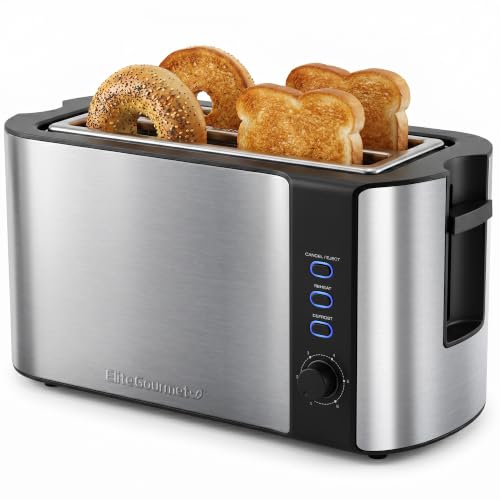


As an Amazon Associate we earn from qualifying purchases at no extra cost to you. Ratings are shown as listed on Amazon.
Most affordable slim 4-slice models cost about $30 to $50, weigh approximately 4.5 to 7.5 pounds, and use roughly 1,400 to 1,800 watts. Prices for the example bella and Elite Gourmet styles generally fall in the low-to-mid $30 range, although color, retailer, and promotions can change the final price.
Standard Sizes
Toaster dimensions vary by slot arrangement, so compare the full exterior dimensions rather than the advertised slot count. The table below shows realistic size ranges for common 4-slice configurations. Measurements are listed as length/depth first, width second, and height third; manufacturers may describe these directions differently.
| Toaster style | Typical exterior dimensions | Metric dimensions | Typical weight | Best for |
|---|---|---|---|---|
| Compact 4-slot toaster | 11.5–13 in L × 10–11.5 in W × 7–8 in H | 29–33 cm L × 25–29 cm W × 18–20 cm H | 4–6 lb | Open counters with more side-to-side room |
| Slim long-slot toaster | 13–15 in L × 5.5–7 in W × 7–8.5 in H | 33–38 cm L × 14–18 cm W × 18–22 cm H | 4.5–7 lb | Narrow counters and apartment kitchens |
| Extra-wide long-slot toaster | 14–16 in L × 6–7.5 in W × 7.5–9 in H | 36–41 cm L × 15–19 cm W × 19–23 cm H | 5–8 lb | Thick bread, bagels, and artisan slices |
| Large traditional 4-slice toaster | 12–14 in L × 10–12 in W × 8–9 in H | 30–36 cm L × 25–30 cm W × 20–23 cm H | 6–9 lb | Families that toast several slices at once |
For a narrow countertop, the second and third rows are generally the most useful. A long-slot design may have slots around 5 to 5.5 inches deep and approximately 1.25 to 1.5 inches wide. That accommodates standard sandwich bread, Texas toast, English muffins, and many bagels. Check the manufacturer’s slot dimensions if you regularly use thick homemade bread.
Remember that the listed body size is not the same as the clearance needed to operate the toaster. Add at least 2 inches on each side when possible, plus several inches behind the appliance for the cord and ventilation. If the toaster sits under cabinets, measure from the counter to the bottom of the cabinet. A toaster that is 8 inches tall may need around 12 to 14 inches of open space above it when bread is inserted and removed.
How to Measure Your Space
- Clear the intended area. Remove canisters, coffee makers, knife blocks, and other objects so you measure the actual usable surface.
- Measure the counter length. Measure from the wall or backsplash to the nearest appliance, cabinet edge, or sink. This is the front-to-back dimension available to the toaster.
- Measure the counter width. Measure the open side-to-side area. Do not count a section that is needed for food preparation or access to a drawer.
- Check vertical clearance. Measure from the countertop to the underside of upper cabinets, shelves, or a microwave. Include room to lift bread from the slots.
- Locate the outlet. Note whether the outlet is behind the toaster, beside it, or above the counter. A short cord or a rear-mounted cord exit can affect placement.
- Add operating clearance. Add about 2 inches to the toaster’s width and at least 2 inches behind it. Add 4 to 6 inches above the listed height if the toaster will remain under cabinets during use.
- Compare the finished footprint. For example, a toaster measuring 14 inches long by 6 inches wide should be assigned approximately 16 inches by 8 inches of clear counter space.
Never measure only the space between two objects and assume the toaster will fit comfortably. Handles, levers, crumb trays, and the power cord can extend beyond the main body. If you plan to store the toaster in a cabinet, measure the cabinet opening as well as the interior depth, and let the appliance cool fully before putting it away.
By Room or Use Case
Small apartment kitchen
Choose a long-slot model around 13 to 15 inches long and no more than 7 inches wide. This shape preserves valuable side-to-side workspace while still allowing four slices to toast together. A removable crumb tray is especially useful when the toaster must be moved frequently. Look for a cord-storage feature and a weight under 7 pounds if you plan to store it after breakfast.
Galley kitchen
A galley counter often has plenty of length but very little depth. Prioritize a body depth of approximately 5.5 to 6.5 inches, and position the toaster parallel to the counter edge. Leave enough room to operate the lever without bumping a wall or backsplash. A long-slot unit is usually more practical than a wide four-slot model in this layout.
Family breakfast station
If several people use the toaster at once, select extra-wide slots and independent controls. A model measuring about 14 to 16 inches long by 6.5 to 7.5 inches wide offers a useful balance between capacity and footprint. Expect a weight of 5 to 8 pounds and power consumption near 1,500 to 1,800 watts. Confirm that the kitchen circuit can handle the toaster alongside a coffee maker, kettle, or air fryer.
RV, dorm, or tiny kitchenette
Measure carefully before buying. A slim toaster under 14 inches long and 6 inches wide is easier to store, but verify that its wattage fits the available electrical system. Many 4-slice models draw 1,400 watts or more, which may be unsuitable for some compact or shared setups. A smaller 2-slice toaster may be the better space and power choice if four slices are not needed daily.
Under-cabinet placement
Do not judge fit by height alone. Toast may rise several inches above the top of the appliance, and steam or heat can affect cabinets and finishes. If the toaster must stay under a cabinet, pull it forward during use and leave approximately 6 inches of open space above it whenever possible. Store it elsewhere if the cabinet clearance is very low.
Common Sizing Mistakes
- Confusing slot length with toaster length: A 5.1-inch slot does not mean the appliance is only 5.1 inches long. The housing, controls, insulation, and crumb tray add several inches.
- Ignoring depth: Slim width does not guarantee a shallow footprint. Long-slot models can extend 14 to 16 inches from front to back.
- Measuring the counter without clearance: A toaster can technically fit while leaving no room for the lever, cord, or safe handling.
- Forgetting thick bread: Standard slots may not accommodate oversized slices, bagels, or dense homemade bread. Check both width and depth.
- Overlooking cabinet height: The appliance may fit while standing still but become awkward or unsafe when toast is lifted out.
- Using a power strip casually: A 1,400- to 1,800-watt toaster can place a substantial load on a strip or shared circuit. Plug it directly into a suitable wall outlet when possible.
FAQ
What are standard 4 slice toaster dimensions for narrow countertop space?
Most slim 4-slice long-slot toasters measure about 13 to 15 inches long, 5.5 to 7 inches wide, and 7 to 8.5 inches high. Plan for at least 16 by 8 inches of clear countertop space after adding operating clearance.
Is a 4-slice long-slot toaster smaller than a regular 4-slice toaster?
Usually, yes in width. A long-slot model often measures 5.5 to 7 inches wide, while a traditional four-slot toaster may be 10 to 12 inches wide. The tradeoff is greater length or depth, so measure both dimensions.
How much space should be left around a toaster?
Allow roughly 2 inches on each side and behind the toaster, with 4 to 6 inches above it during use. Pull it forward from a backsplash or cabinet when possible, and keep towels, paper, and other combustible items away from the appliance.
Are extra-wide slots worth the larger footprint?
They are worthwhile if you toast bagels, thick bread, or homemade slices. Extra-wide models commonly use slots around 1.25 to 1.5 inches wide, but they may be slightly wider and taller. For ordinary sandwich bread on a very narrow counter, a standard slim long-slot design is usually the more efficient choice.





Write Your Review
No reviews yet. Be the first to share your experience!